

Wedding season is not a date, it is a four-month run of functions in four different climates. We have fitted enough of these sets on women the week before a wedding to know that the one which looks best on the hanger is not always the one that survives an Octo
Wedding season is not a date, it is a four-month run of functions in four different climates. We have fitted enough of these sets on women the week before a wedding to know that the one which looks best on the hanger is not always the one that survives an October afternoon in Delhi and a January reception on a lawn outside it. This is how we would choose a kurta set for the season, rather than for one evening.
The season asks more of a set than the wedding does
A north Indian wedding calendar runs from late October into February, and the weather inside that window moves more than most people plan for. A haldi at noon in October is still thirty degrees. A reception in December, outdoors, is ten by the time dinner is served. The tent is heated; the car park is not. Your set has to be in all three of those places within about six hours.
That is the test we would apply first. Not whether the work is beautiful, because at this level it usually is, but whether the cloth behaves indoors and outdoors, whether the dupatta stays where you pinned it when you cross a lawn, and whether an hour in a car on the way there leaves the embroidery flattened against a seatbelt.
Everything below follows from that. A made-to-order set can be cut for the way you will actually sit, stand and travel. It cannot change the weather, so cloth, work and dupatta are what you are really deciding.
Buy for the month, then for the function
October and early November are the forgiving weeks. A chanderi kurta and pant with an organza dupatta is comfortable through a long day and cool enough in the evening that you will be glad of a shawl. This is the window where a worked set earns its price, because the same outfit can go to a mehendi at eleven in the morning and a cocktail at eight with nothing changed but the jewellery.
December and January need a small adjustment, not a different wardrobe. The same chanderi set works if two details are chosen deliberately: sleeves you can live in when the evening runs late, and a kurta length that lets you sit on the floor for the pheras without the hem pooling around you. If you are buying for a January wedding, ask for those two things specifically. What we would not do is buy a heavier, winter-only set. It gets worn once, and the same money buys a better shawl that works with everything already in the wardrobe.
February is the month most people under-buy for. Warm afternoons, cold nights, and often a daytime function where a fully worked set feels like too much by two o'clock. A lighter set, or a worked set worn with a plain dupatta, is the practical answer.
One more thing about the month: it decides the shoe, and the shoe decides the hem. A hem measured in flat sandals will be wrong at a December wedding where you are in a heel on grass. Have the length taken in the shoes you will actually wear.
Light decides which work you will actually see
Handwork is not one thing. Gota is flat ribbon work, stitched down rather than built up, so it catches daylight and reads crisply in the sun. That makes it the right choice for a haldi or a mehendi photographed outdoors at midday. Zardozi is metal thread worked into the cloth, and dabka is the small coiled wire that gives it relief. Both sit proud of the surface, hold shadow, and are what you see under warm evening light and in the flash photographs taken at a reception.
The other half of that decision is the cloth. Chanderi has a soft sheen but no glare, so a worked front photographs with its detail intact. Organza is crisp and slightly reflective, which is exactly why a worked organza dupatta keeps its shape instead of collapsing at your elbow; it is also why that dupatta can lose its pattern into a bright rectangle under direct flash. Buy the organza for structure, not for the close-up.
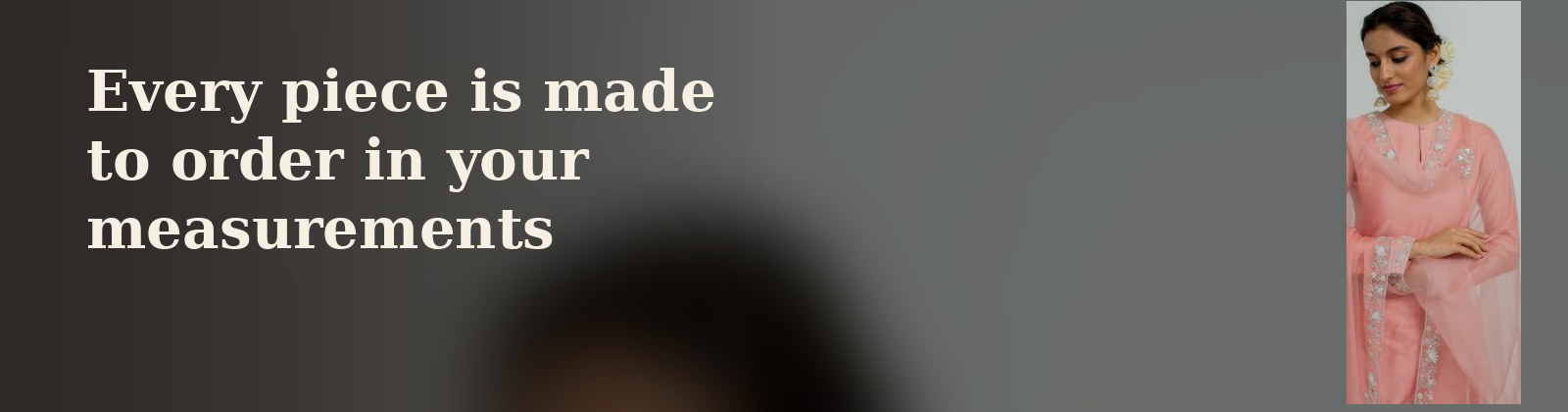
Colour matters most in the hour you will be photographed in. Ivory and soft rose hold detail in low light and read beautifully in black and white, which is why the Farsi set is the one we lend most often for a photographer's test shot. A deep red or fuchsia carries a room from a distance, but in a tight flash portrait the work can disappear into the colour. If the only photographs you care about are the ones taken at eight in the evening, decide the set in the evening, not in the shop's daylight.
Six sets, sorted by month and hour
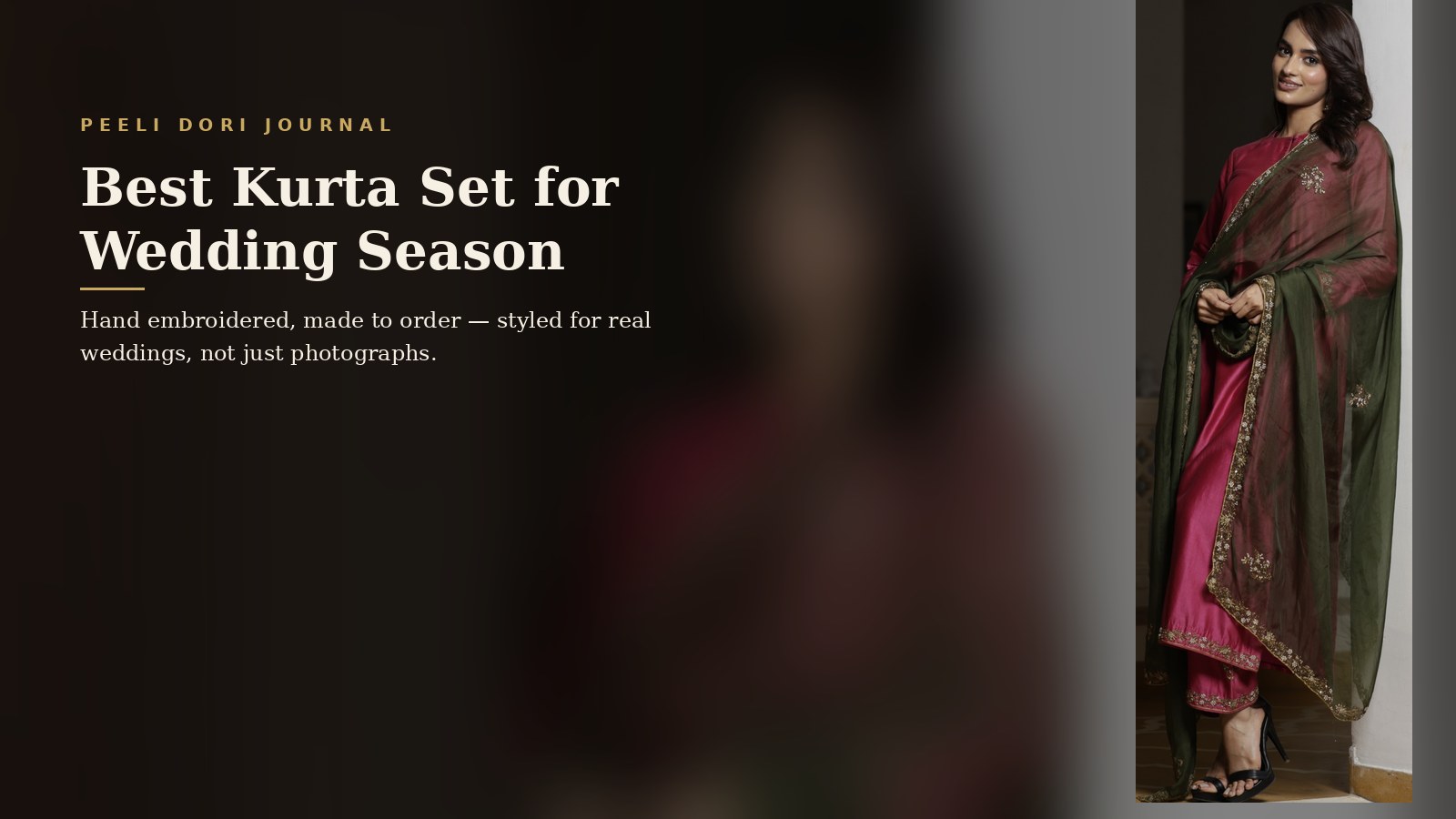
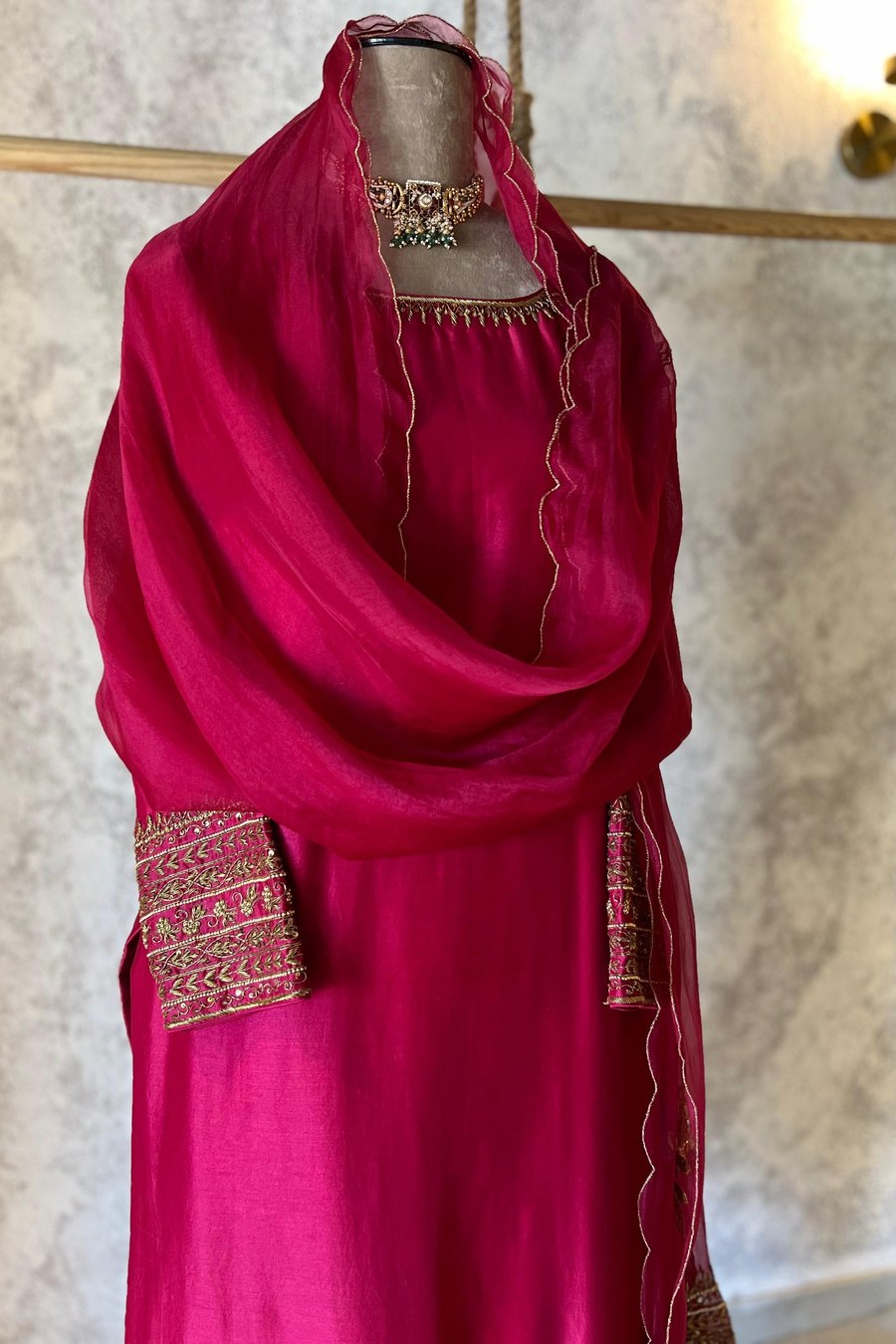
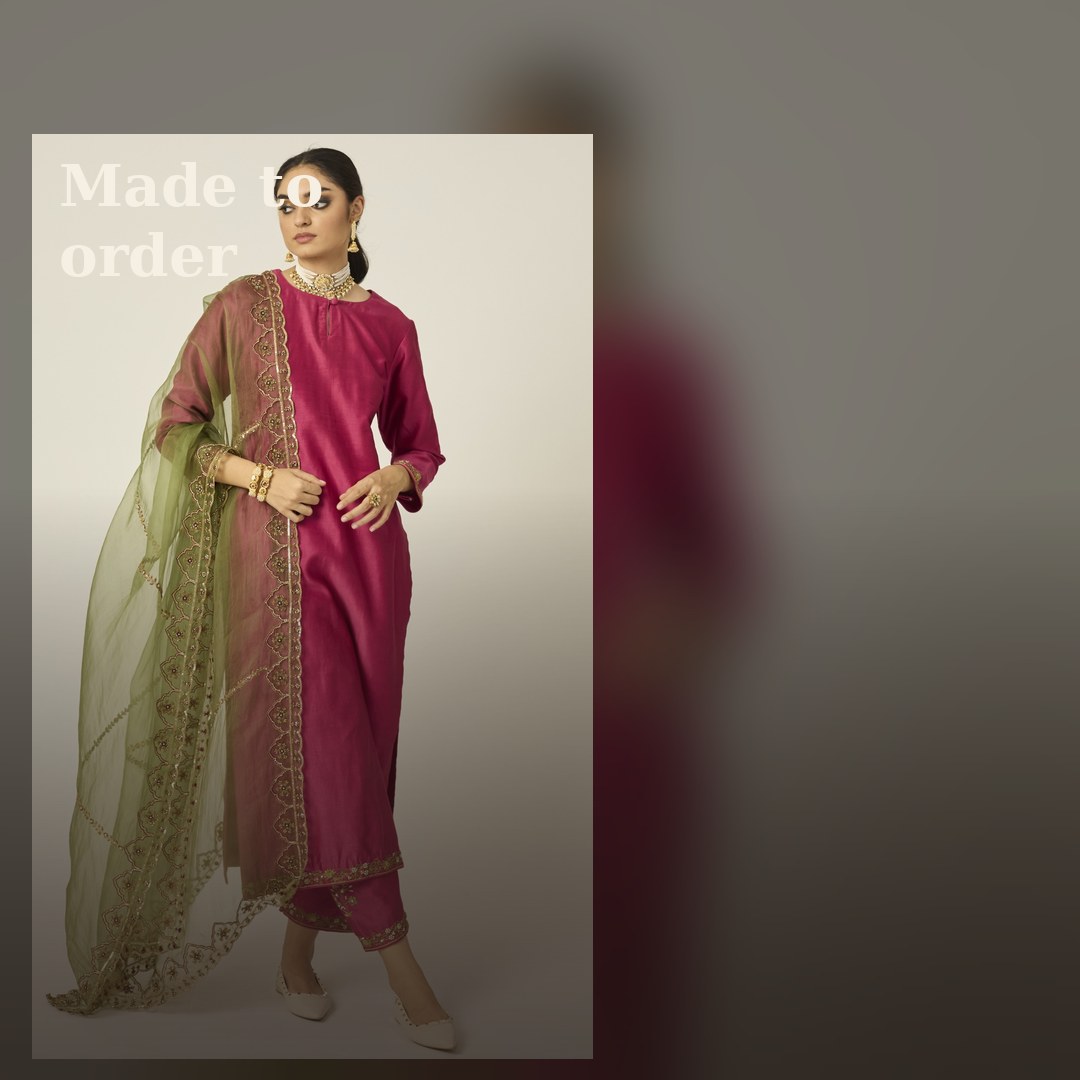
GULMOHAR RED KURTA SET, ₹36,500. Chanderi kurta and pant, organza dupatta, handwork carried across all three pieces. This is the December and January evening set: the raised work holds the light in a reception tent, and the red carries across a room. If you are photographed once all season, this is the one to be photographed in.
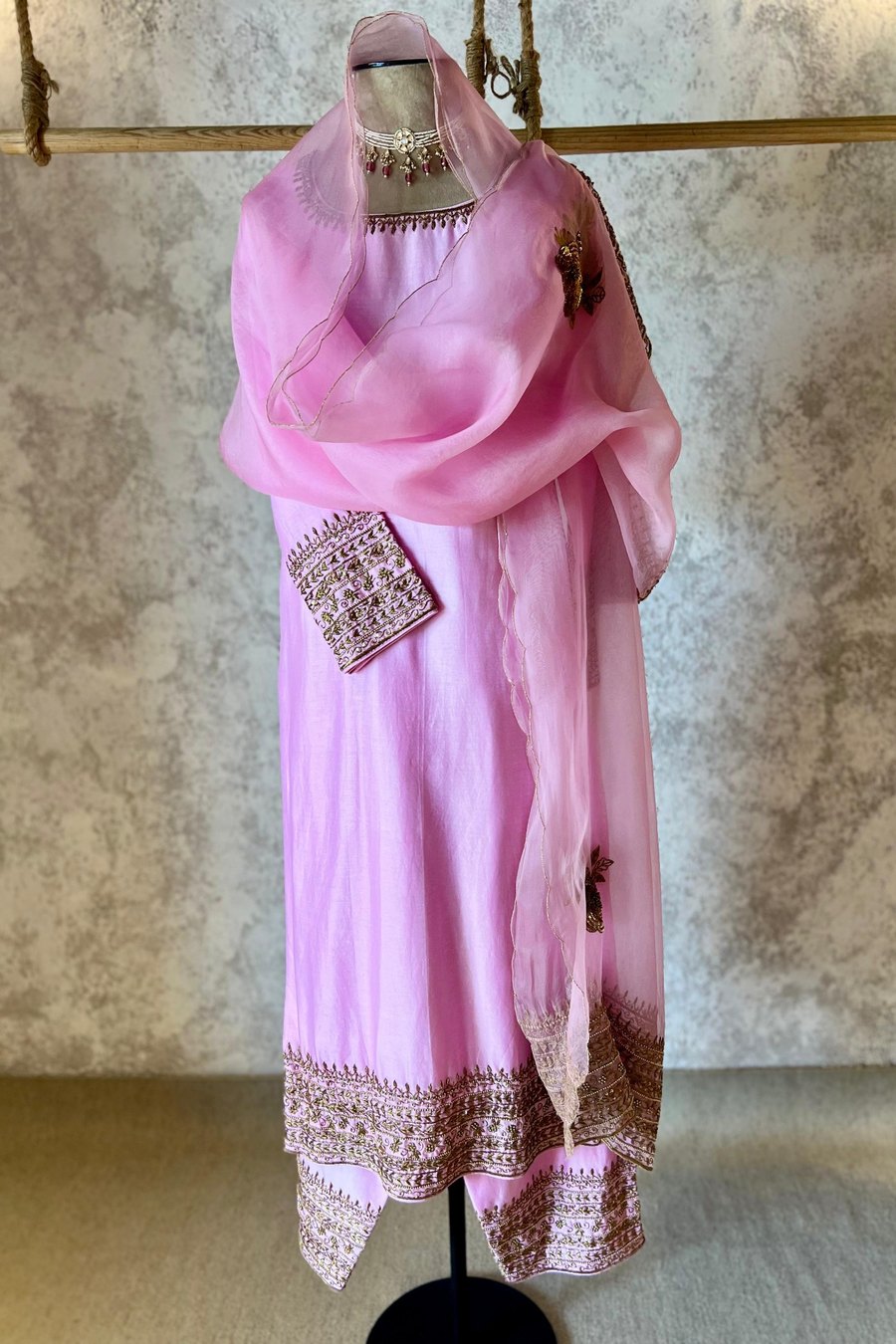
GULMOHAR RANI PINK KURTA SET, ₹36,500. The same construction in a deeper pink, and the one most women choose for a sangeet where they will be moving for four hours. Same price for the same reason: the work does not change with the colour.
GULABI GULMOHAR KURTA SET, ₹36,500. The softer rose of the same set, and the version we suggest for a daytime mehendi in October, when a heavy red at noon can feel like a costume.
GULMOHAR ORANGE KURTA SET, ₹36,500. The same construction in marigold, and the one we would put on the rail for a haldi. It is strong enough for an evening as well, but if you are buying a single set for an October wedding, this is the one that earns its price in daylight photographs.
GULMOHAR FUCHSIA PINK KURTA SET, ₹36,500. The brightest of the four and the easiest to wear with almost no jewellery, because the set is already doing the work. Best after dark, and best in a photograph with a lot of people in it.
IVORY FARSI KURTA SET, ₹29,500. Ivory chanderi, sleeveless kurta, antique gold work along the neckline and front. Less worked surface than the Gulmohar sets, which is why it sits a band lower. It is the best set on this page in low light and the easiest to wear twice in one season; sleeveless also means it is for October, or for a December venue you know will be heated.
RANI PINK RUQSAT KURTA SET, ₹28,500. Lighter handwork, chanderi through, and the kurta length set to your preference. This is the travel set: it packs smaller, creases less and still looks considered next to the heavier pieces at a family lunch.
If you want the quietest version of the same idea, the Ruqsat sets at ₹28,500 sit one band below the Gulmohar four and wear more like clothing than like occasion wear.
₹36,500
₹36,500
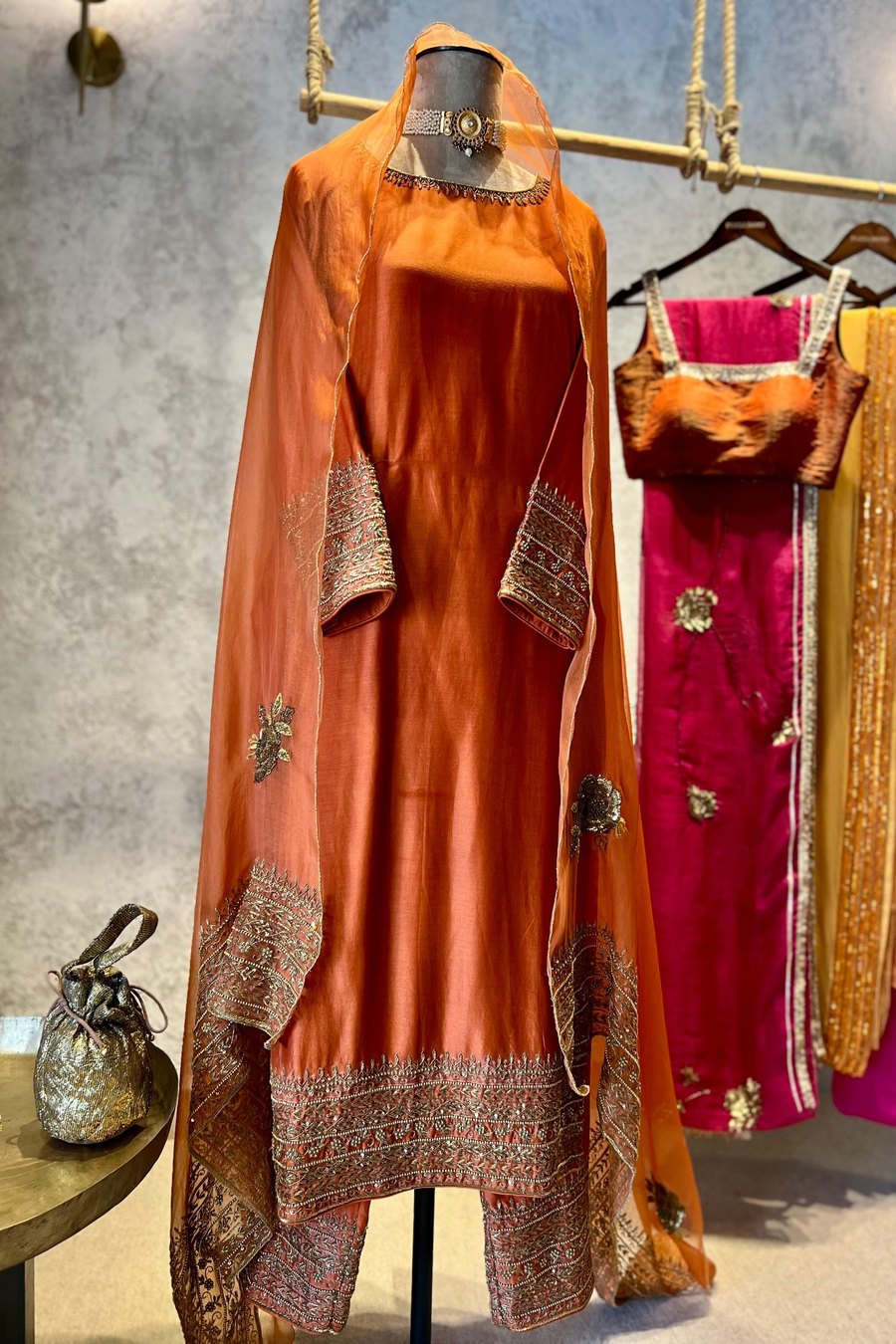
₹36,500
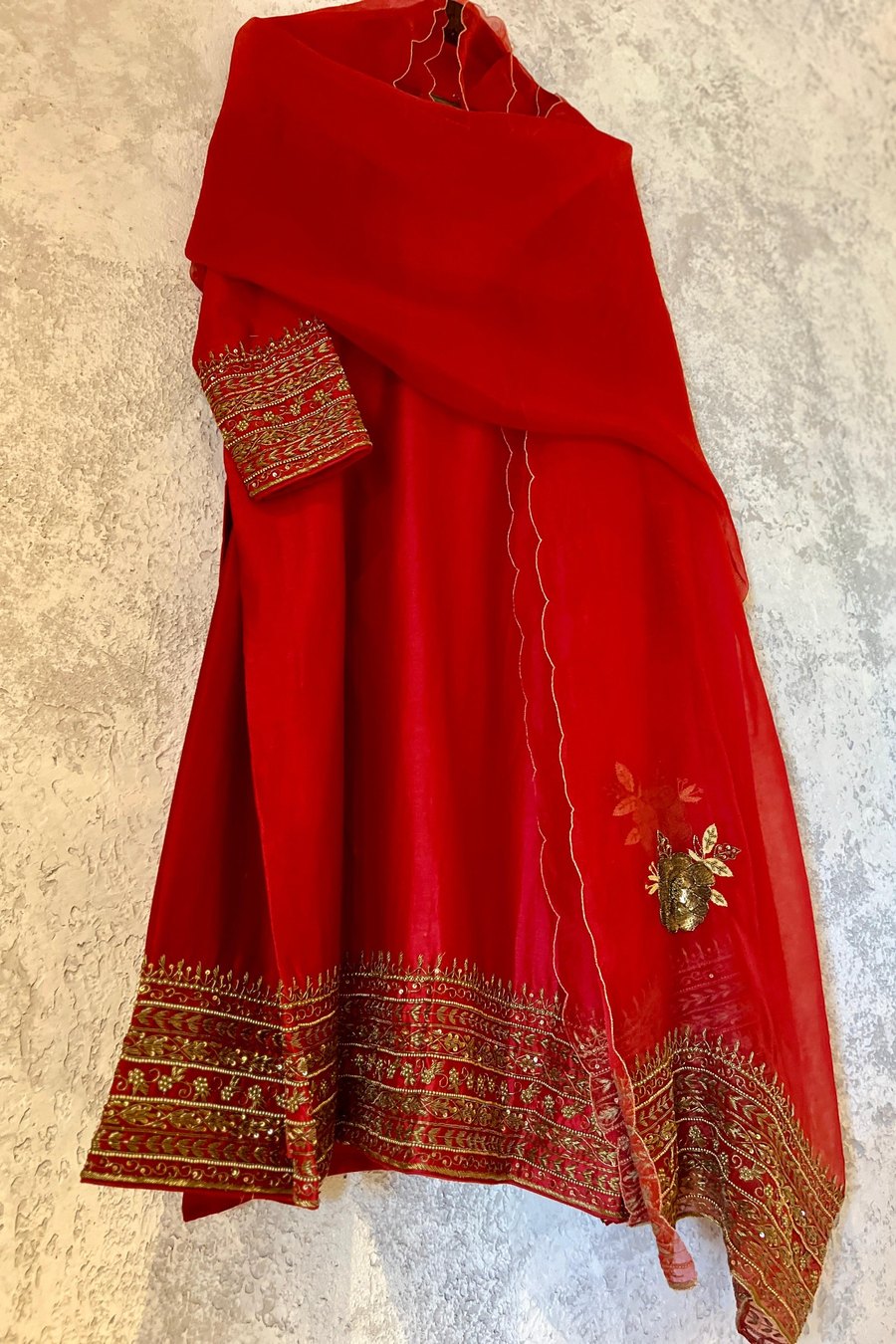
₹36,500
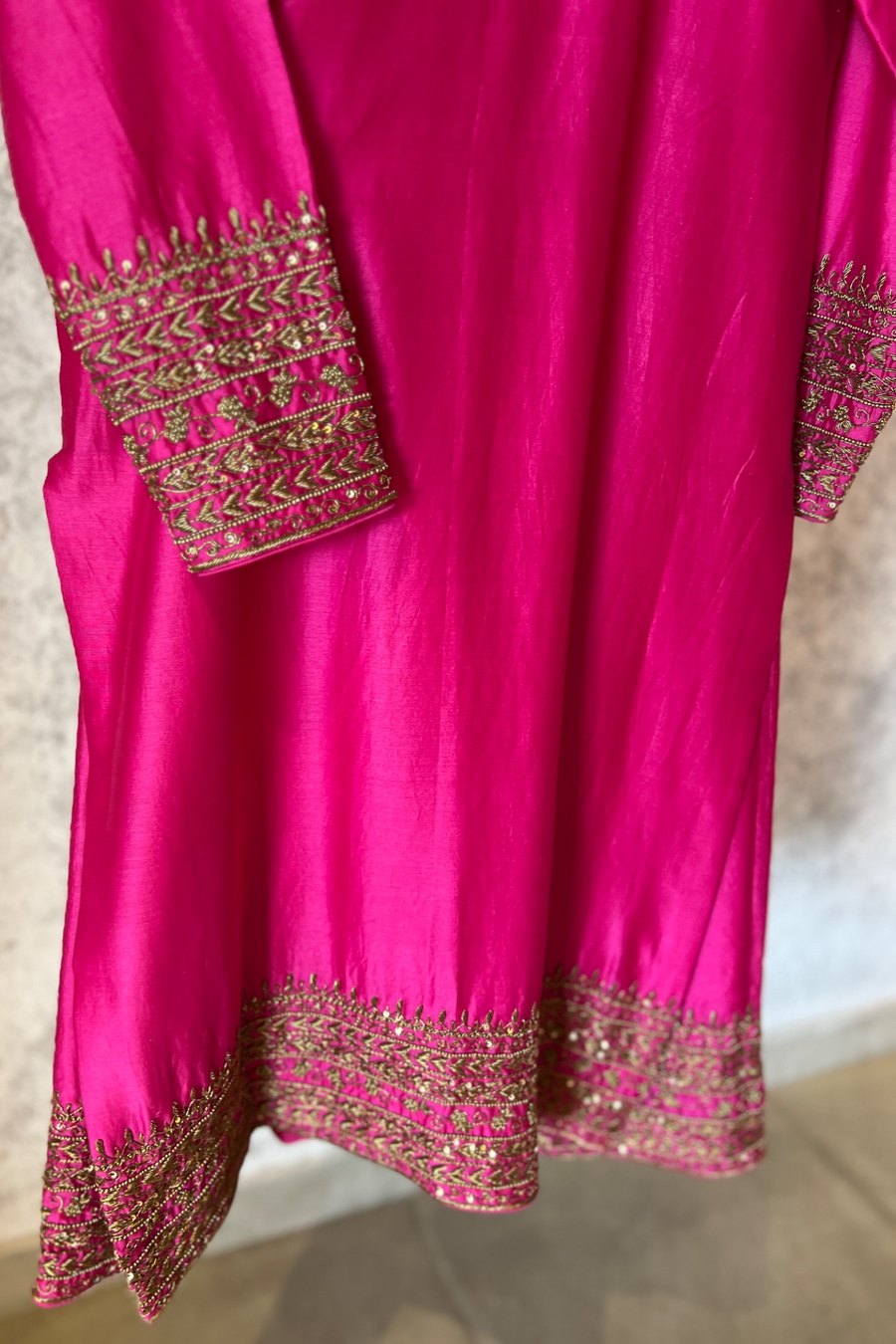
₹36,500
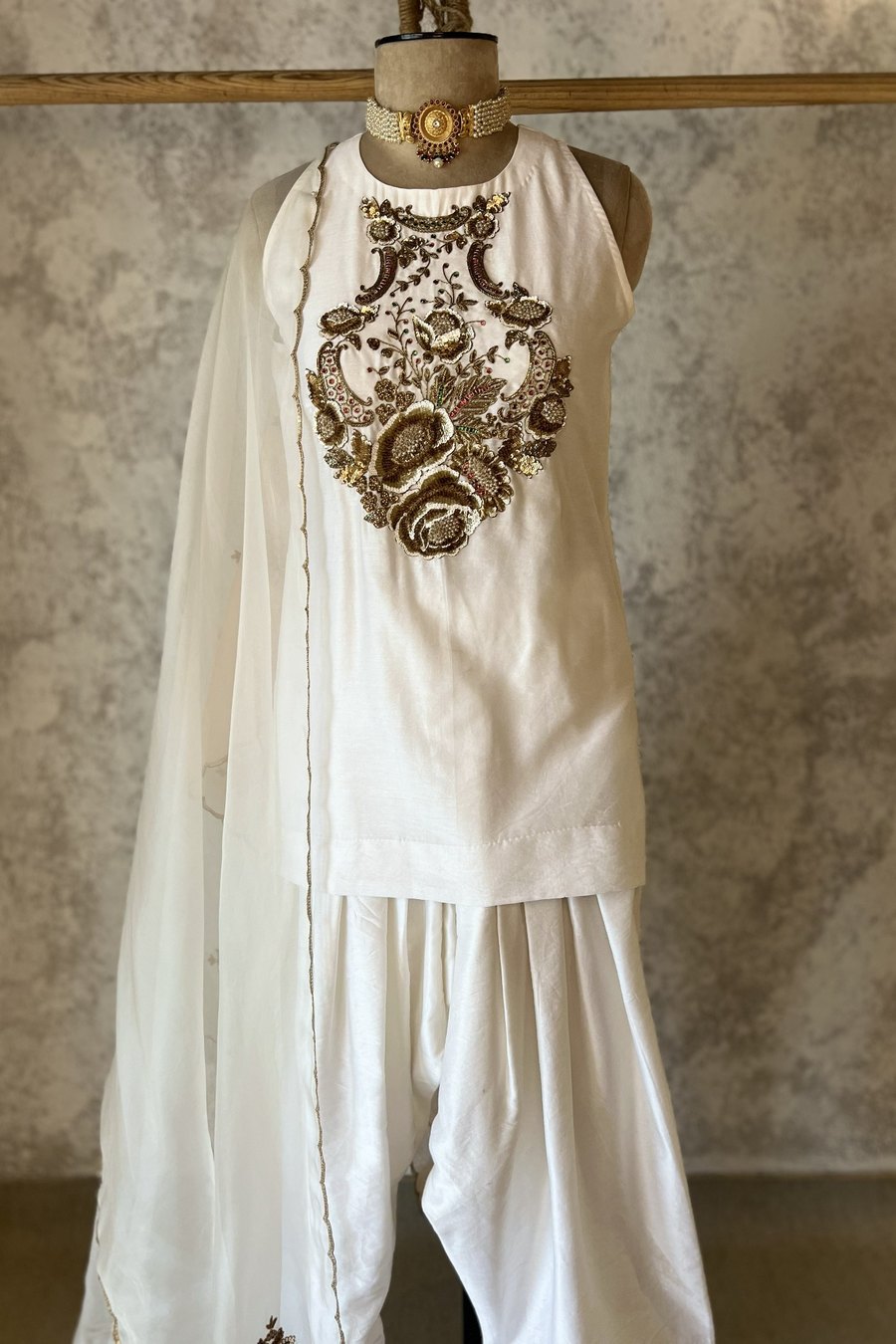
₹29,500
The three failures we see, and the fixes
The dupatta. It is the first thing to misbehave and the easiest to prevent. Pin through the shoulder seam of the kurta, not through the organza, and use a brooch with a flat back. Pinholes in organza do not close. If the dupatta keeps sliding, the real problem is usually that it is held at one point: two points, one at the shoulder and one at the waist, will take it through a lawn, a staircase and a dance floor.
The hem. A length that is correct while you are standing is usually two centimetres too long for stairs and grass. It is the single most common alteration we do in the week before a wedding, and on a made-to-order set you can simply ask for it in advance.
The crease. A worked panel folded in a suitcase for six hours will crease, and zardozi does not like a hot iron. Fold flat with tissue between the worked surfaces, unpack as soon as you reach the hotel, and steam from the inside rather than pressing. If a crease does set, give it a day hanging in a bathroom after a hot shower, not five minutes with an iron.
Packing for a wedding week
For a destination wedding, the set travels folded flat in a cotton or muslin cover, in hand luggage if the airline allows it. Do not roll it. Rolling puts a crease straight through the worked panel, and that is the crease that a steamer struggles to lift out of metal thread.
Two sets and one plain dupatta will cover four functions without anyone noticing a repeat. Put the heavier work on the evening you will be photographed most, keep the lighter set for the daytime functions, and use the plain dupatta in a colour pulled from the embroidery to change the look of both for far less than a third kurta. That is also the answer to packing light: three pieces, six outfits.
Every set we make is hand embroidered, made to order and cut to your measurements, on cloth coloured with organic dyes by artisans we work with directly. Shipping within India is free above ₹10,000, and there is an international shipping offer on the site with the code INTSHIP above ₹89,000. If you are deciding between two sets, message us on WhatsApp with the months and the functions and we will tell you which one you will genuinely wear more than once. Both stores, Shahpur Jat in New Delhi and Dehradun, will show you the pieces in person and measure you there.
Frequently asked
What is the best kurta set for a winter wedding?
One you can wear indoors and outdoors on the same evening: a chanderi kurta and pant with an organza dupatta, sleeves you can live in, and a length that lets you sit on the floor. The Gulmohar sets at ₹36,500 are the most worked version of that; the Ruqsat sets at ₹28,500 are the lighter, more wearable version. Add a shawl rather than buying a heavier set you will only wear once.
Can a kurta set be worn to a reception?
Yes, and it is often the better choice if you are not the bride. A worked set with the dupatta pinned full at the shoulder is formal enough for a reception; worn without the dupatta it becomes the outfit for the dinner after the wedding. Keep the jewellery to one good pair of earrings so the embroidery stays legible in photographs.
Will a chanderi kurta set be warm enough for a December wedding?
Indoors, in a heated venue, yes. Outdoors after ten at night, no cloth at this weight will be, which is why we suggest a shawl rather than a heavier set. A shawl also travels better than a second winter outfit and changes the look of the same set across three functions.
How do I keep the dupatta from slipping all evening?
Pin it through the shoulder seam of the kurta rather than through the organza, using a flat-backed brooch, and add a second point at the waist. Pinholes in organza do not close, and one pin alone will always give way once you start walking, dancing or climbing stairs.
Can the kurta length and sleeves be changed?
Yes. Every set we make is made to order, so length, sleeve and fit are set to your measurements rather than to a size chart. We check them against the style before the final stitching, and can do a fit check on WhatsApp if you are not visiting Shahpur Jat or Dehradun in person.
Explore more: kurya · dupatta — or message us on WhatsApp for styling help.

The information below is required for social login
Sign In
Create New Account