

Nearly every conversation we have about a designer saree reaches the same pause. The saree is chosen. Then comes the form — bust, waist, shoulder, armhole, blouse length — and the conversation stops for a few days. It looks like a tailor's paperwork and it fee
Nearly every conversation we have about a designer saree reaches the same pause. The saree is chosen. Then comes the form — bust, waist, shoulder, armhole, blouse length — and the conversation stops for a few days. It looks like a tailor's paperwork and it feels like a commitment. It is neither. It is six numbers, a tape measure and about ten minutes, and this is what we actually do with them.
The order starts with a tape, not a photograph
A made-to-order saree does not exist until someone is going to wear it. The fabric is there, the embroidery design is there, and the artisans are there — but the piece is cut after you order, in your length, with a blouse made to your measurements. The dyes are organic, the embroidery is done by hand, and nobody else is waiting for your exact piece.
That is the whole difference from buying off a rack, and it is also why we ask for numbers instead of offering a size chart. A size chart is a compromise built for an average body. On a saree, the average body does not exist: the drape falls from your shoulder, the pleats sit at your waist, and the blouse is the only tailored thing in the whole outfit.
So the form is not admin. It is the part of the order that decides whether the piece looks like the photographs you saved, or like a saree that is nearly right.
What made to order actually changes
Length. A shop saree is cut to a standard length and hemmed for a standard height. If you are shorter, the pleats pool at your feet and the border drags. If you are taller, the pallu stops short of where you want it to fall. We can cut to your height, including the heels you plan to wear.
The blouse. This is the piece people underestimate. The same saree on the same body reads completely differently with a blouse that sits properly at the shoulder and an armhole that is not fighting the arm. A blouse made to your measurements is the cheapest upgrade in the whole outfit, and it is the one thing a ready-made size cannot give you.
Where the embroidery lands. On a hand-embroidered border, the motifs run along the edge and up the pallu. When the piece is cut after you order, that border can start where your pallu actually falls rather than where it falls on a model who is a different height.
The finish before it ships. The fall — the cotton strip along the hem that gives the pleats their weight — and the pico on the ends are done before the saree reaches you, not left for a tailor afterwards.
What it costs you is time, not fit. A piece that is cut and embroidered after you order is not a same-day purchase, so ask us for the timeline on the specific saree you are looking at. It depends on the embroidery on that piece, and we would rather confirm it for your order than publish an average that will be wrong for half the people reading it.
The six numbers we ask for, and what each one does
- Bust — around the fullest part, tape level across the back, not pulled tight. This sets the front of the blouse and where the dart sits. Measured tight, it produces a blouse that strains at the hook; measured loose, one that gaps at the armhole.
- Waist — the narrowest point, usually just above the navel. It keeps the blouse from riding up when you sit, which is the difference between a blouse that survives a four-hour function and one that does not.
- Shoulder — bone to bone across the back, not across the front. A blouse one centimetre narrow here pulls at the sleeve all evening, and no amount of adjusting the drape fixes it.
- Sleeve length — from the shoulder point to where you want the sleeve to end, with the arm relaxed at your side. Measure it on the arm that will be wearing it, not on a friend.
- Armhole — around the arm where the sleeve joins the body, arm down. This is the number most often got wrong when someone measures alone, and the one that shows first in photographs.
- Blouse length — from the shoulder at the neck to where you want the hem, usually an inch or two below the bust line for a saree blouse. Longer if you like a covered midriff, shorter if the saree is pleated high.
The seventh number is your height, and the heel height you plan to wear. It goes to the saree, not the blouse — it decides how much length goes into the pleats and where the pallu ends.
Length, fall and pico: settle these before the piece is cut
Standard saree length is five and a half metres, and most people never question it. If you are on the taller side, if you like a deep pleat stack, or if the pallu is broad and heavily bordered, that standard runs out. Ask for the longer cut and say why — we would rather cut once, correctly, than have you discover the shortage on the morning of a function.
The fall is a strip of cotton stitched along the inner hem. It gives the saree weight so the pleats hold their line and the hem does not fray as it moves across a floor. It has to go on before the first wear; stitching it later means unpicking and re-hemming, and the pleats never sit quite the same again.
The pico is the rolled, stitched finish on the raw ends, done in matching thread. Small thing, visible thing — an unfinished end shows every time you turn the pallu.
If the saree comes with a blouse piece, tell us at order whether you want it stitched to your measurements or left in the box. Both are fine. What is not fine is deciding after the piece has been cut.
Where fit matters most
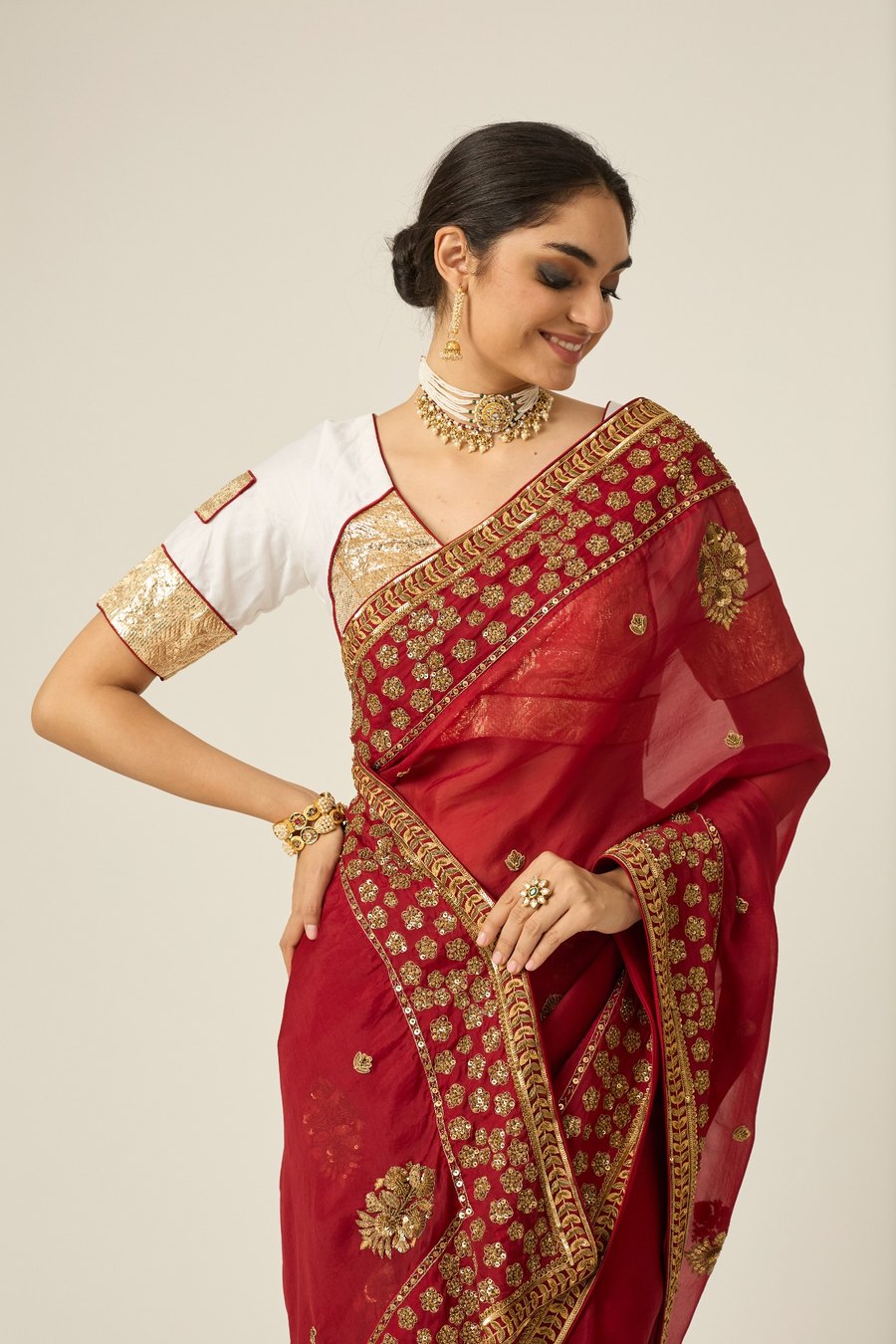
A heavily bordered saree puts weight at the hem, and the blouse has to hold that weight through a long evening. On pieces like the MYRA RED organza or the NOOR BAHAR, the shoulder measurement does more work than any other number, because the drape hangs from it.
Velvet has no give. The EDAN velvet saree is cut close and stays where you put it, which is a pleasure on the day and unforgiving in the blouse — measure the bust honestly rather than aspirationally.
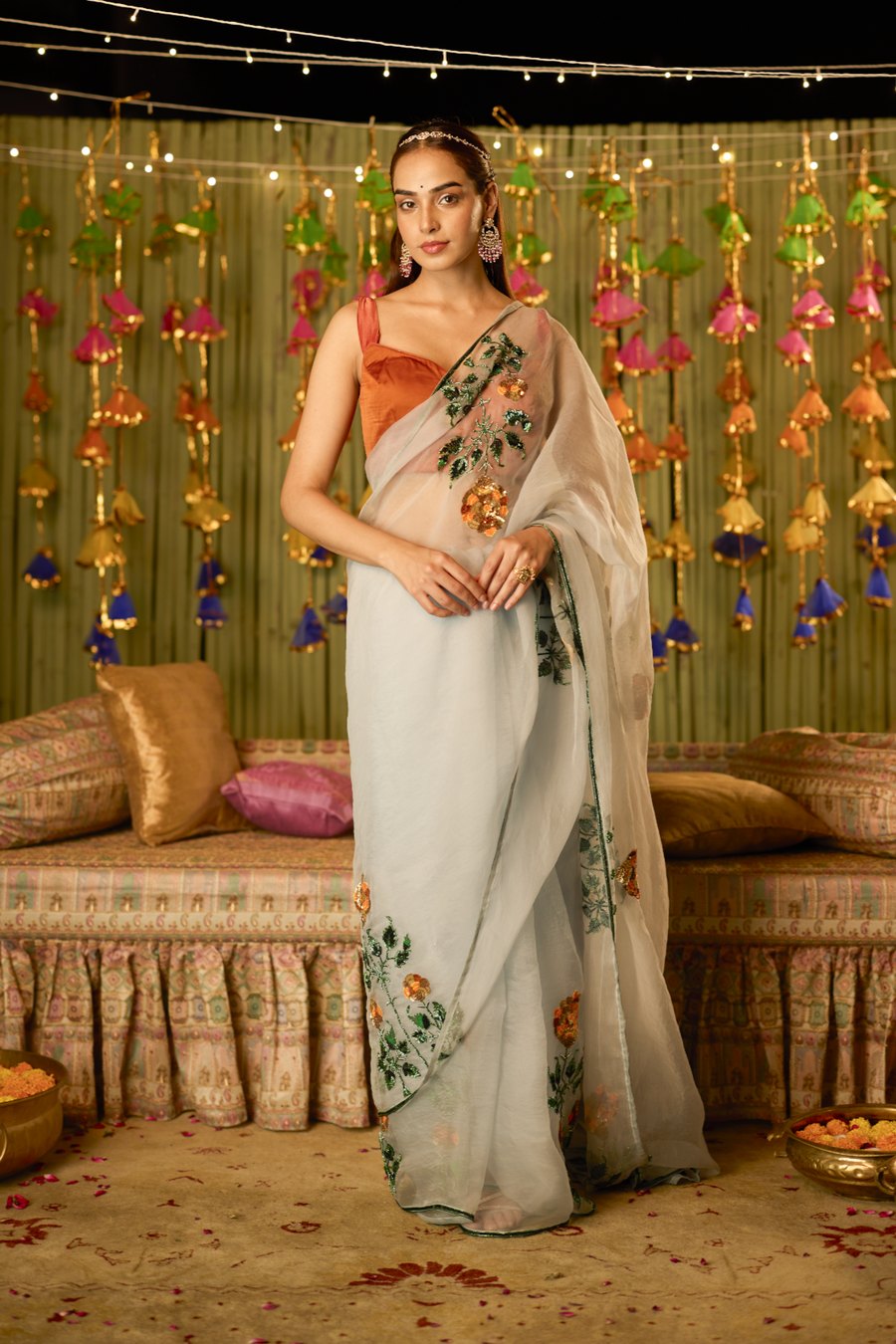
Crisp silk organza with hand embroidery shows every crease at the armhole. On the RUQMANI and GULBAHAR pieces, an armhole that is even slightly tight reads as a fold in the photograph, so we would rather build it with a little ease and adjust.
₹59,500
₹48,500
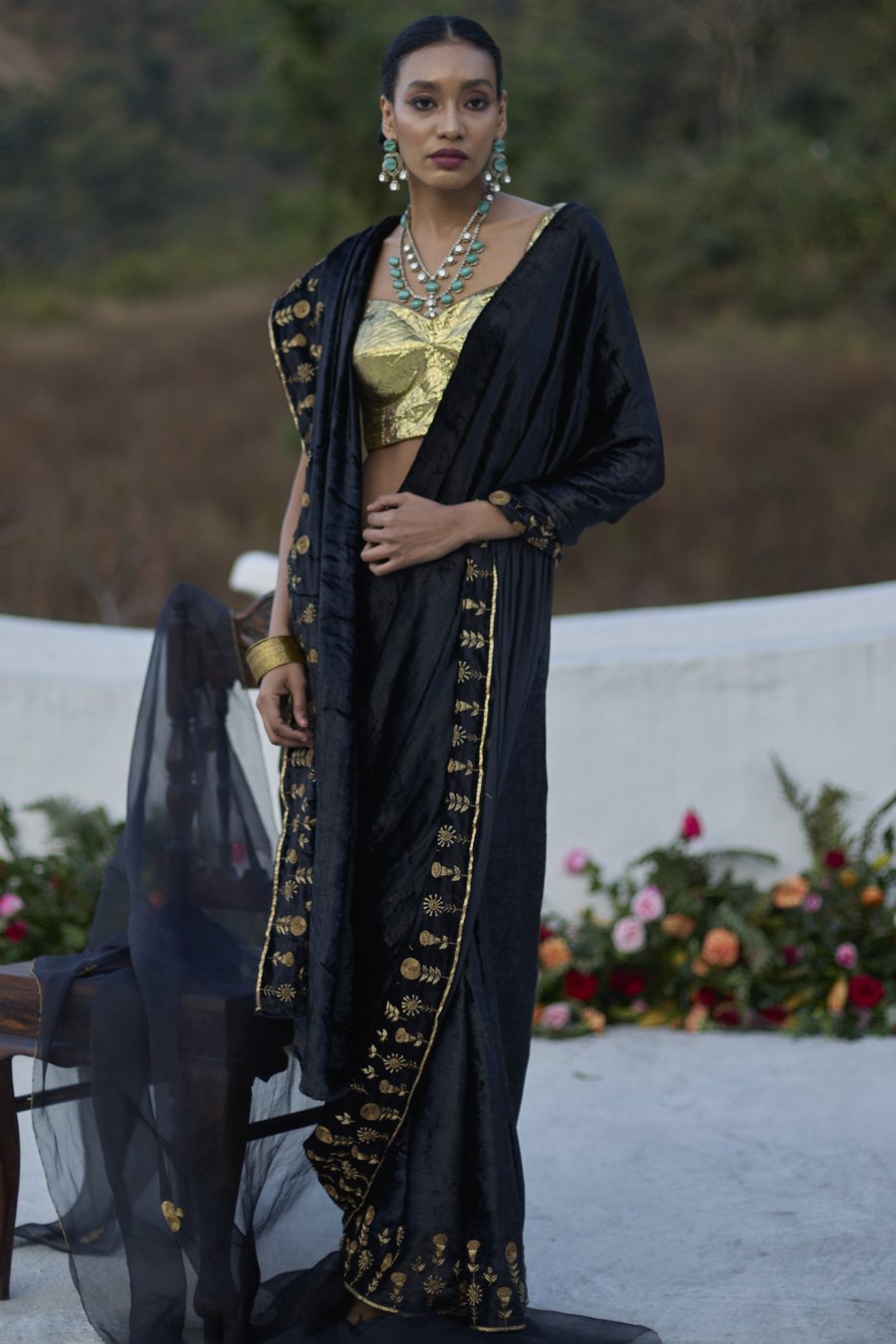
₹48,500
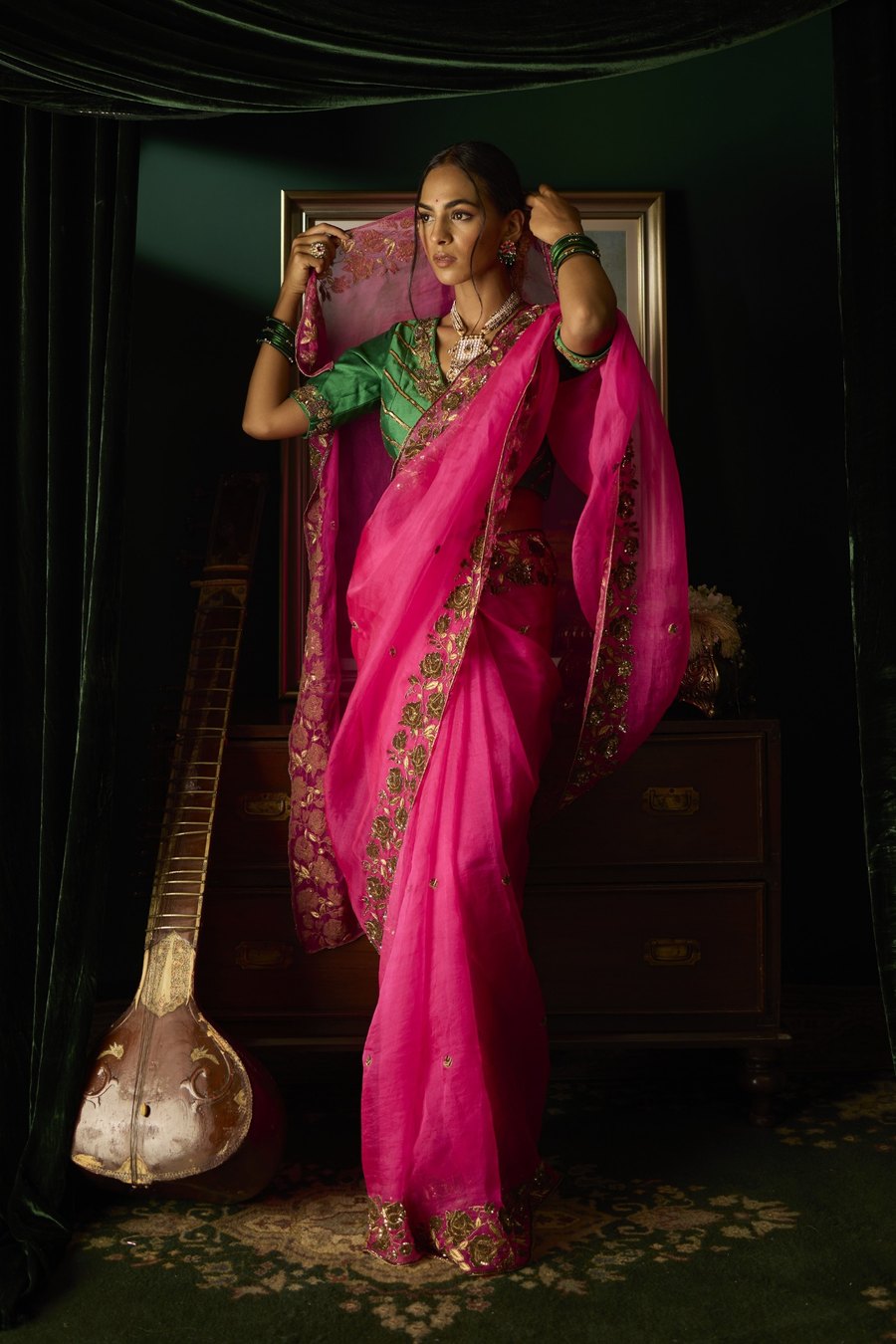
₹46,500
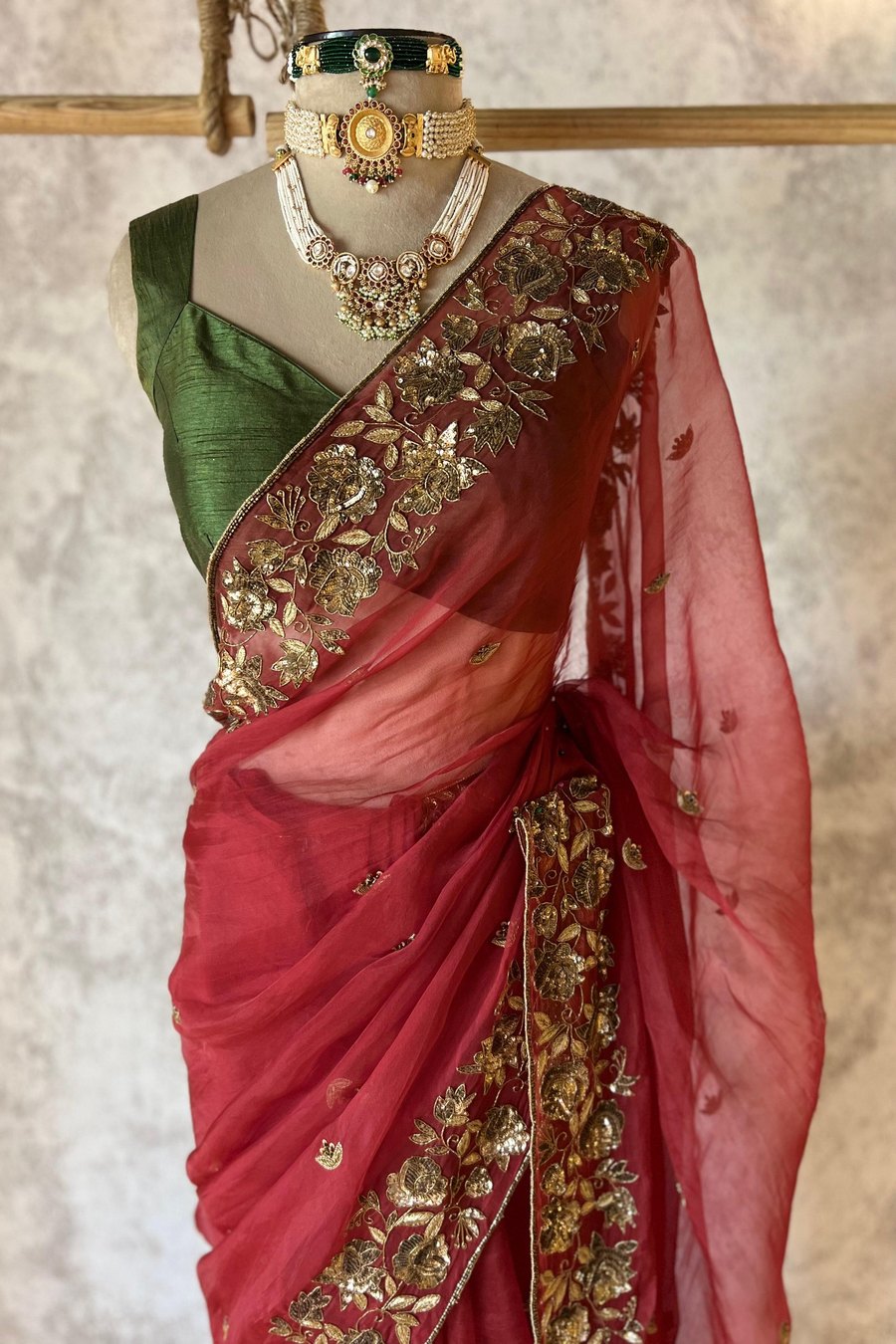
₹46,500
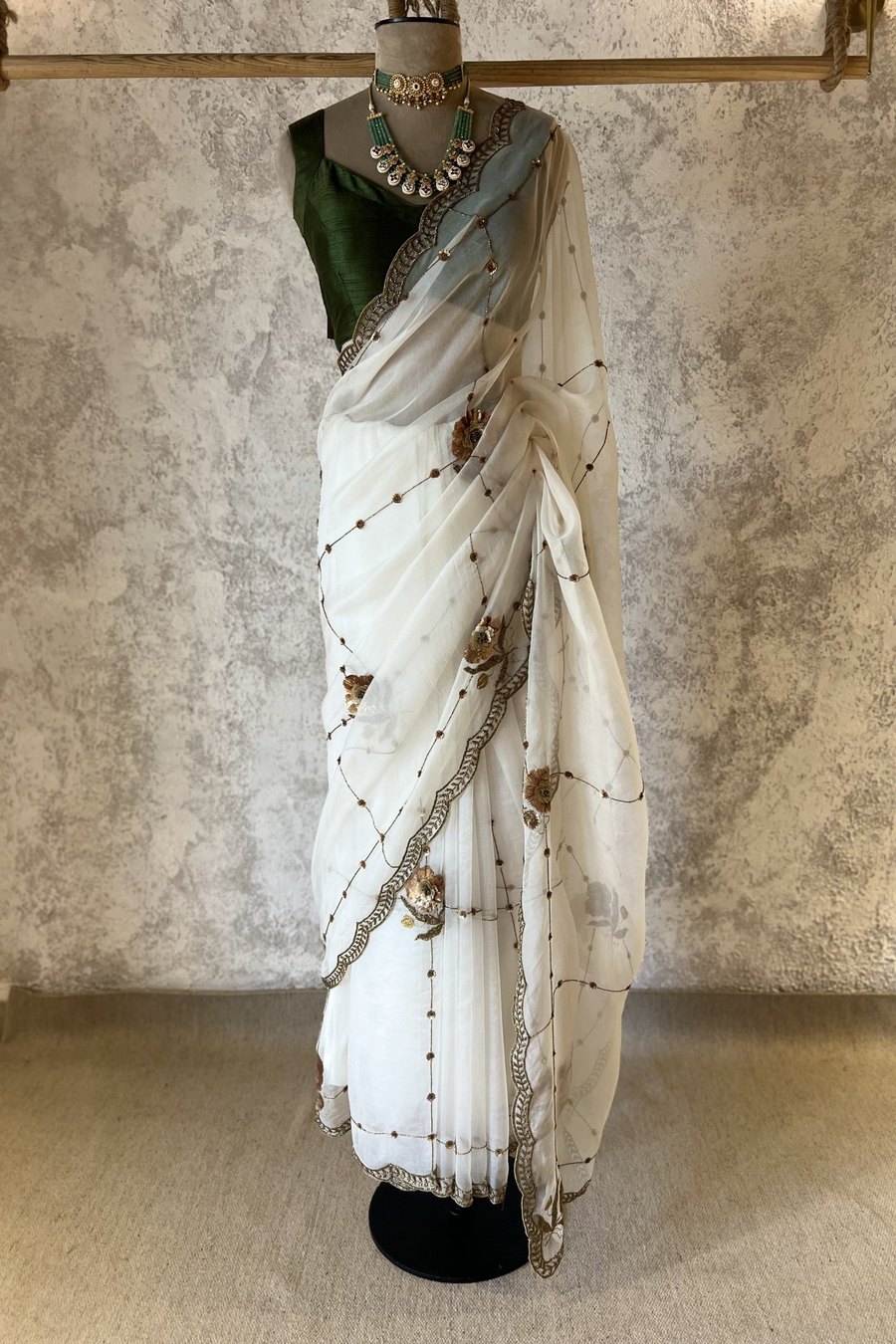
₹46,500
Taking your own measurements at home
You do not need a tailor for this. Wear the blouse that fits you best — the one you reach for without thinking — and measure over it, or lay it flat and measure the garment itself. If you measure the garment, say so; garment measurements and body measurements are not the same thing, and mixing them is the single most common reason a blouse comes back too small.
Stand in front of a mirror, or better, have someone stand behind you. The classic error is a tape that is level at the front and dipping at the back, which quietly adds two centimetres to the bust. Breathe out normally and do not hold. For the armhole, keep the arm down; for the sleeve, keep it relaxed at your side.
Write the numbers down in either inches or centimetres, and tell us which. Then take three photographs: the blouse laid flat from the front, the same from the back, and one of you wearing it. Those three pictures explain more than the numbers do — where it sits on the shoulder, how much ease you actually like, whether you prefer a higher neckline. It is exactly the sort of thing we look at when we do a fit check on WhatsApp before a piece is cut.
Between two sizes, and bodies that change
Plenty of people sit between two sizes, and the honest answer is that both numbers are useful. Send both and tell us which ready-made blouse fits you better and where — tighter at the bust, looser at the waist. We would rather build to a range than guess at a single number.
If the wedding is some months away, say so when you order, along with the date you actually need the piece. Dates change, plans change, and a measurement taken in June for a November function is worth flagging as a June measurement. Nobody needs to pretend their body is a fixed quantity across five months.
The blouse is the piece with the least give in the whole outfit, which is why we spend the time on it. Everything else about a saree can be adjusted with a pin and two minutes in front of a mirror.
The first wear
Set the pleats at home, a day before, with the blouse on and the heels you plan to wear. Press them with a cloth between the iron and the embroidery — never directly on hand work, which flattens the raised stitches and takes the light out of them.
Wear the blouse for an hour at home before the function. Hook and eye, sleeve, armhole: an hour in your own room is a kinder place to find a problem than a dressing room at a venue.
Store the saree folded in muslin rather than plastic, and keep the blouse with it. A made-to-order piece and its blouse are cut for each other; separating them is how a matching set becomes two nearly-matching things.
Frequently asked
Do you stitch the blouse as well, or only the saree?
Both. The blouse is made to your measurements. If you already own a blouse you love the fit of, send its measurements and we will work from those instead.
How long does a made-to-order saree take?
It depends on the embroidery on the piece, so we quote it for your specific order rather than publish an average. Ask on WhatsApp with the saree you have in mind and we will confirm the timeline before anything is cut.
What if one of my measurements is wrong?
Tell us before the piece is cut — that is the moment it can still be changed. It is also why we ask for photographs of a blouse that fits you: they catch the mistakes a tape measure hides.
Is the saree length standard?
Five and a half metres is the standard cut. Tell us your height and the heels you plan to wear, and if you need a longer length for a deeper pleat stack or a broad pallu, say so at order.
Can I order a size that is not on the website?
Custom sizing is how we work, so there is no list to choose from. Send your measurements and we will build the blouse to them.
Explore more: lotus collection · chidiya · rani sa collection — or message us on WhatsApp for styling help.

The information below is required for social login
Sign In
Create New Account