

Most of the damage we see on a designer saree did not happen at the wedding. It happened in the fortnight after it, in a plastic bag, folded on the same two lines it was folded on in the shop. This is the guide we give clients when they ask how to keep a heavy
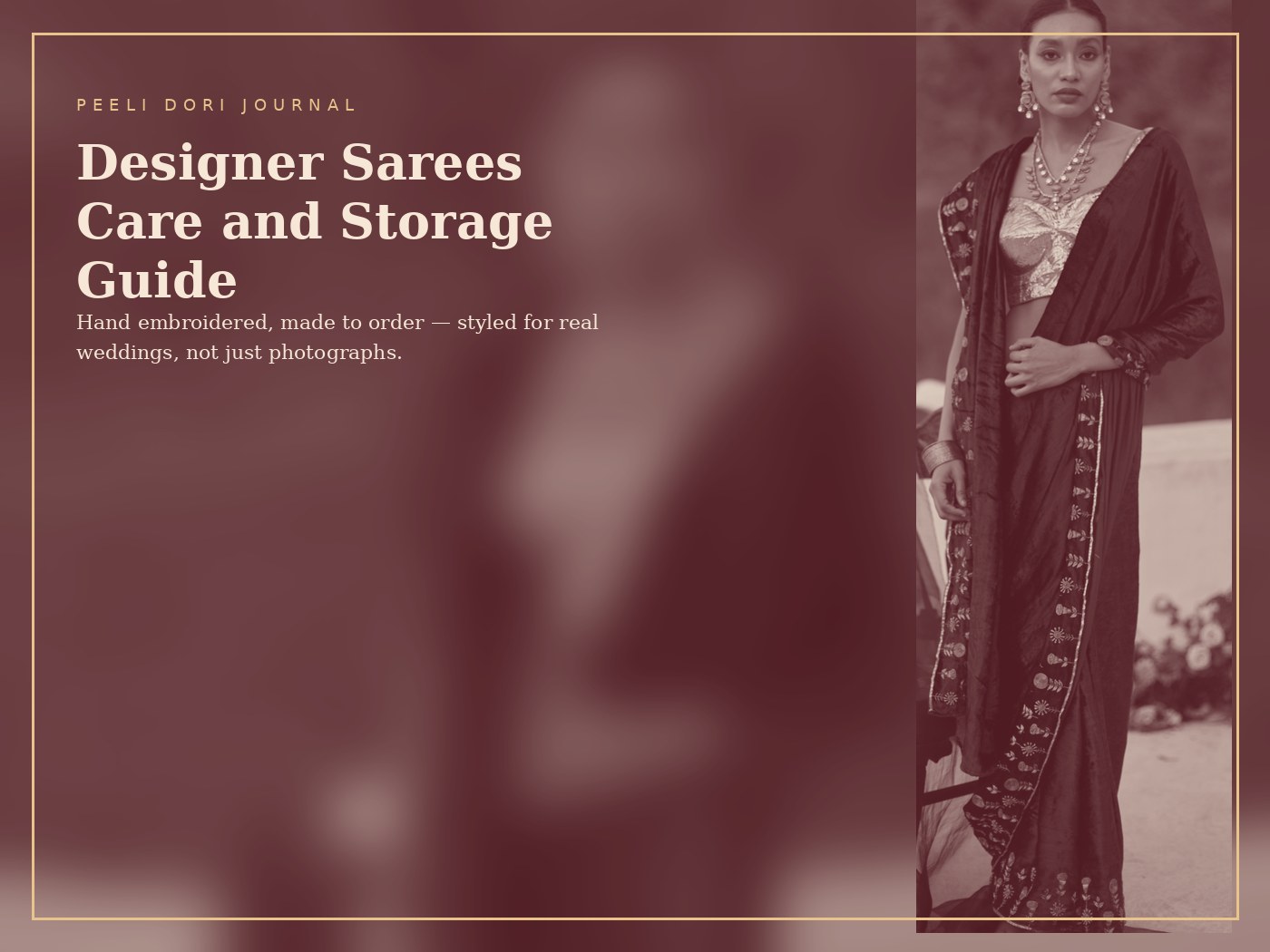
Most of the damage we see on a designer saree did not happen at the wedding. It happened in the fortnight after it, in a plastic bag, folded on the same two lines it was folded on in the shop. This is the guide we give clients when they ask how to keep a heavy piece alive between seasons — fabric by fabric, because organza and velvet fail in opposite ways.
The fortnight after the wedding is where sarees are lost
A designer saree comes home from a wedding carrying three things: dust from the venue, a little body moisture in the blouse and the petticoat, and whatever was in the air at the reception — attar, smoke from the grill, hairspray from the room next door. None of that is visible in the photographs. All of it is still sitting in the cloth when the piece goes into the wardrobe, and it stays there until the next function, which may be eight months away.
The instinct is to fold it neatly and put it away while the compliments are still fresh. The better instinct is to give it a day. Air it flat on a clean cotton sheet in a room with a fan but no direct sun, let the blouse and petticoat dry separately, and only then decide whether it needs cleaning. A saree that was worn for four hours indoors rarely needs a full wash. A saree that sat through a December evening of barbecue smoke usually does, and the difference matters because every trip to the dry cleaner is a small tax on the zari.
We tell clients the same thing we tell ourselves in the workshop: the piece you paid for is not the piece you wore. It is the piece you will wear in 2031, at your cousin's reception, when the colour is eleven years old and still true.
Four fabrics, four different problems
Silk organza is the fabric most of our designer sarees are built on, and it is the one people mishandle most. It is crisp because it is stiff, and it is stiff because the finish is doing the work. What destroys that finish is heat and pressure: an iron pressed directly on the weave flattens the stiffness into a shine that never comes back, and a plastic cover traps moisture against the same surface until it milks. Organza also creases hard along a fold, and a crease left in for two years becomes a memory the fabric keeps.
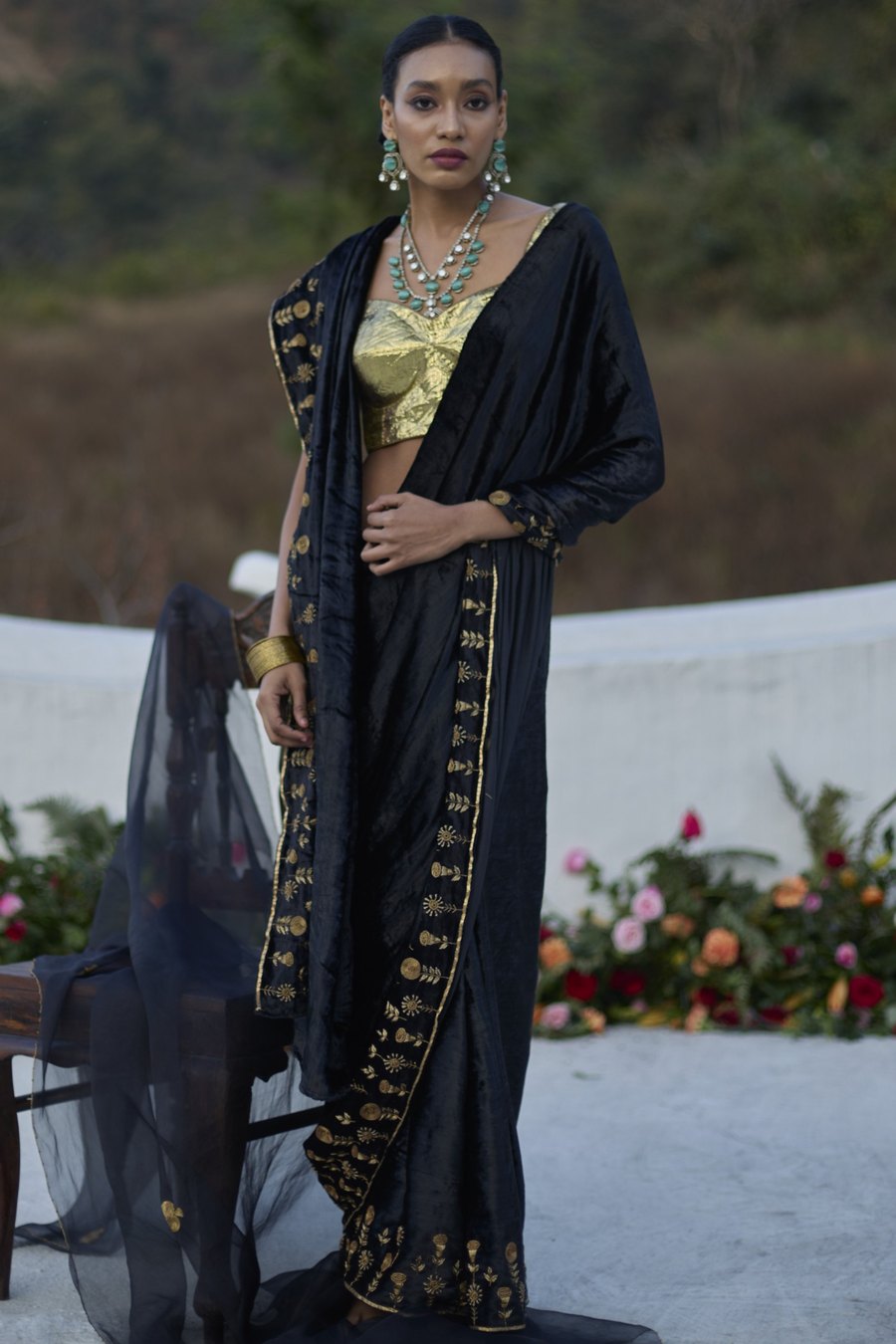
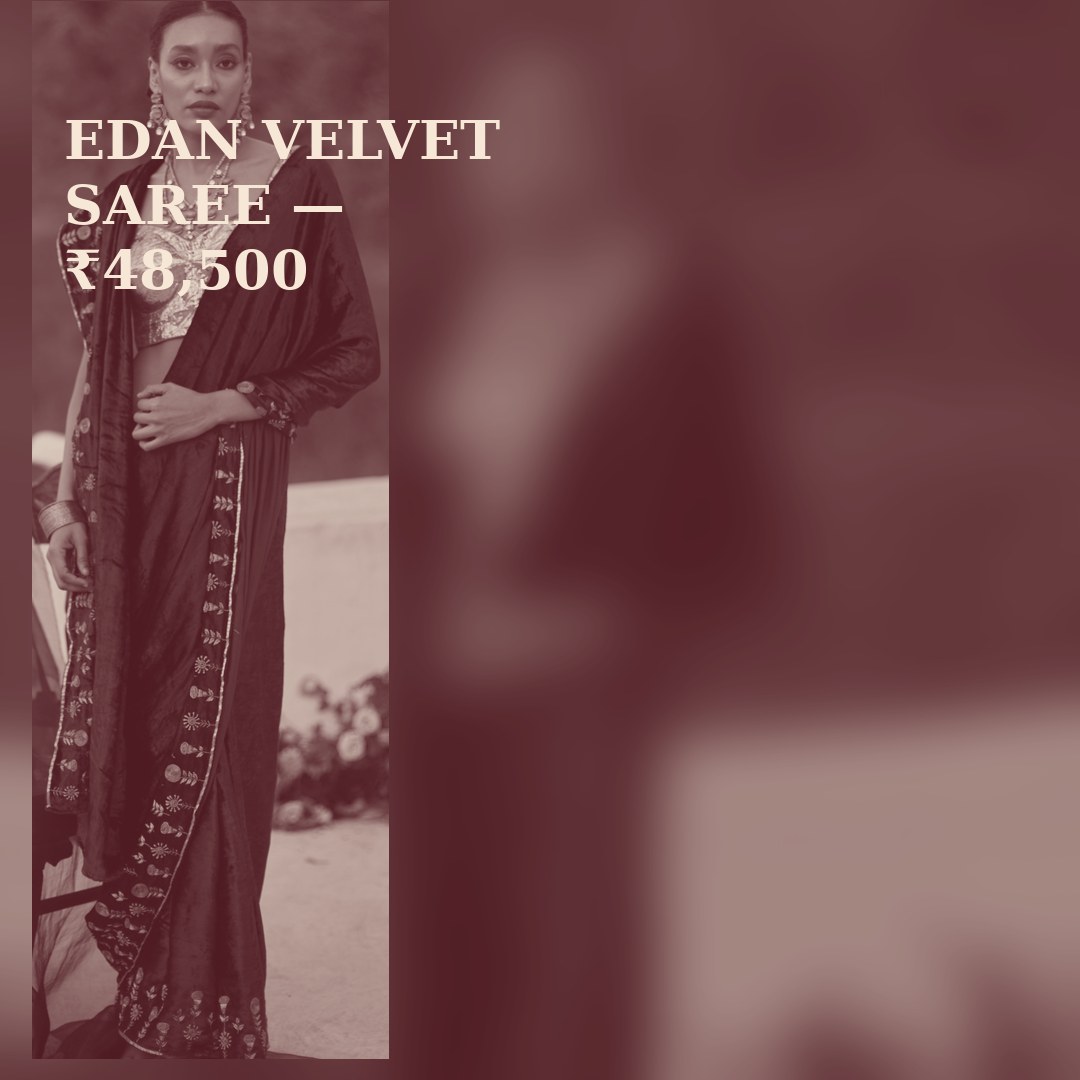
Velvet fails in the opposite direction. A velvet saree like the Edan is a pile fabric, so the danger is not heat but crush — a heavy piece folded flat under three other sarees leaves a flattened band across the pile that steaming only partly lifts. Velvet also hates being hung for months on a thin hanger, because the shoulder takes the entire weight of the border. Store it rolled, pile side out, in a loose cotton sleeve, and keep it away from the same shelf as anything with a hard embellishment.
Silk satin and tissue are the quiet ones. They look forgiving, they take a fold beautifully, and then a pin left in the pallu leaves a rust mark that surfaces two seasons later. Pins, safety pins and the little tag from the tailor are the single most common cause of an orange spot on an ivory saree, and the fix is simply not to store it pinned.
Zari and gota are metal, and metal behaves like metal. It oxidises in damp air, it tarnishes against newsprint, and it dulls faster in a closed plastic bag than in a breathable one. If your city is humid in July, that matters more than any of the care labels.
Clean the right thing, not everything
Dry cleaning is not free for the garment. Every cycle is solvent and mechanical handling, and on a hand-embroidered border the handling is what loosens the thread. So we separate the decision: clean the blouse and petticoat when they need it, and clean the saree when it needs it. Those are three different garments with three different lives, and treating them as one set is how a saree ends up at the cleaner six times for every two times it is worn.
For body contact — the blouse, the inner edge of the petticoat, the section of the saree that sat against the waist — spot attention is usually enough. For the pallu and the border, air and a soft brush do more good than another wash. If there is a stain, take it to a cleaner who will tell you what they intend to use. A cleaner who cannot answer that question in one sentence is a cleaner who is about to experiment on a ₹48,000 piece.
One more thing we ask clients to stop doing: starching. Starch was a solution for cotton sarees that needed body. On an embroidered organza it holds dirt, attracts silverfish, and gives the border a papery hand that reads cheap in photographs.
Folding it so the border never sits on a crease
The rule we use in the studio is short: never fold the same piece the same way twice. Fabric has a memory, and a fold repeated every season becomes a permanent line across the pallu — usually exactly where the camera catches it, a hand's width above the hem.
For a light organza, fold along the length in thirds, then loosely in half, with acid-free tissue or plain white cotton between the layers. Avoid printed newspaper entirely; the ink transfers, and on an ivory piece it transfers invisibly and shows up later as a grey bloom. For a heavier embroidered border, roll the saree around a padded tube instead of folding it, so the weight of the zari is distributed rather than concentrated on one edge.
Do not hang a designer saree on a wire hanger for a season. The pallu is the heaviest part of the garment and it will pull the shoulder out of shape; if you must hang, use a wide padded hanger and take the weight off the pallu by resting it in a cotton sleeve on the bar.
And leave the wardrobe breathing. A closed plastic cover, a vacuum bag, or a suitcase under the bed are all the same mistake in different packaging: they hold moisture in and keep air out. Cotton or muslin sleeves, a dry shelf, a packet of silica changed once a year, and no direct sunlight on the folded edge.
Six designer sarees, and how each one wants to be kept
The piece you own decides the routine more than any general rule does. These are six from the current collection, and the note against each one is what we would actually say to a client taking it home.
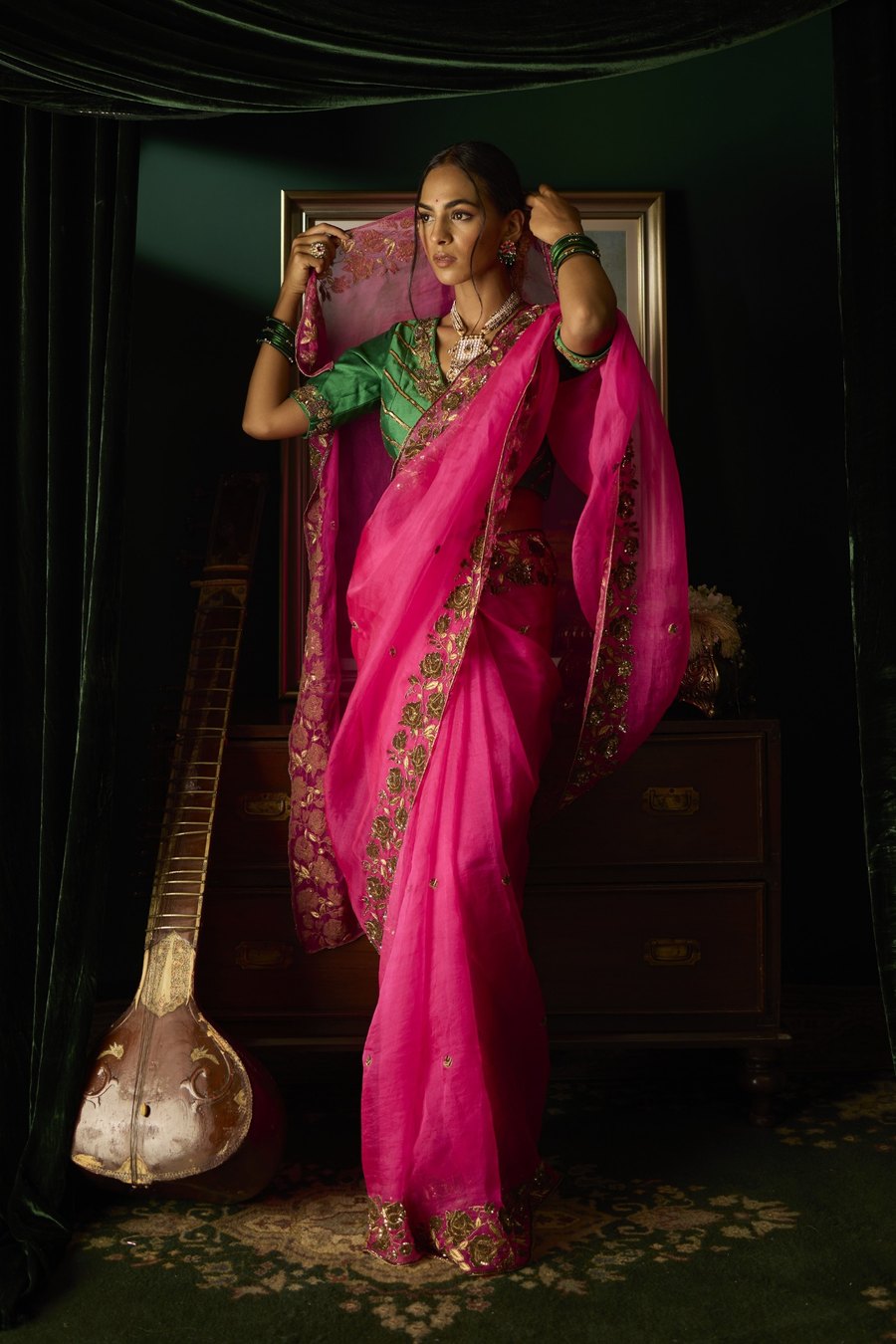
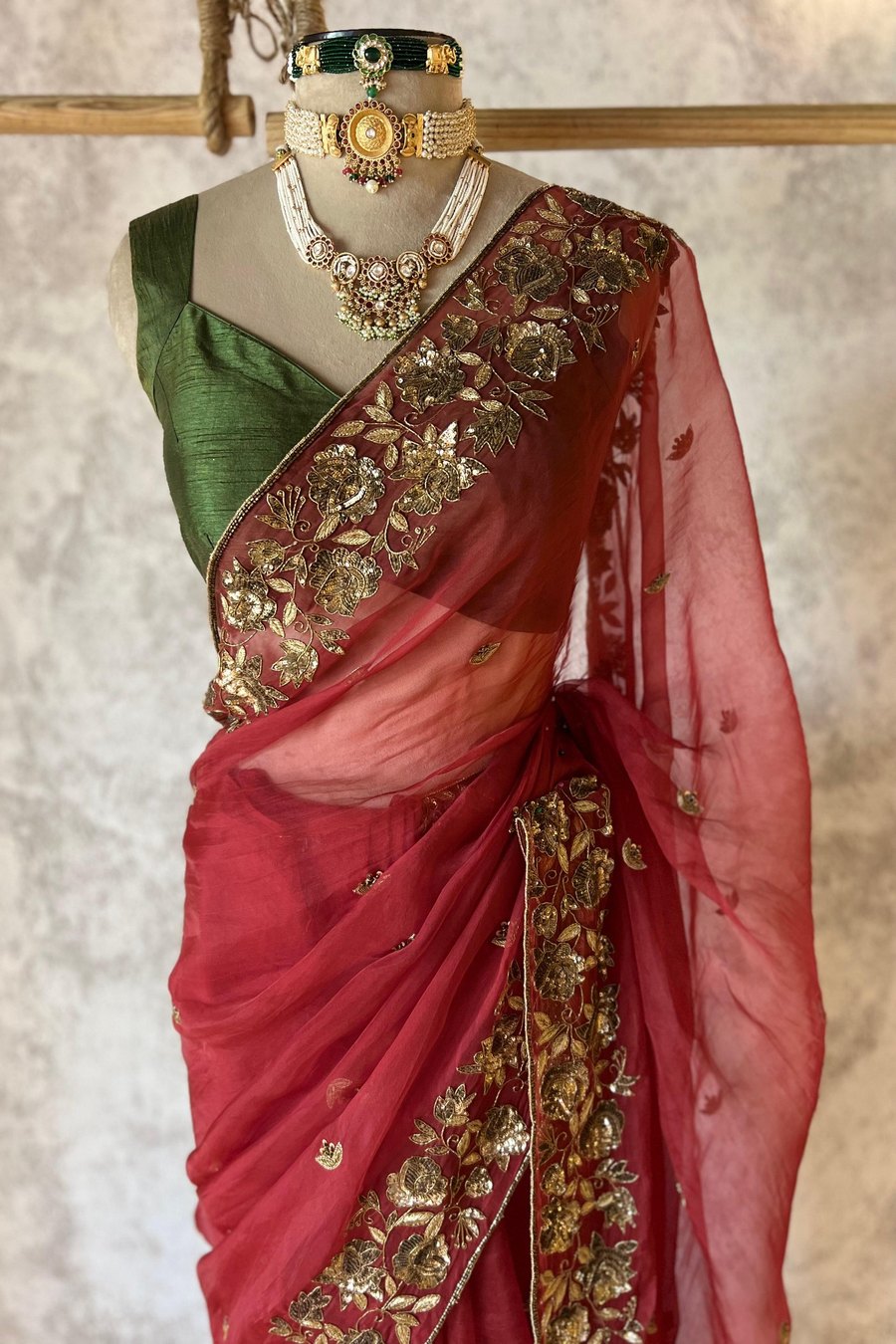
The Myra Red Organza is the heaviest of the group at ₹59,500 and the one that needs the most room — roll it, do not fold it, and give it its own shelf. The Noor Bahar Organza at ₹48,500 sits in the middle: fold in thirds, tissue between layers, rotate the fold line each season. The Edan Velvet at ₹48,500 is the only one here that should never be pressed at home, and the only one that should be stored rolled with the pile facing out.
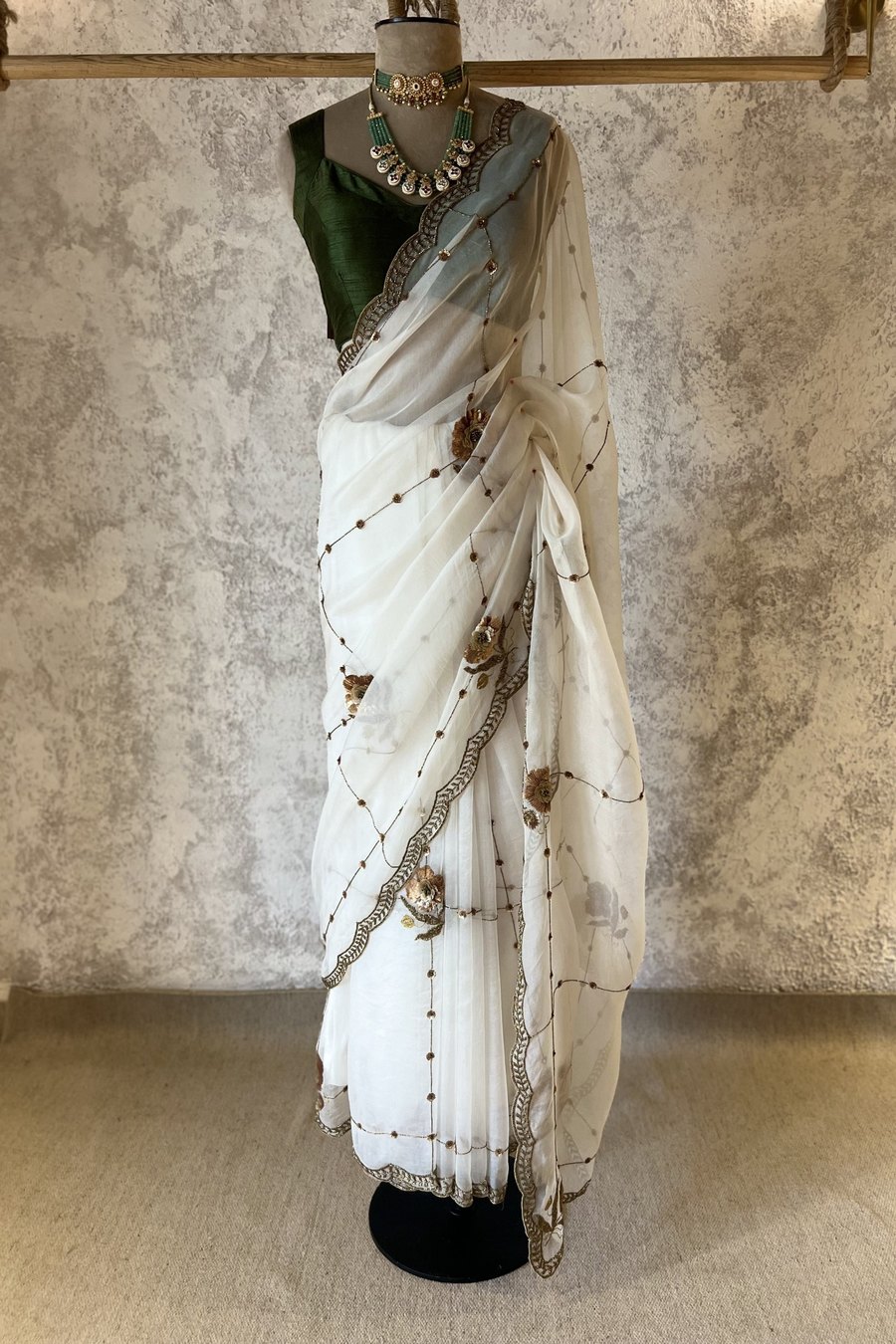
The Ruqmani Ranisa silk organza at ₹46,500 has a broad embroidered border, so the border takes the fold, not the body of the saree. The Gulbahar Ivory at ₹46,500 is the one to keep away from newsprint, pins and anything dyed — one rust mark on ivory is a permanent conversation. The Ruqmani Maroon at ₹46,500 is the most forgiving of the six on colour, and the least forgiving on creasing: maroon shows a hard fold line at an angle of light where a lighter colour would hide it.
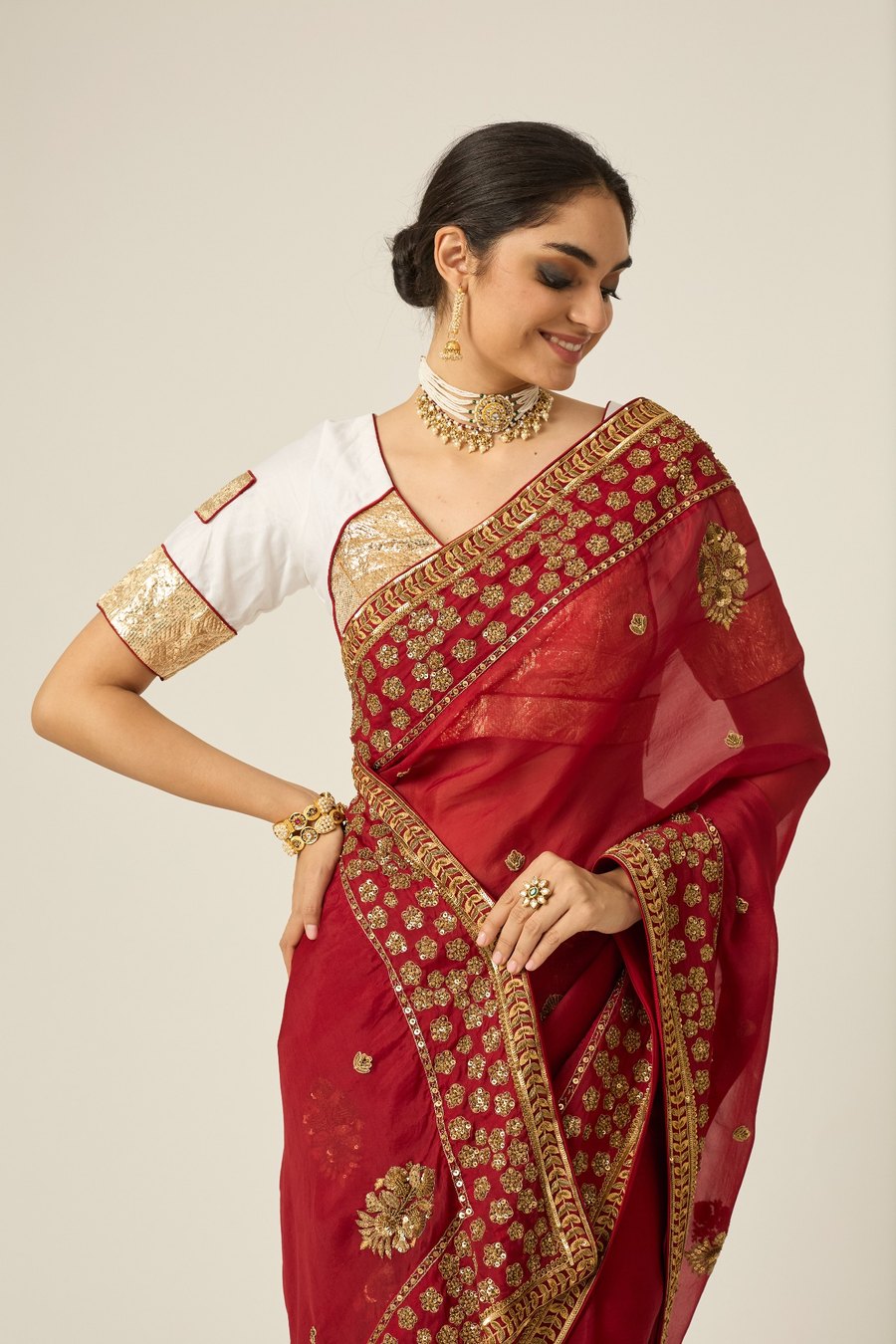
₹59,500
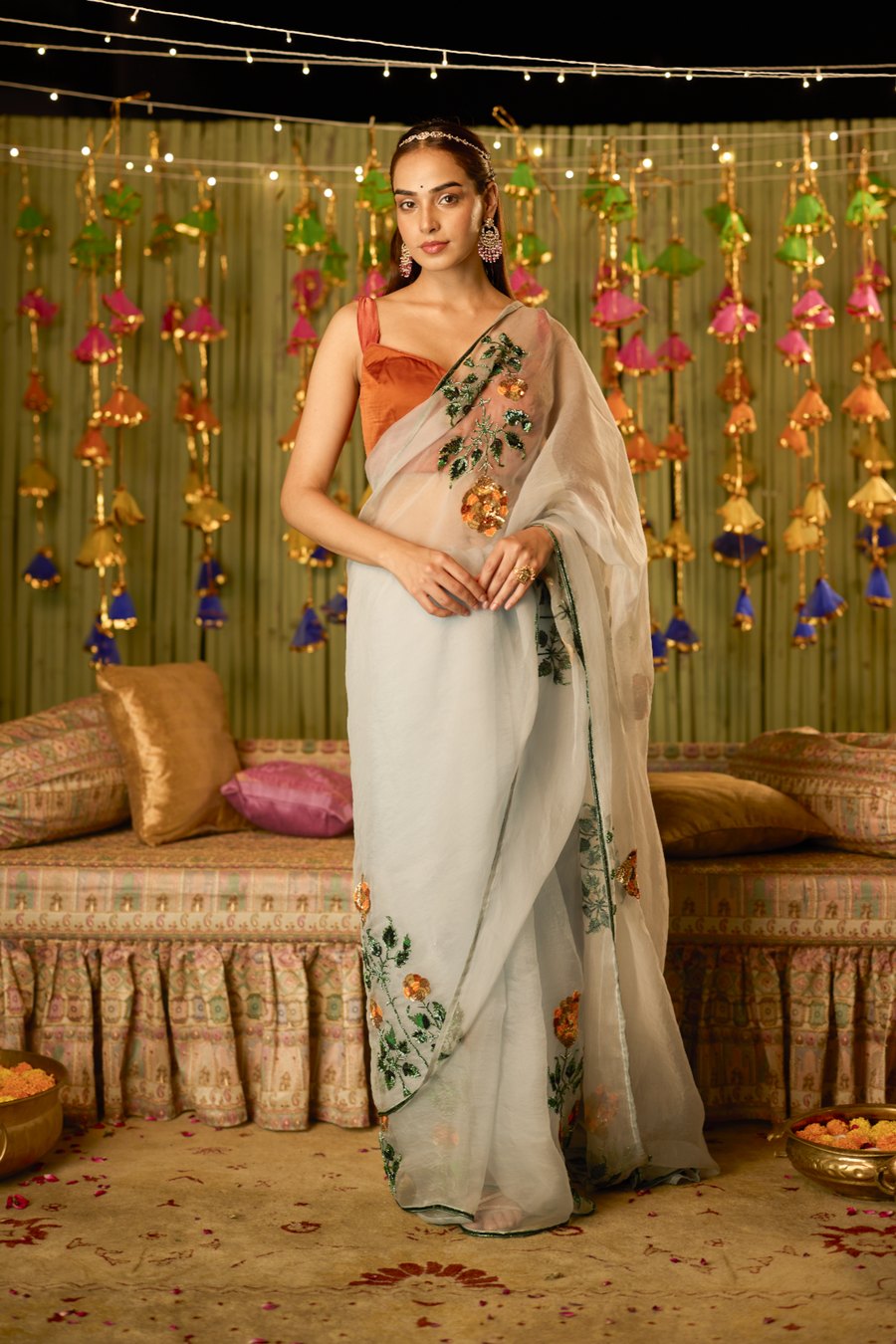
₹48,500
₹48,500
₹46,500
₹46,500
₹46,500
Travelling to a wedding with it
For a destination wedding, the saree travels better than the lehenga and worse than the kurta set. Carry it in the cabin, rolled, inside a cotton sleeve, and carry the blouse separately in a flat pouch so the embroidery is not pressed against a zip for four hours. If the piece has a stiff border, roll around a sheet of tissue rather than a tube — airport security will unroll it, and a tube will not survive that.
Pack it last and unpack it first. Twenty minutes out of the bag, hung in a steamy bathroom with the shower running and the door closed, does more for a creased organza than an iron ever will. Do not let the hotel laundry press it. We have seen a ₹48,500 saree come back from a hotel with a shine across the pallu that no amount of steaming could take out, and the guest wore it anyway because there was no second option.
If you are ordering a made-to-order piece for a specific date, tell us the date when you start, not when you are chasing it. Custom sizing and the embroidery both take calendar time, and the WhatsApp conversation is much calmer three weeks out than three days out.
Frequently asked
How do I remove creases from a silk organza saree without ruining it?
Steam, not pressure. Hang the saree in a bathroom with a hot shower running and the door closed for twenty minutes, then let it dry flat. If you must iron, use the lowest setting with a cotton cloth between the iron and the fabric, and never let the soleplate touch the organza directly — direct heat flattens the crisp finish into a permanent shine.
Can I store a designer saree in a plastic cover?
No. Plastic holds moisture against the fabric and, on zari and gota, speeds up tarnishing. Use a cotton or muslin sleeve instead, keep the shelf dry, and change a silica packet once a year. The same applies to vacuum bags and suitcases under the bed.
Should a heavy embroidered saree be folded or rolled?
Roll it if the border is heavy or the embroidery is dense, so the weight is spread instead of sitting on one folded edge. Lighter organza can be folded in thirds with acid-free tissue between layers, as long as you change the fold line each season — fabric keeps a memory of a repeated fold.
How often should a designer saree be dry cleaned?
Far less often than people assume. Clean the blouse and petticoat when they need it, and the saree only when it has actually been marked or worn somewhere smoky. Each dry-clean cycle is solvent and handling, and on hand embroidery the handling is what loosens thread.
Do you make designer sarees to order in custom sizes?
Yes. Our sarees are hand embroidered and made to order, with custom sizing on the blouse, and we do fit checks over WhatsApp if you are not in Delhi or Dehradun. Free shipping applies above ₹10,000 across India, and you can also see the pieces in person at our Shahpur Jat and Dehradun stores.
Explore more: lotus collection · chidiya · rani sa collection — or message us on WhatsApp for styling help.

The information below is required for social login
Sign In
Create New Account