

A sangeet is the one wedding function where the saree has to work while you move — through somebody else's choreography, four hours of sitting and standing, and a floor that opens up at eleven. That is a different brief from a wedding-day saree, and it is the
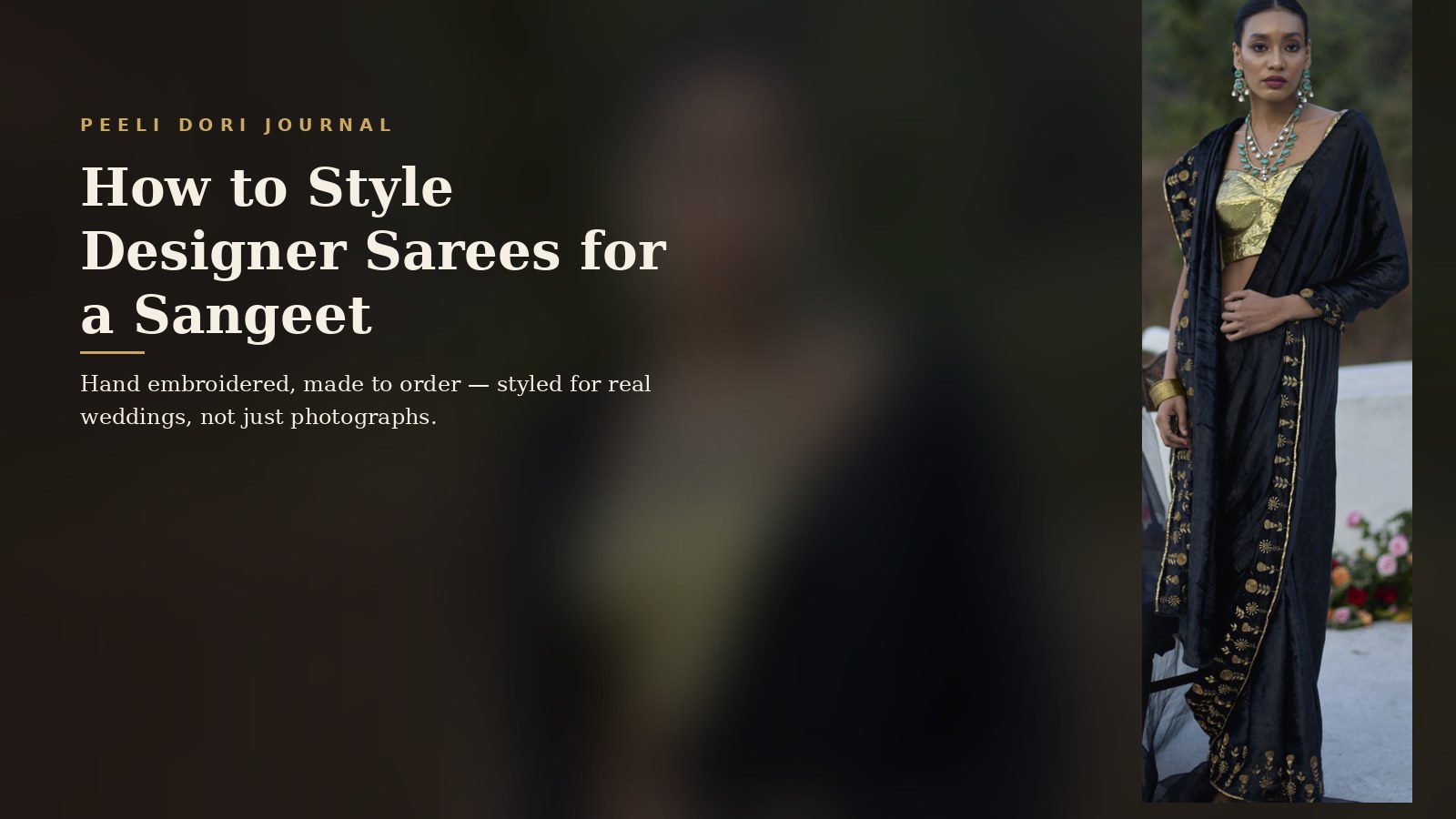
A sangeet is the one wedding function where the saree has to work while you move — through somebody else's choreography, four hours of sitting and standing, and a floor that opens up at eleven. That is a different brief from a wedding-day saree, and it is the one we style for here.
The guest wears one saree for six hours
The bride changes. She has a performance look, a family-photograph look and a final look, and somebody is assigned to manage all three. If you are the sister, the cousin or the friend in the good red saree, you get one piece and one drape, and it has to hold from the entrance photograph at seven to the last song after midnight. Most of the styling advice you read online is written for the bride. This is the other brief.
Think about what the evening actually does to a garment. You walk in and stand under flash for ten minutes. You sit on a low sofa through the family performances, which puts pressure on the pleats at the hip. You are pulled up for a group number you rehearsed once, in front of two hundred people and about sixty phone cameras. Then the lights go down and the floor gets crowded. Every one of those moments stresses a different part of the drape, and they do not all want the same saree.
So we plan for the fifth hour, not the first. A designer saree at this level is usually bought as a piece you will wear more than once — to a sangeet this season, a reception next year, a close friend's mehendi after that. If it only looks right standing still, it was the wrong purchase for the money. The test is simple and slightly unglamorous: put it on, pin it the way you would pin it, put your heels on, and dance one full song in your bedroom. Whatever moves, moves at the venue too.
Fabric and work: what holds up in motion
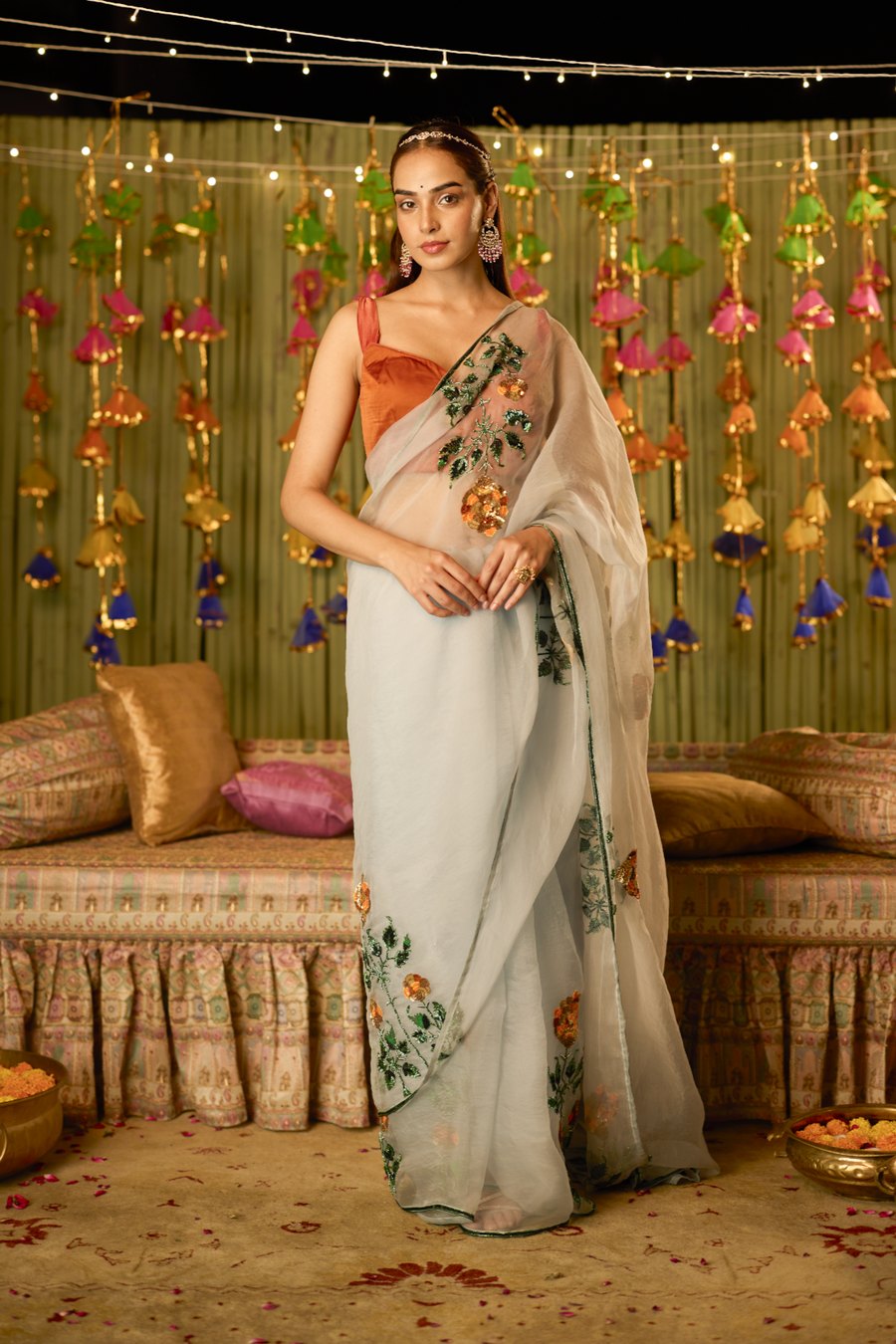
Organza is the fabric most of our sangeet pieces are cut from, and for a moving evening it earns its place. It is light enough that the pleats do not pull on the petticoat, it keeps a defined line instead of collapsing into your legs when you sit, and it does not hold heat the way a heavier weave does. Silk organza is the crisper version: a little more body, a cleaner fall, and the one we would choose if you are actually performing rather than watching.
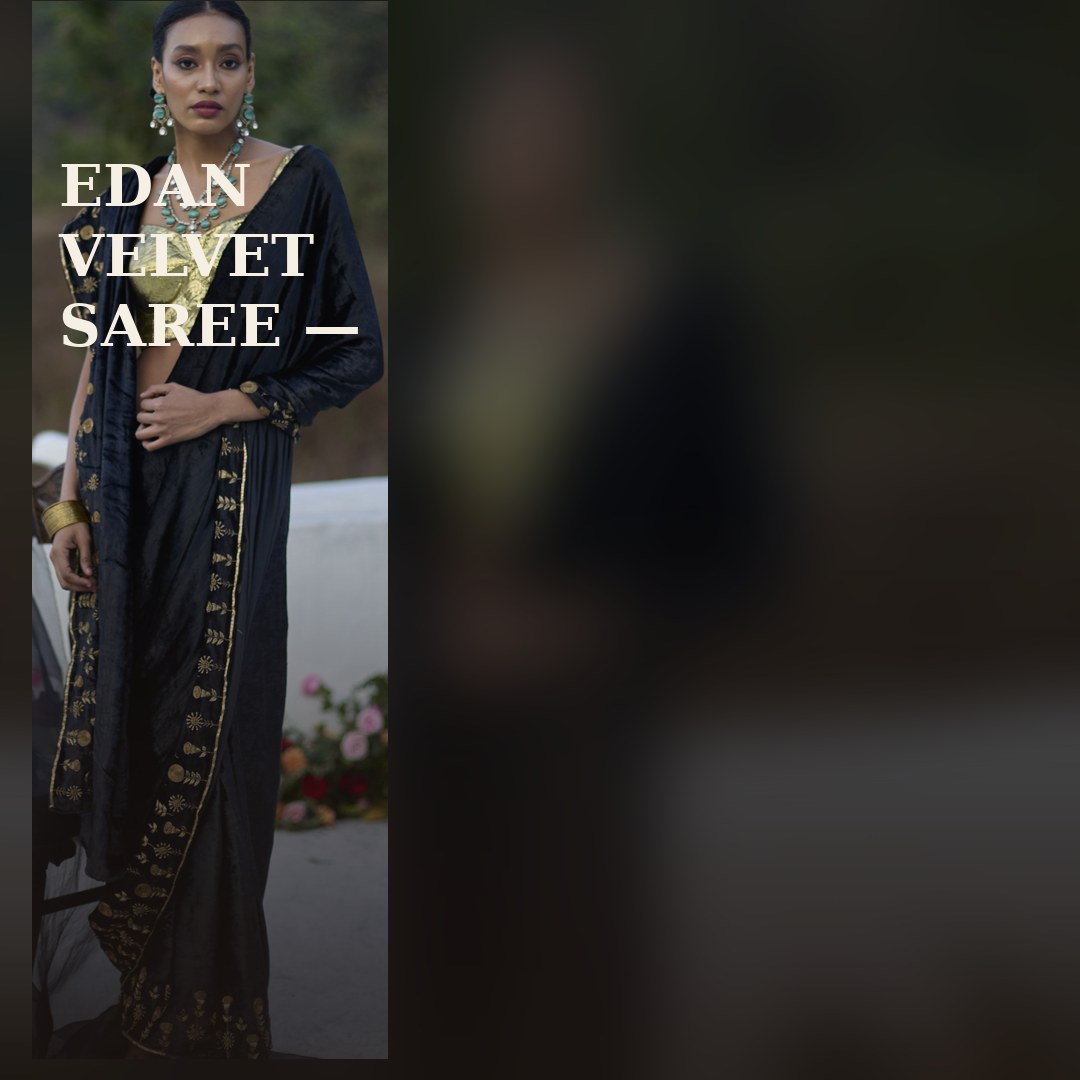
Velvet is the exception, and it is a winter answer. In a Delhi or Dehradun December, a velvet saree is genuinely comfortable at an outdoor or thinly heated venue, and it photographs as depth rather than shine in low light. What it will not do is move. It is warm, it is heavy on the shoulder, and by the third fast song you will feel every metre of it. Beautiful for a winter sangeet where you are seated and hosting; difficult if you are in the choreography.
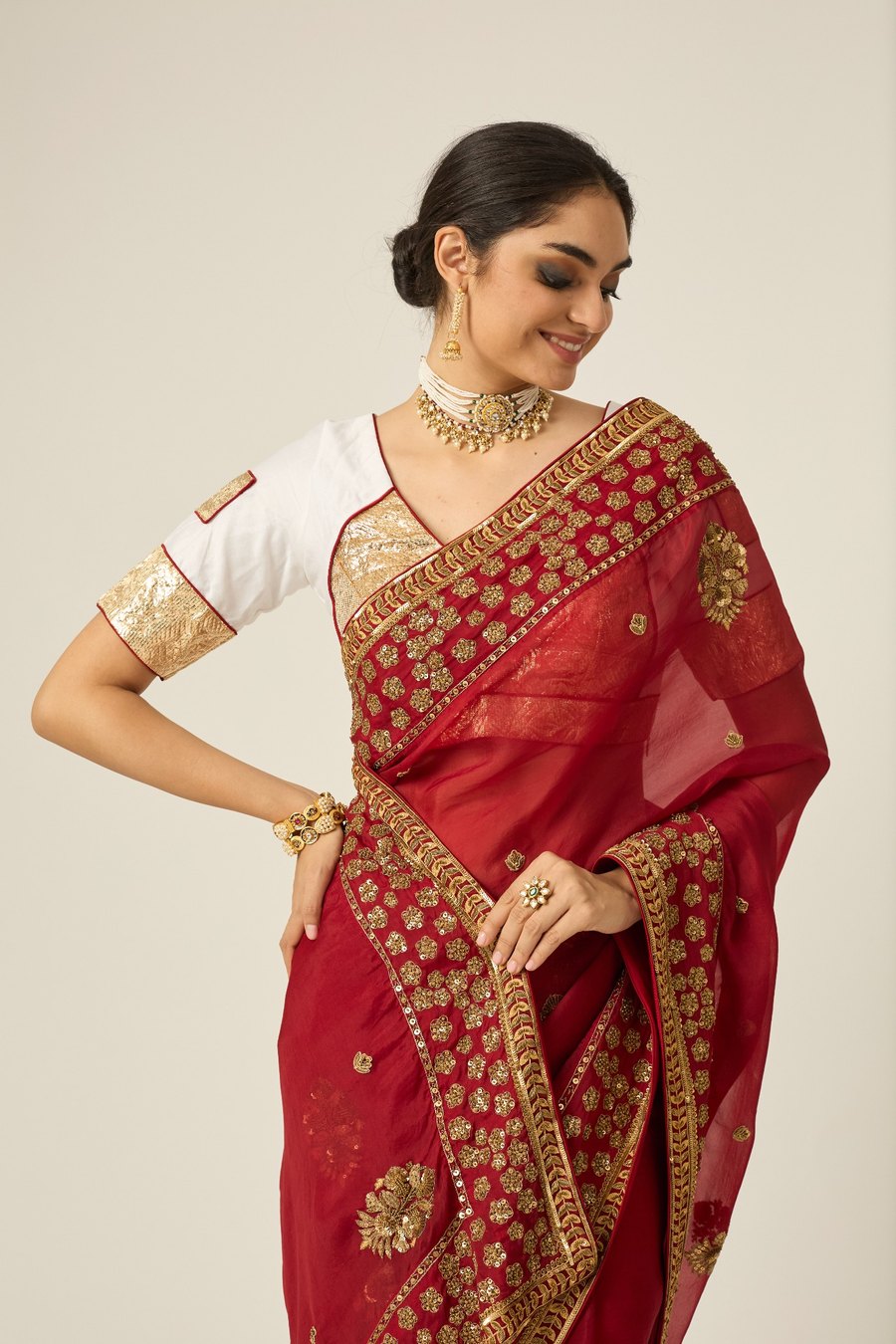
The embroidery matters as much as the cloth, because the technique decides where the weight sits. Gota patti is flat ribbon work laid onto the surface — light, and it returns light back at the camera, which is why it survives a dark room and a phone flash. Zardozi and dabka are raised, built up in layers, and they hold small shadows under warm stage light. Both are gorgeous. The practical difference is distribution: work spread across the body carries more easily than a dense, heavy border at the hem, which gathers weight at the one point that swings when you turn.
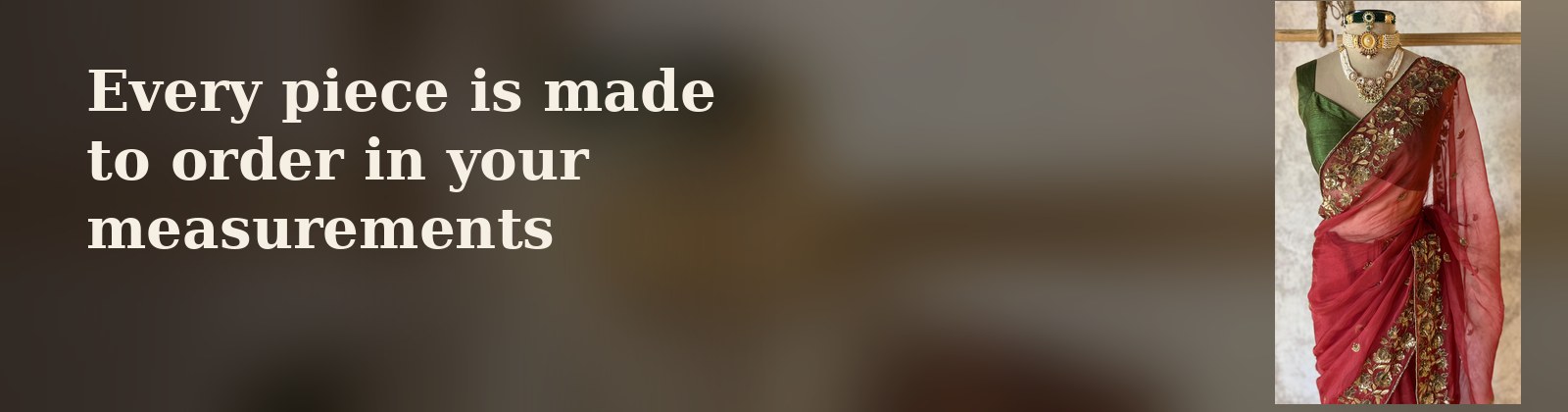
Our pieces are hand embroidered and made to order, so the work is not a print sitting flat on the surface — it has texture you can feel with a thumb. On the rail that reads as quality. On the dance floor it means the saree has a grain, and the grain decides how it falls. Look at where the density is before you commit.
Choosing for your role, and for how you are built
Start with the job, not the colour. If you are hosting — greeting at the door, managing the family, on your feet but not dancing — you can carry the denser piece and the heavier border. If you are in the performance, choose the lighter arrangement and the crisper fabric. If you are a guest who will be on the floor from the first song, favour the saree that weighs least on the shoulder and has the least to catch on somebody else's jewellery.
Then the body. A saree is a wrapped garment, so the two things that change how it behaves on you are the pleat depth and the blouse. Deeper pleats over the hip give you room to sit and to move without the fabric riding up; shallow pleats look sharper in photographs and are less forgiving after an hour. If you are tall, the pallu can be pinned longer and looser; if you are small, a shorter, tighter pallu keeps the proportion right and stops the worked end from dragging.
The blouse is where most sangeet outfits fail, and it fails at the armhole. A blouse cut close and high under the arm will restrict you the moment you raise your hands, and you will feel it before anyone sees it. We cut to your measurements, so this is a conversation worth having properly — tell us if you are dancing, and the armhole, the sleeve and the back closure get cut for that. A WhatsApp video fit check before the final stitch is usually enough to catch it.
One more choice people forget: the petticoat. A drawstring that sits comfortably at the waist and a hem that clears the floor by an inch are what let you walk fast, climb a stage and dance without stepping on yourself. Our custom sizing covers this, and it is the least visible and most felt part of the whole outfit.
Six designer sarees, and the sangeet each one suits
These are the pieces we would put on the rail for this kind of evening, from the top of the range down. Prices are what they are on the site today; every one is hand embroidered to order.
Read them by the job they do rather than by the colour. The first is the one for the photographs and the stage; the middle three are the adaptable ones that will work for a sangeet this year and a reception next; the last two are the softer, quieter pieces for a guest who would rather not be the brightest thing in the room.
₹59,500
₹48,500
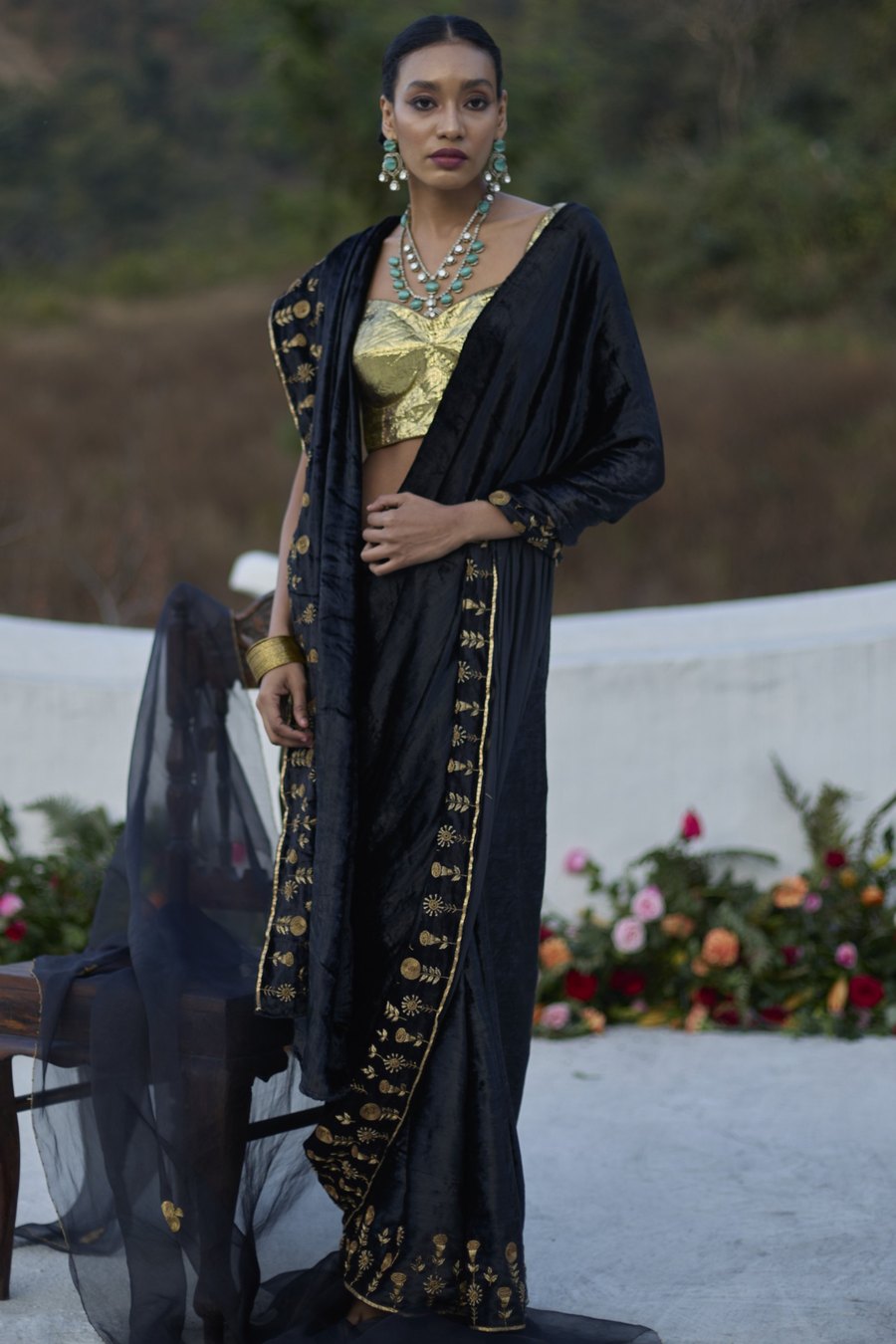
₹48,500
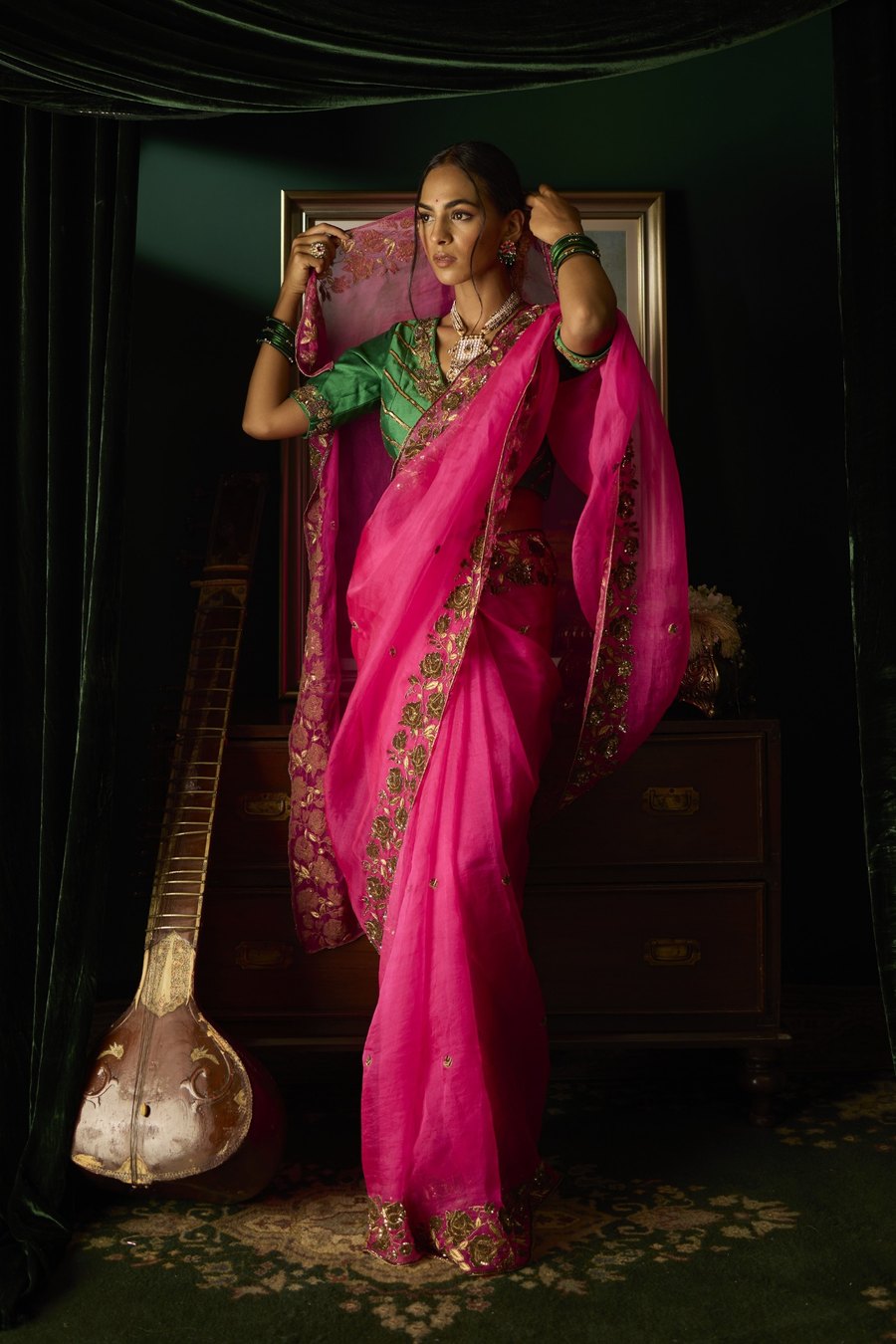
₹46,500
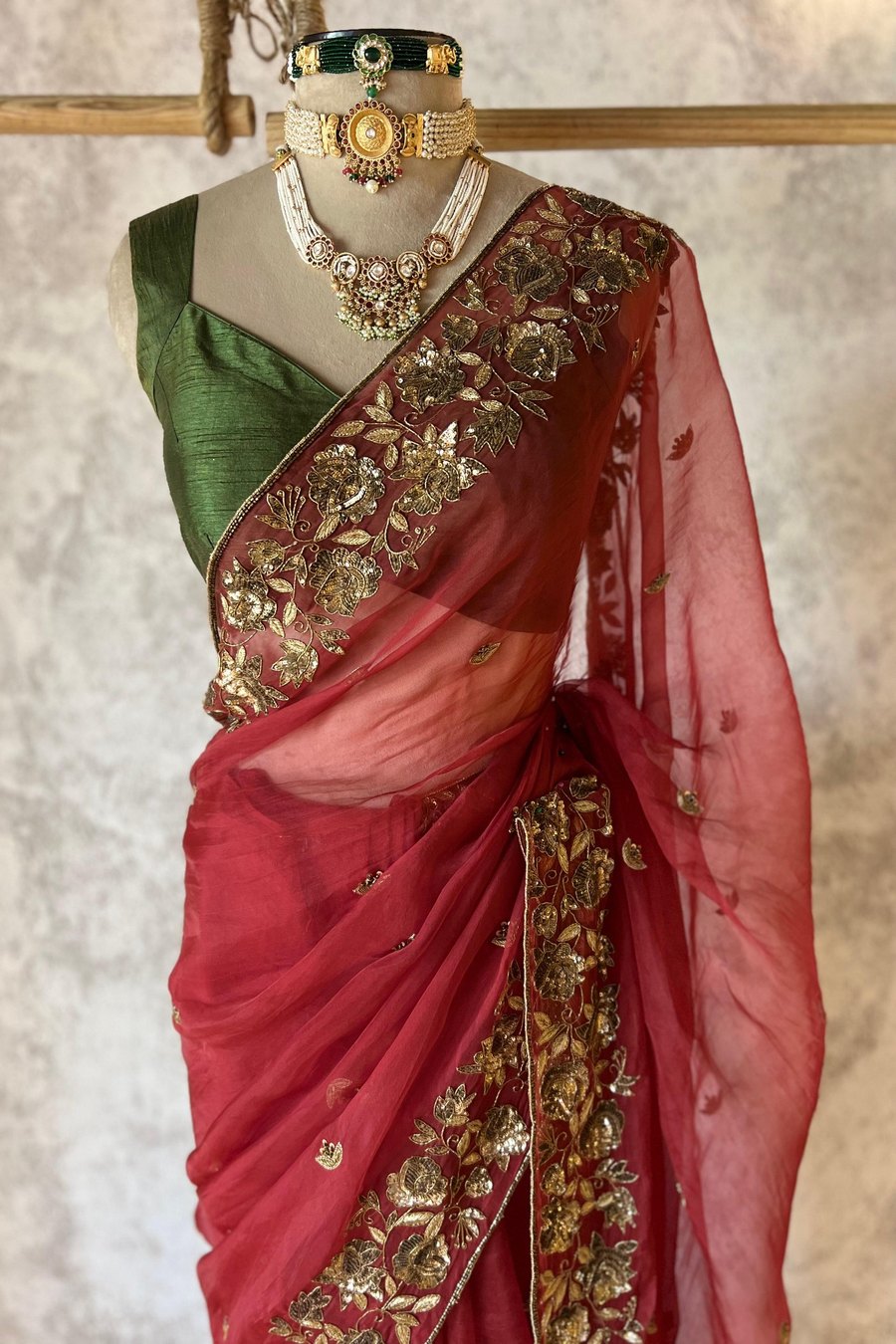
₹46,500
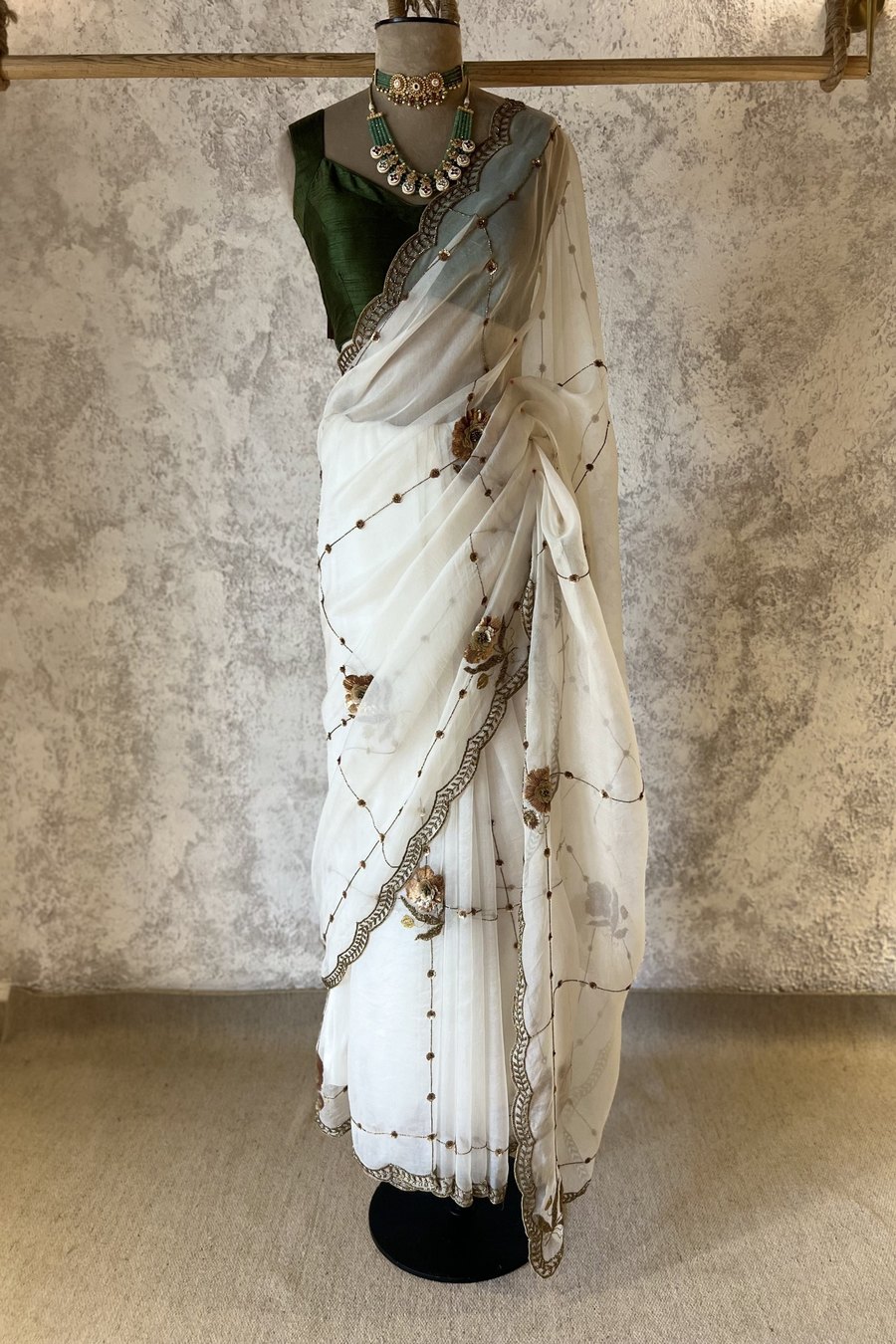
₹46,500
The blouse, the pins and the drape that stays
Three pins, placed properly, will do more for your evening than any accessory. One at the shoulder where the pallu crosses, one at the waist on the left where the pleats tuck in, and one hidden at the back of the pleat fan if the fabric is slippery. Pin through the weave, never through raised embroidery — a needle leaves a permanent hole in zardozi and a visible mark in gota, and the mark is exactly where the light catches.
Do not over-pin. A pallu pinned at four points stops moving with you, and a saree that does not move looks borrowed. Pin the shoulder and the waist, let the rest hang, and accept that you will adjust it once or twice in the evening. That adjustment is what a saree does.
Jewellery: the work on the saree is already the ornament, so keep the neck light if the embroidery is dense across the chest, and go heavier only if the piece is quiet at the neckline. A potli in the hand is more useful than a clutch on a dance floor — it stays on your wrist and it does not need a table.
Shoes are the last practical decision and the first one that ruins the night. A block heel you have already worn for an evening is worth more than a new pair of anything. If the hem is long, have it finished for the heel you will actually wear.
After the night, before the next one
A sangeet is hard on a saree: sweat, stage makeup at the shoulder, other people's perfume and a hem that has been on a floor. Take it to a dry cleaner you trust within a few days — not weeks — and tell them what the work is, because zardozi and gota are cleaned differently from a plain weave.
Store it folded in a cotton or muslin bag rather than a plastic cover, which traps moisture and yellows ivory over time. Refold along slightly different lines each season so the same crease does not sit on the same embroidery year after year, and keep it flat if you have the shelf space. Our ivory and blush pieces in particular will thank you for this.
Then wear it again. The whole argument for spending this much on a designer saree is that it is not a one-night object — it is the piece you reach for when the invitation says sangeet and you already know it will hold.
Frequently asked
Can I wear a designer saree to a sangeet if I am not the bride?
Yes, and it is often the better choice. A designer saree at this level is a single, finished piece rather than a set of pieces to coordinate, so you get an outfit that reads as considered without looking like you are competing with the bride. Choose the lighter arrangement if you plan to dance, keep the jewellery from repeating the embroidery, and let the saree be the one strong thing you wear.
How do I stop the pallu from slipping while I dance?
Pin the shoulder and the waist, not the whole length. A single pin where the pallu crosses the shoulder, one at the waist where the pleats tuck in, and one hidden in the pleat fan if the fabric is slippery will hold through most of an evening. Pin through the weave and never through raised embroidery, because the hole is permanent. Keep the pallu a little shorter rather than longer — a long, loose end drags and pulls the drape down.
Is organza or velvet better for a winter sangeet?
If you are dancing, organza. It is light on the shoulder, it keeps its pleats when you sit and it does not hold heat. Velvet is warmer and photographs with more depth in low light, which suits a December venue where you are seated and hosting, but it is heavy and it does not move well. Silk organza sits between the two: crisper than plain organza, far easier than velvet.
How far in advance should I order for a sangeet?
Our sarees are hand embroidered and made to order, and the blouse is cut to your measurements, so the earlier the conversation starts the more choice you have. Message us on WhatsApp with the date and the function and we will tell you honestly what is realistic. If you are travelling to the venue, add time for a fitting before you fly.
Will the embroidery be damaged if I dance in it?
Movement itself does not damage hand embroidery; bad pinning does, and so does a hem that drags on the floor. Pin through the ground fabric only, keep the hem an inch clear of your heel, and have it dry cleaned promptly afterwards. Gota and zardozi are built to be worn, not preserved in a cupboard.
Explore more: lotus collection · chidiya · rani sa collection — or message us on WhatsApp for styling help.

The information below is required for social login
Sign In
Create New Account