

The sangeet is the one function where a hand embroidered saree is judged in motion. Haldi and the wedding are mostly about how you sit and stand; the sangeet is about how you move, under coloured stage light, into a room full of phone cameras held at every ang
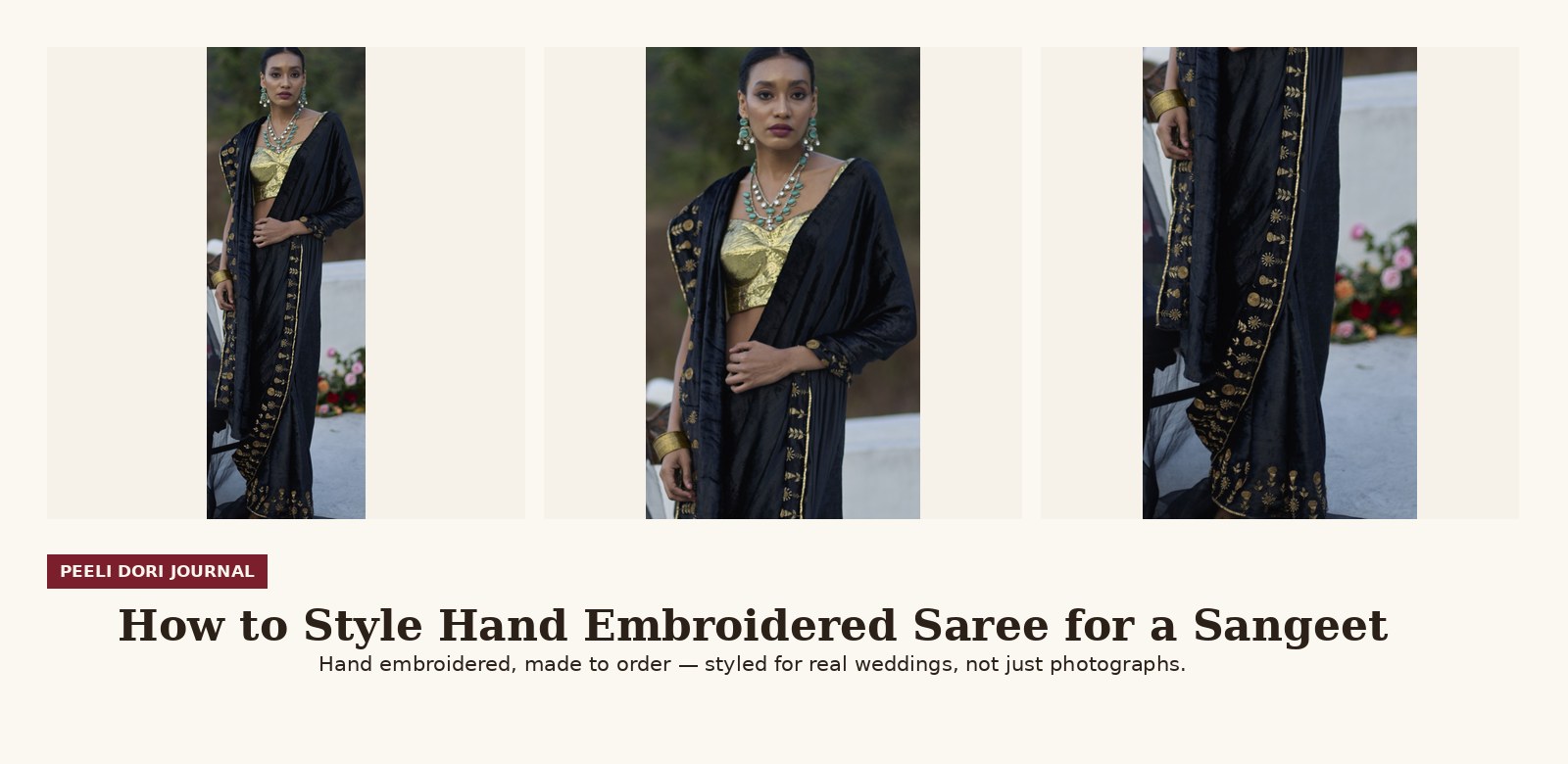
The sangeet is the one function where a hand embroidered saree is judged in motion. Haldi and the wedding are mostly about how you sit and stand; the sangeet is about how you move, under coloured stage light, into a room full of phone cameras held at every angle. That changes the styling brief. The choices that look right in a mirror on a still afternoon are often the ones that let you down by the second song, so we style a sangeet saree against a single test: three hours of dancing, low light, and no adjusting.
A sangeet asks different questions of a saree
Think about what you actually do at a sangeet. You walk in, you are photographed at the entrance, you sit through the family performances, you are pulled up for a group number you rehearsed once, and you end the night on the floor with the lights down. Every one of those moments puts a different demand on the garment, and they pull in different directions. The heavy, richly worked piece that photographs beautifully at the entrance is not always the piece you want on you at midnight.
So we style for the whole arc rather than the first photograph. That means the work has to read from a distance under low light, the blouse has to let your arms go where the choreography sends them, the pallu has to stay where you pinned it, and the weight has to sit somewhere you can carry for three hours without thinking about it. Get those four things right and the saree stops being something you manage and becomes something you dance in.
There is also a useful distinction between the stage part of the evening and the floor. If you are performing, you are standing under lights, largely still, and being watched, so you can carry a denser piece. If you are dancing, you want the same craft in a lighter arrangement. Where possible we style one saree to do both — worn full for the performance, then gathered and re-pinned for the floor.
Read the embroidery before you style it
The embroidery is the first thing we look at, because the technique decides everything that goes around it. Gota patti is flat ribbon work laid on the surface, so it catches and returns light — it reads brilliantly in daylight and in direct flash, which is why it photographs so well at an entrance or a daytime function. Raised metallic work like zardozi and dabka is built up in layers, so it throws small shadows and holds its shape under warm, low stage light, exactly where a flat work can go quiet. Resham and aari chain-stitch are thread alone — matte, softer, reading as texture up close rather than as shine from across the hall.
Once you know which of those you are wearing, the styling answers itself. A gota or flat-work piece wants the light kept simple around it: plain gold, a clean neckline, nothing that competes with the sparkle. A raised zardozi piece already has depth, so it can take a fuller earring and a worked blouse back. A resham piece is quiet by nature, so it is the one that benefits from a stronger colour underneath and jewellery with a little more weight.
Where the work sits on the body matters just as much as the technique. Work concentrated on the border and the pallu over a calm body keeps the piece light enough to move in, and puts the light-catching detail at the edges, which is where it is caught as you turn. An all-over jaal, a full scatter of butis across the whole length, is denser and heavier — wonderful for a stage moment where you are largely standing, more tiring if you mean to be on the floor for the last hour. Neither is wrong; they are two different evenings.
The blouse is what decides whether you can dance
If there is a single piece of the outfit we would spend the most attention on for a sangeet, it is the blouse. On a saree it is the only part we cut to fit you — the drape follows the cloth, but the blouse follows your measurements — so it is where we can solve the problems that dancing creates. The armhole needs enough depth that raising your arms does not pull the front of the blouse up with them. A sleeve has to sit close enough at the top that it does not ride as you move. The back has to stay closed under its hooks with a covered placket, because a back that gaps is the first thing to give when the choreography starts.
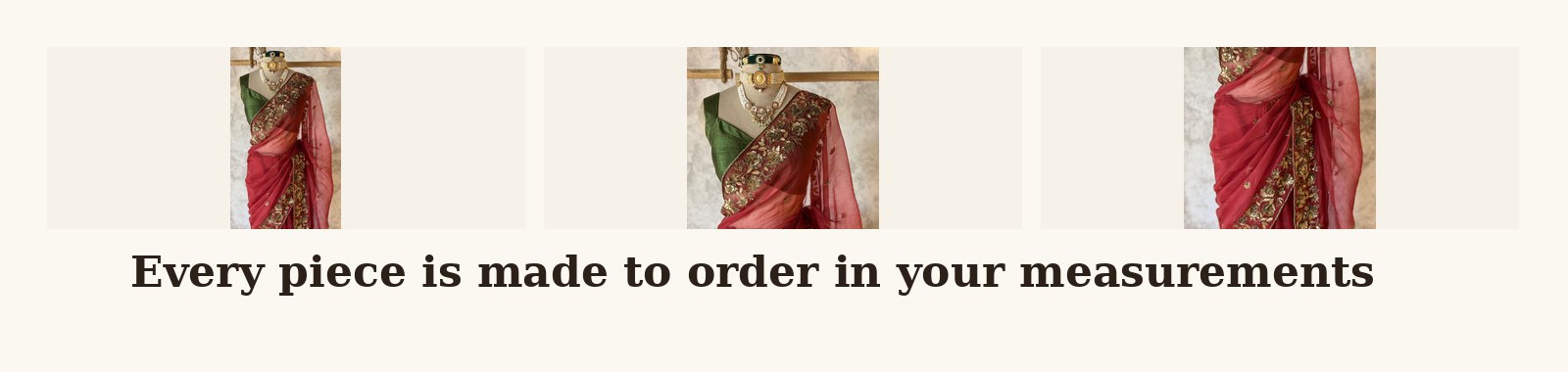
Because everything we make is made to order, we cut the blouse to your measurements rather than adjusting a standard block, and we run a fit check on WhatsApp before the final stitching, while the piece is still with the tailor. Sending your measurements early is the whole trick; a sangeet blouse is not something to leave until the last week.
Changing only the blouse is also the cheapest way to move one saree between two functions. A sleeveless blouse with a plain back suits the dance floor and keeps the shoulders free. For a stage performance, where you are standing still under lights, a longer sleeve and a worked back can carry more. The saree stays the same and the evening changes around it.
Pleats, pallu and pins: the drape that stays where you put it
Drape is where a hand-embroidered sangeet saree is won or lost, and most of it is decided before you leave the house. Set the fall to the exact heel height you will wear, because the heel sets both the hem and the line the pleats break on; a saree set for flats and worn with heels sits wrong all night. Make the pleats a little deeper than you would for a seated function, because a deep pleat holds its line through dancing where a shallow one opens and drifts.
For the pallu, our rule is pin once and leave the rest soft. Pin it at the shoulder only, so the embroidered length still falls and moves; pinning the pallu flat along its width presses the work against you and kills the light-catching detail you paid for. If the pallu carries real weight, wear it on the shoulder you do not lead with — the left, for most people — so the heavier side stays back and off your working arm.
Build a small pin kit and put it in someone else's bag, not your own: a few safety pins, a couple of spare hooks to match the blouse, and a tiny fold of matching thread is overkill but a couple of pins is not. Check the drape by doing one full turn in your heels at home the day before. A single turn finds the loose pin far more reliably than any amount of standing still in front of a mirror.
Six hand-embroidered sarees we would put on a sangeet floor
MYRA RED ORGANZA SAREE, ₹59,500 — the deepest piece on our rail, on crisp silk organza in a red that holds its depth under warm stage light rather than going bright. This is the one for a bride who will be photographed all night, or for the person who has decided she wants to be unmistakable.
NOOR BAHAR ORGANZA SAREE, ₹48,500 — quieter, in silk organza that moves with you, and the piece we would hand a sister or cousin who is on stage for a number and should not compete with the bride.
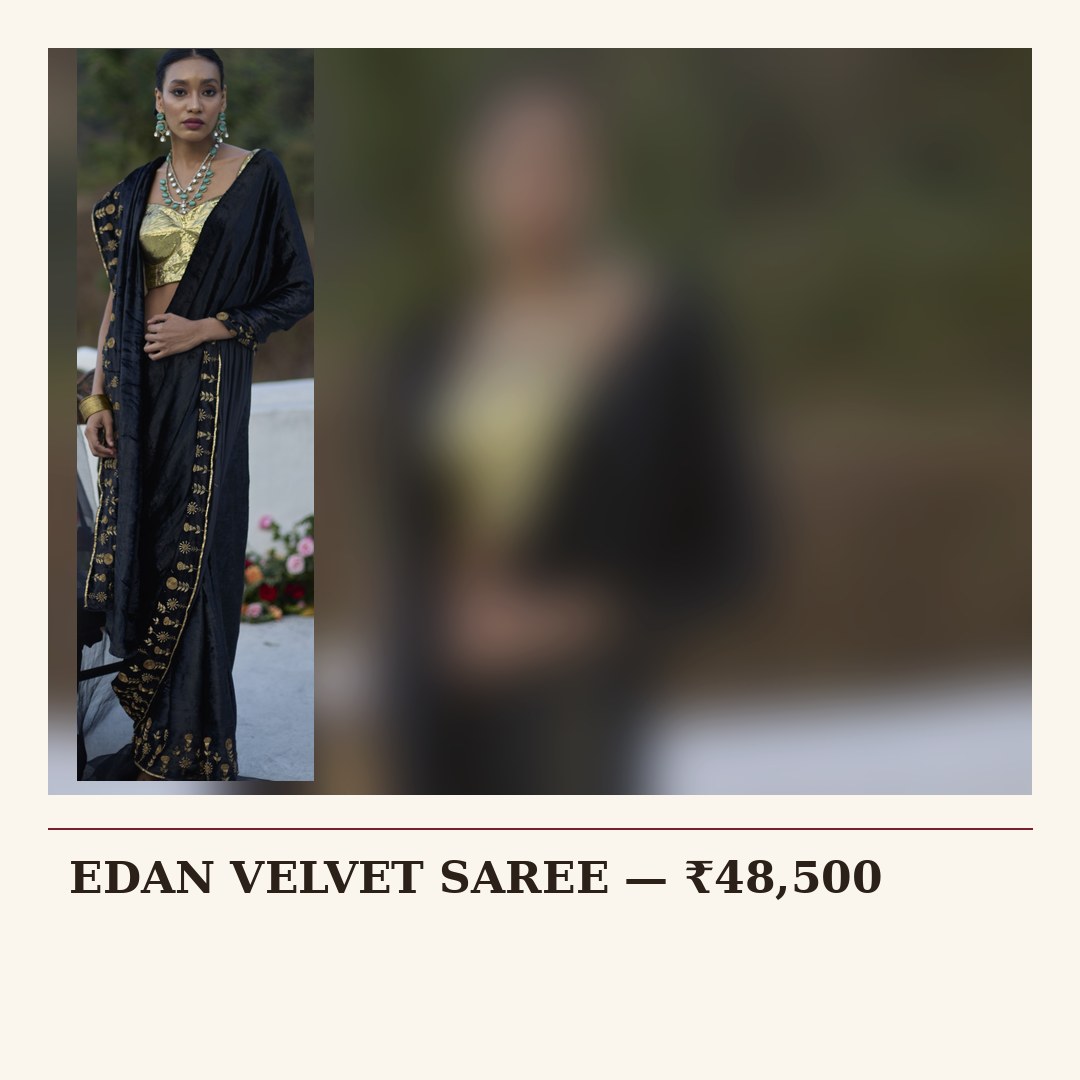
EDAN VELVET SAREE, ₹48,500 — velvet, so it belongs to a winter sangeet, and it takes the heaviest raised metallic work without crowding. Under low light, a deep ground with dense metal is the combination that still reads across a dark hall.
RUQMANI MAROON ORGANZA SAREE, ₹46,500 — maroon on organza, for the guest who wants presence without weight. Keep the blouse plain and let the embroidery make the argument.
GULBAHAR IVORY ORGANZA SAREE, ₹46,500 — ivory, and the most daytime of the six, which makes it right for a mehendi that runs straight into a sangeet evening. Wear it with gold, or with a coral or green blouse when you want contrast.
RUQMANI GULABI ORGANZA SAREE, ₹46,500 — a soft pink organza, easy to move in and easy to photograph, the one we would put on the friends for the chorus number. Behind these six there is a royal blue georgette for anyone who wants a stronger evening colour and easy travel, so tell us your function and your role and we will point you rather than list at you.
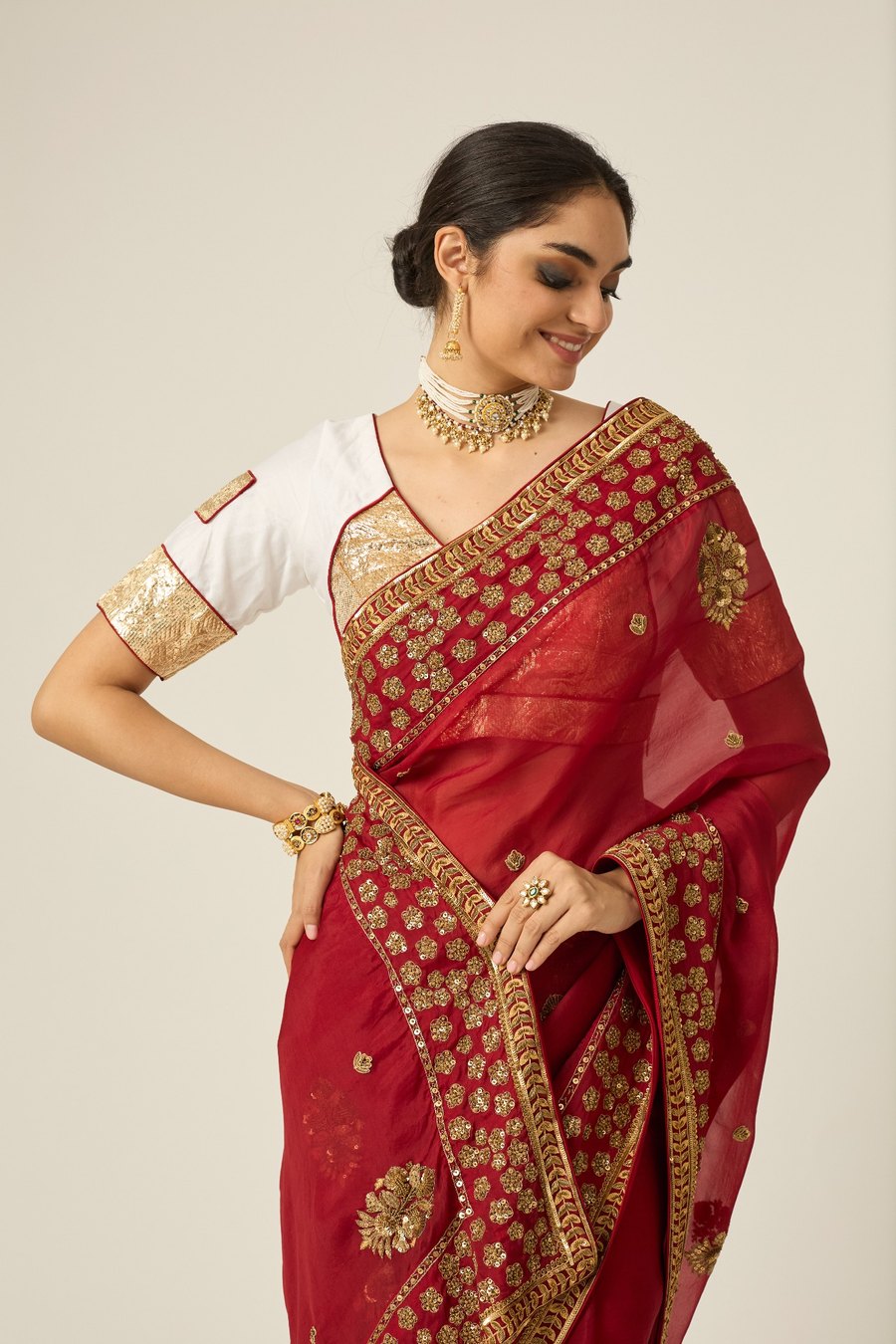
₹59,500
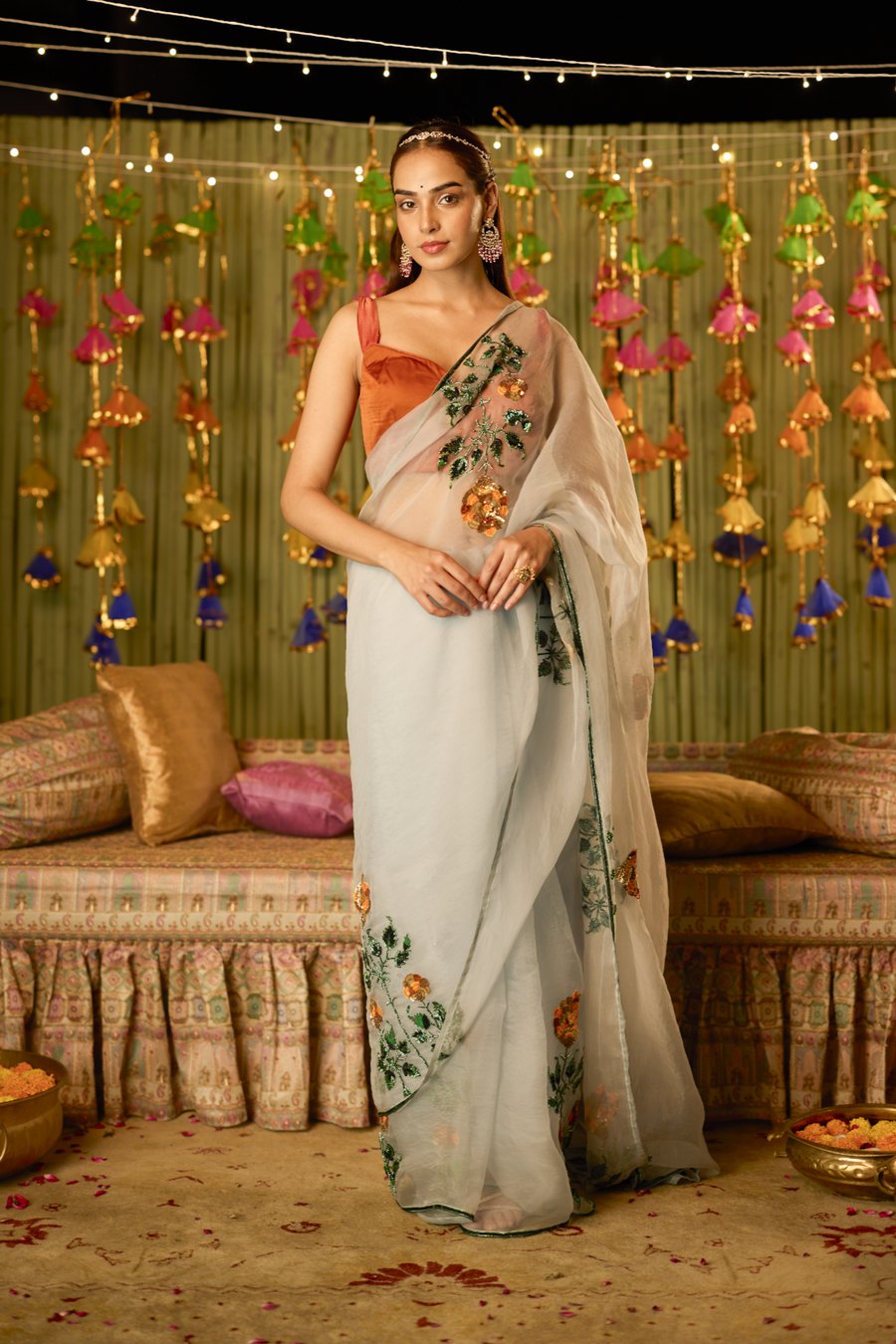
₹48,500
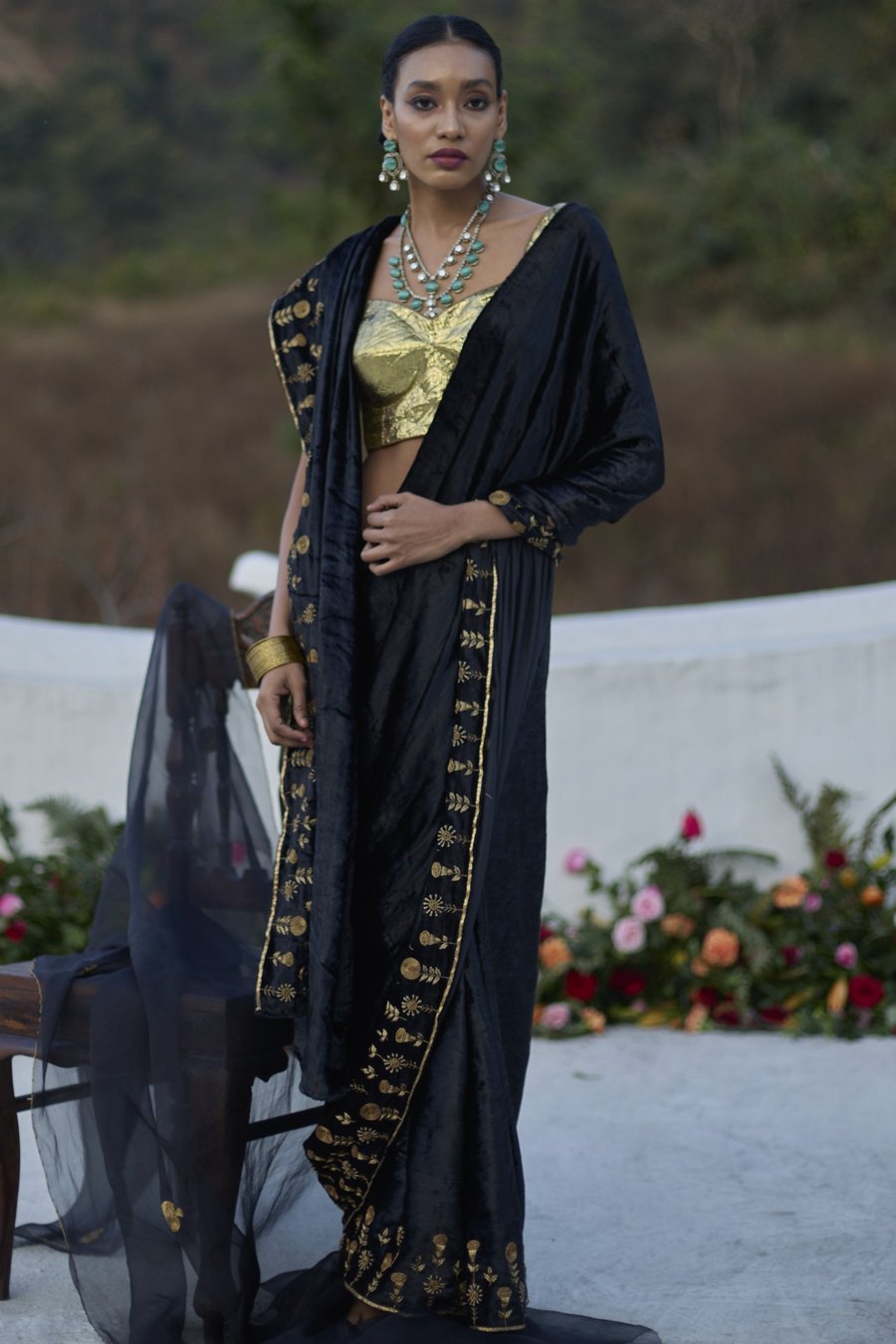
₹48,500
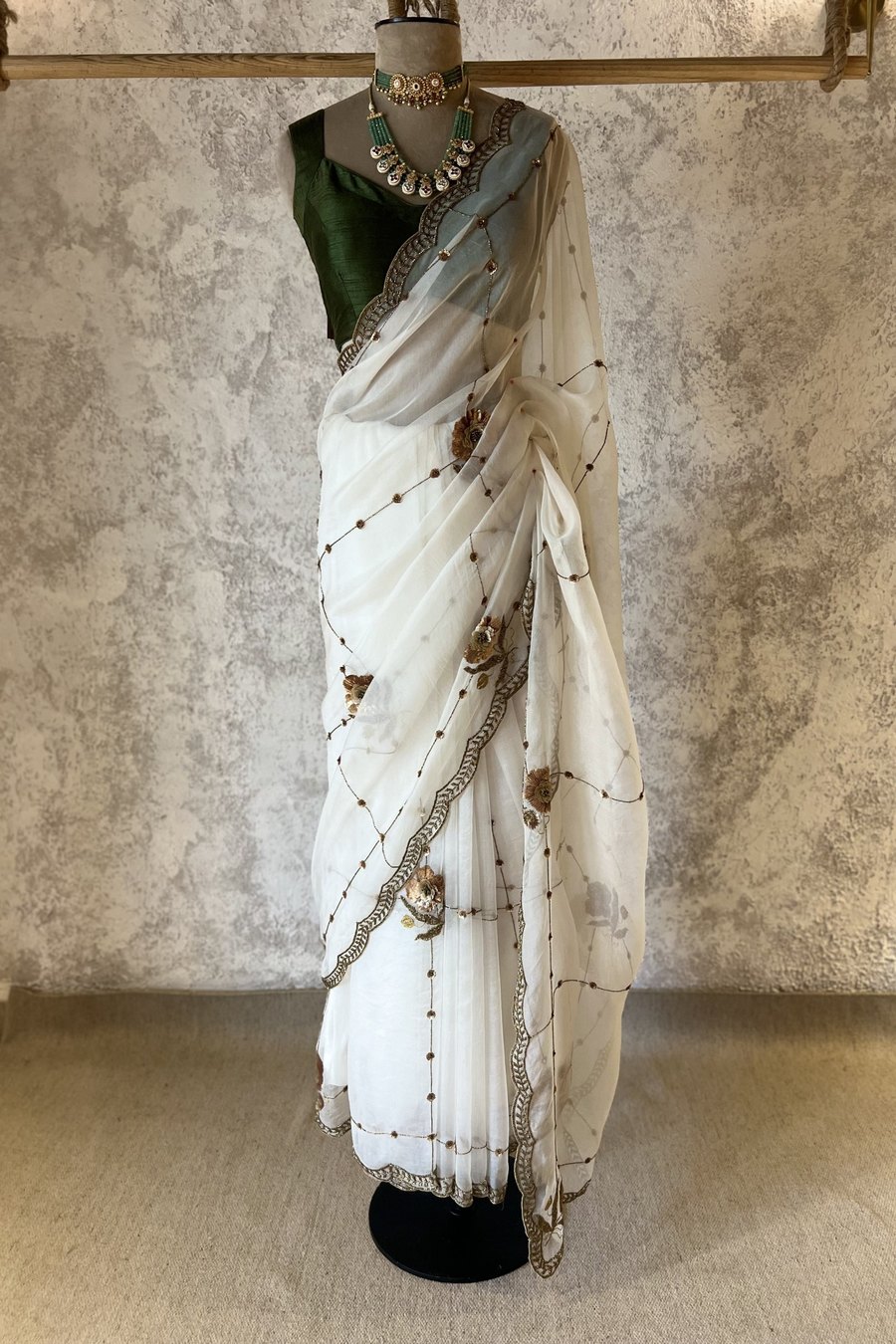
₹46,500
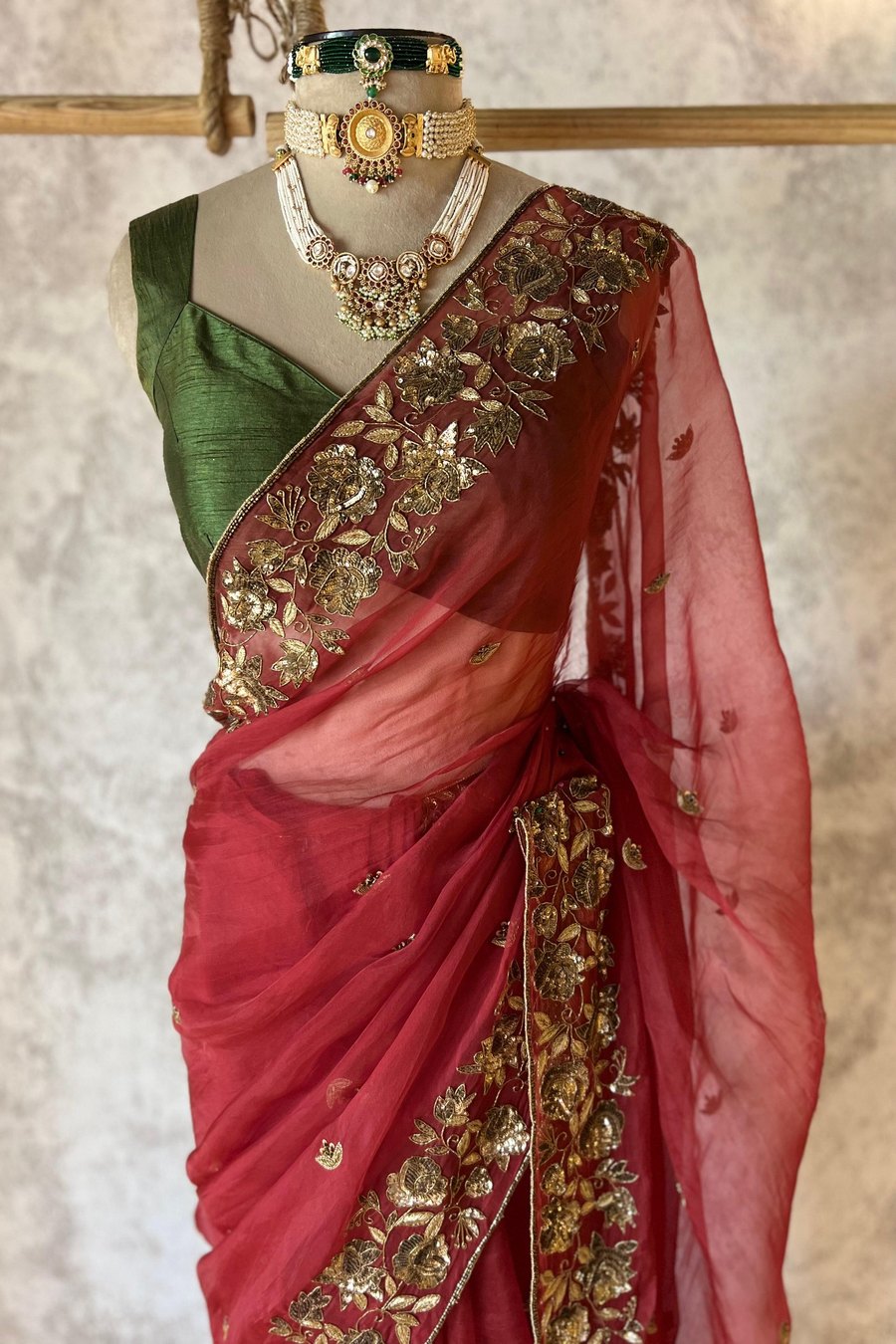
₹46,500
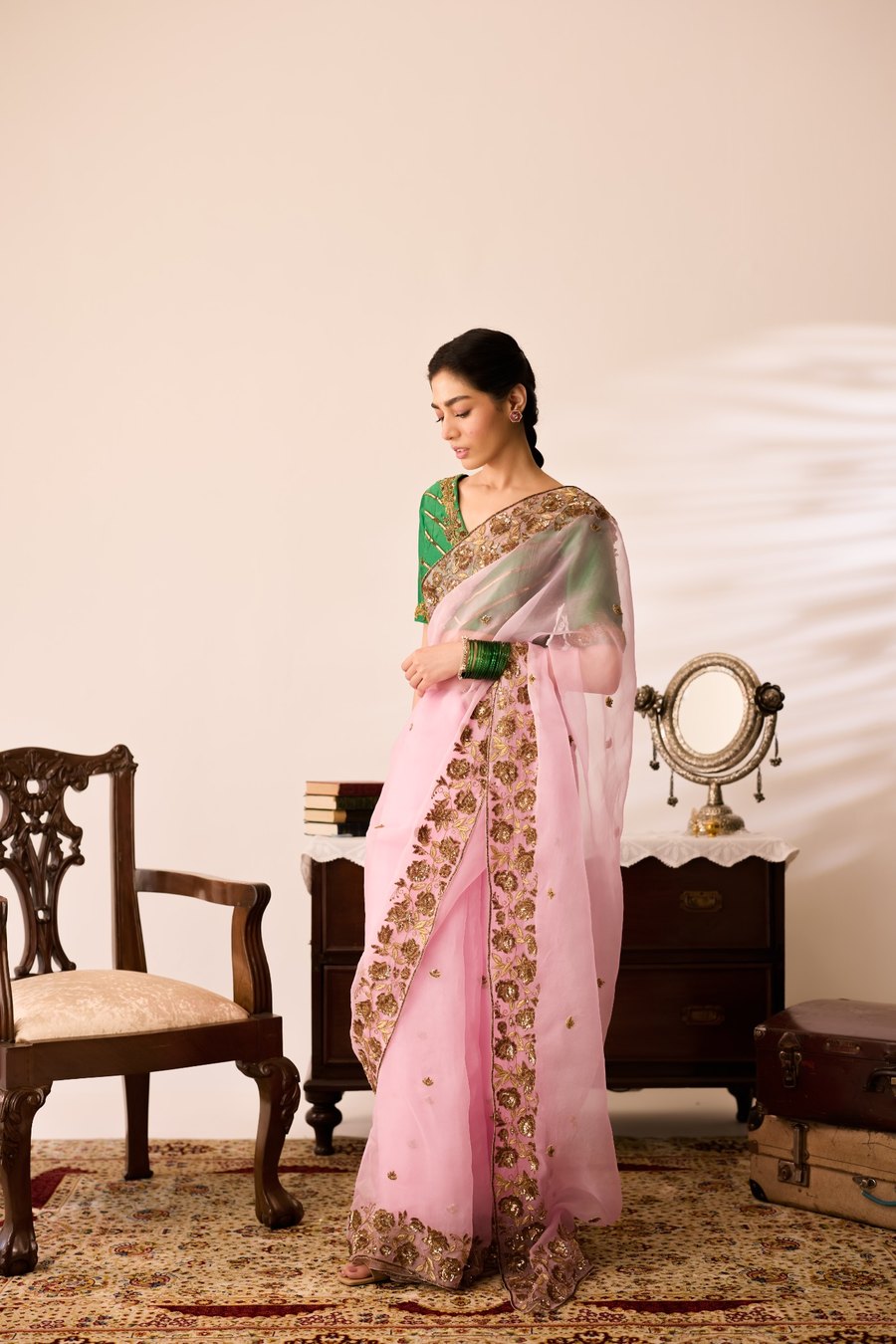
₹46,500
Jewellery, the dupatta, and not competing with the work
With a hand-embroidered saree the simplest rule is to let the embroidery be the shine. That has two practical halves. The first is what not to put against the work: a dupatta finished with a heavy worked edge, a bag with a hook-and-loop fastening, or any brooch or pin with a rough back can catch a raised stitch or a length of ribbon and pull it. If you want a second layer over the shoulder, keep it plain, or take it on the other shoulder from the pallu so nothing rubs.
The second half is the jewellery itself. For an all-over jaal, keep the neckline simple and go long on the earring, so the eye is not competing with itself. For a border-and-pallu piece over a calm body, a worked blouse back and a stronger earring can lead, because there is space to carry them. And keep the metal tones in mind: gold work reads with gold; wearing oxidised or silver jewellery directly over gold zardozi is a finish question as much as a styling one, and it is easier to just keep them apart.
Colour is worth one line. A sangeet is a low-light, warm-light room, and deep grounds — maroon, red, royal blue, black — hold their richness where a pale colour can wash out under stage gels. If you love a light piece, save it for the daytime functions and let a deeper one take the night.
Getting ready, and putting it away
The getting-ready sequence for a sangeet is worth rehearsing once. Blouse first and fastened completely, then the pleats set and pinned, then the pallu, then the jewellery last so nothing snags on a pin as you dress. Decide before the function whether you are wearing the saree full for a performance and gathering it for the floor, and pin it that way from the start so you are not re-pinning in a corridor.
Afterwards, treat the piece the way the work deserves. Dry clean after the season rather than after every function, because every clean is a little wear on the threads. Refold along a different line each time so no single fold takes all the weight. Store it wrapped in muslin rather than sealed in plastic, away from direct light, and hang a heavy piece on a padded hanger between wearings instead of folding it into a stack, since crushing is the real enemy of raised work.
If you would rather choose in person, our stores in Shahpur Jat, New Delhi and Dehradun both carry the season's rail, and everything is cut to order in the same studio, so a sangeet piece can be commissioned to your measurements. Styling help and fit checks happen on WhatsApp when a visit is not possible, shipping is free across India above ₹10,000, and there is an international shipping offer on the site, code INTSHIP, above ₹49,000. The colours come from organic dyes worked by artisan hands, so the piece you choose for the sangeet is one you can wear to the next one.
Frequently asked
How do I style a hand embroidered saree for a sangeet?
Style it for movement and low light rather than for a mirror. Match the styling to the embroidery — flat gota reads in flash, raised zardozi reads under stage light, resham is quieter — cut the blouse for the range of motion dancing needs, set the pleats a little deeper, and pin the pallu once at the shoulder so the worked length stays soft. Then test the whole look with one full turn in your heels the day before.
What blouse works best with a hand embroidered saree for dancing?
One cut to your measurements, not adjusted from a standard block. The armhole needs enough depth that raised arms do not pull the blouse up, the sleeve needs to sit close at the top so it does not ride, and the back must stay closed on its hooks. A sleeveless blouse with a plain back is the easiest for a dance floor; a longer sleeve and worked back suit a stage performance where you are standing still.
Will a heavily embroidered saree be too hot or too heavy to dance in?
It depends more on where the work sits than on how much of it there is. Work concentrated on the border and pallu over a calm body stays light enough to move in and catches the light at the edges as you turn. A dense all-over jaal is heavier and better for a stage moment where you are largely standing. For the floor, take the lighter arrangement.
How do I keep the pallu in place while dancing?
Pin it once at the shoulder and leave the rest of the length soft, rather than pinning it flat along its width — that presses the embroidery against you and kills the light-catching detail. Set the pleats a little deeper than for a seated function, and if the pallu is heavy, wear it on the shoulder you do not lead with so the weight stays off your working arm.
Can I wear the same hand embroidered saree to the sangeet and the wedding?
Yes, and that is often the best reason to buy one. Change what surrounds it: a sleeveless blouse for the dance floor, a longer sleeve and a stronger earring for a seated ceremony, and a plain second dupatta to move it between functions. Because the piece is made to order and the blouse is cut to your measurements, the restyling happens around a saree that already fits.
Explore more: saree — or message us on WhatsApp for styling help.

The information below is required for social login
Sign In
Create New Account