

A hand-embroidered saree almost never fails in the cloth. It fails in the work. The organza or the velvet can be cleaned and pressed and worn for years, but the day a zardozi border goes dull or a gota edge begins to fray, the piece never quite looks the same
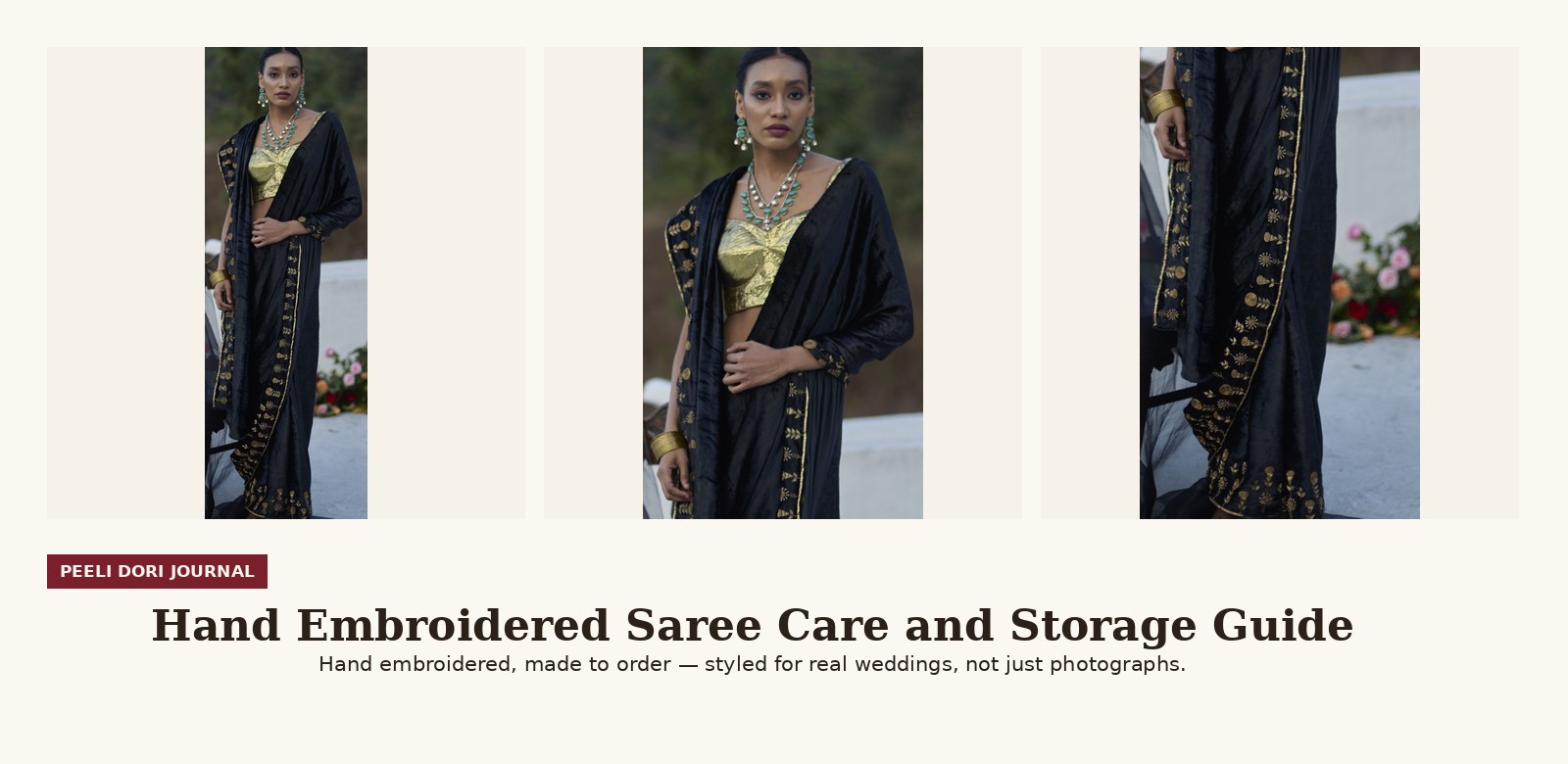
A hand-embroidered saree almost never fails in the cloth. It fails in the work. The organza or the velvet can be cleaned and pressed and worn for years, but the day a zardozi border goes dull or a gota edge begins to fray, the piece never quite looks the same again. So this is not really a fabric-care guide. It is how we look after the embroidery on our sarees at Peeli Dori, and what we tell every customer who asks us how to store a hand-embroidered saree properly.
Why the embroidery decides the routine, not the fabric
Most people who ask us how to take care of a hand-embroidered saree expect a fabric answer — silk this, organza that, velvet something else. The honest answer is that on our sarees the cloth is the easier half of the problem. Organza, georgette, silk tissue and velvet each have a few well-known habits, and once you know them they behave. The embroidery is the part that does not forgive.
Our pieces are worked by hand, and the damage we see is almost never chemical. It is a pin left in a pleat overnight, a blouse hook catching the pallu inside a bag, a fold pressed into the same line for a whole season, a cupboard that stays damp from July to October, a hot iron laid straight on the zari. None of those is a detergent question. They are habit questions.
That is why this guide is arranged around the work first and the cloth second. Get the embroidery right and the fabric follows on its own.
Know what is sitting on the cloth
Before any care advice makes sense, it helps to know what is actually on a piece, because gota, zardozi, dabka and resham want slightly different things from you.
Gota is a ribbon of metal wrapped around thread and stitched flat, which is why it throws light across a border the way it does. It is the most light-sensitive of the traditional work and the one most affected by damp — a gota panel kept in a plastic bag in a humid room will dull long before its time, while the same panel kept in cotton comes out looking as it did.
Zardozi is the heavier metallic thread work, often with small stones or beads set into it. It is weighty, it stands up off the cloth a little, and it is the part that abrades: against a hook, against another saree in the same stack, against itself in a tight fold.
Dabka is fine coiled wire stitched down in small loops, and it catches on things. Anyone who has lifted a dabka work saree out of a bag and seen a loop pulled up on a fingernail knows exactly what we mean. Resham is the silk thread work, softer and quieter, and the one to keep away from water, because a colour can run.
Our pieces are made by hand in these traditions, and the first rule of care is simply that the work — not the cloth — is what you are protecting.
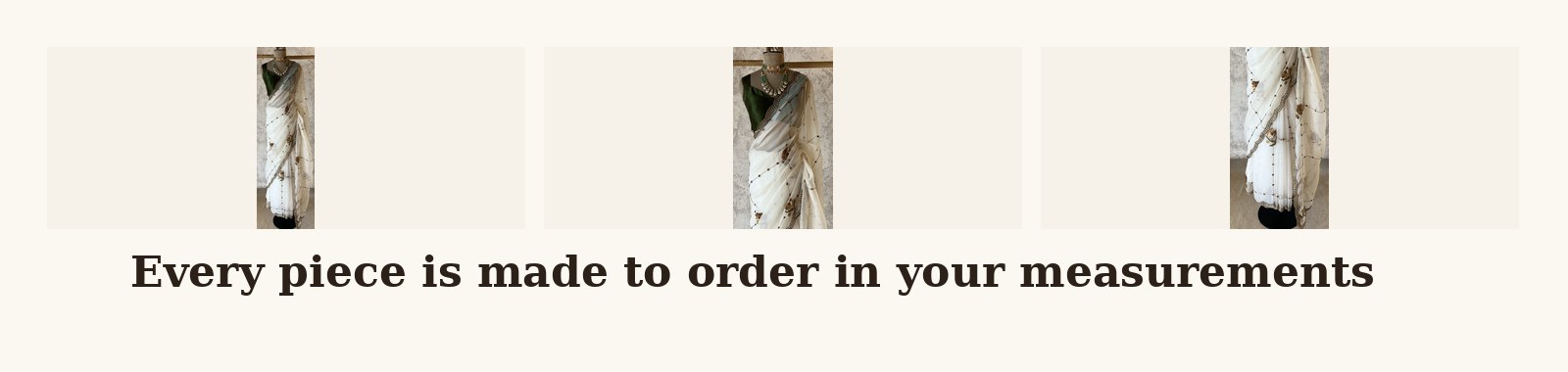
The base cloth still matters
Where the embroidery sits changes how you keep the whole piece. An organza saree, the lightest thing we make, takes and keeps a crease, so it is the one that must be refolded on fresh lines. A velvet saree should not be folded flat at all: folded and left, velvet crushes and the pile never fully lifts, so we roll velvets loosely around a tube of tissue. Georgette sits in the middle — it drapes, it hangs most creases out, and it travels better than either.
Silk tissue is deceptive. It looks delicate and it is, but it also takes a heat set badly, so a piece on a tissue base wants shade and a low iron rather than an afternoon in a hot car. Plain silk organza responds to steam and drops its creases on its own; a synthetic organza holds a fold more stubbornly and likes heat even less.
Organic dyes are part of how our pieces are coloured, and a dyed ground generally prefers to be kept out of long, direct sun between wearings. A cupboard, not a display shelf by a window, is the right home for one.
The function itself, and the hour after
The evening a piece is worn is when most of the damage you cannot fix happens. Pin as little as possible. With a made-to-order blouse cut to your measurements you need far fewer pins than with a ready blouse, and every pin is a small strain on the weave and a small risk of a rust mark if it is left in.
Take the saree out of its creases as soon as you are home. Open it fully, give it a shake, and let it air for a few hours in a shaded room. If the evening was warm and long, the waist pleats will have taken up moisture even when the cloth does not feel damp, so air it a little longer. Keep the blouse away from the saree that first night so the hooks and eyes cannot catch the pallu.
Blot spills at once. Use a clean dry cloth, press from the outside in, do not rub, and do not reach for water or a home stain remover on an embroidered panel — you can lift the cloth and dull the metal in the same motion.
Cleaning: what we advise, and what we refuse to do
Dry clean, and less often than most people expect. Repeated dry cleaning is harder on handwork than a couple of wearings, so we advise cleaning a piece at the end of a season rather than after every function. Between events, a day of airing and a fresh fold is usually the whole job.
We never recommend washing an embroidered saree at home, not even the slow hand-wash that is fine for plain cotton. Water can mark the ground, soften the drape and loosen work that was stitched thread by thread; a resham colour can run; uncushioned rubbing can flatten a dabka loop for good. If something has to be treated, it should be treated by someone who knows handwork.
Three things we would not do to any hand-embroidered piece: bleach it, spray perfume or deodorant directly on the embroidery, or press an iron straight onto it. Perfume and heat dull metal work faster than age does, and there is no way back from a flattened zari. When a piece goes to a cleaner, say plainly that the work is hand done and where it is heaviest; a good cleaner will do the blouse and the saree as separate pieces and press through a cloth.
Storing it so the work survives decades
Store in cotton or muslin, never in plastic. Plastic holds moisture against the cloth and keeps it there, which is exactly how you get dulled gota and a faint smell by the next wedding season. A plain pillowcase is honestly fine. Slide soft white tissue along the folds, and put cloth or tissue between one embroidered saree and the next so metal cannot catch on thread.
Fold along a different line every time, and this is the single most useful habit in the whole guide. Left on the same crease for a season, a heavy embroidered panel will remember that line permanently. Move the folds a few inches each time you put the saree away and no single fold ever sets. Velvet is the exception — roll it, do not fold it.
Store flat in a stack, heaviest at the bottom, somewhere dark, dry and airy: not against a window, not against a damp external wall, and not with a naphthalene ball pressed into the cloth. If you must hang a light piece for a season, pad the hanger and take it down again at the end of the season rather than leaving it up for a year.
Finally, open the stack and refold long-stored pieces at the start of every season. Twenty minutes before the weddings begin catches anything that has started to set, and it tells you early if a piece wants cleaning before you discover it three days before a function.
Six hand-embroidered sarees, and how each one wants to be kept
The heavier the work, the more all of the above matters. MYRA RED ORGANZA SAREE at ₹59,500 is the deepest and most worked piece on this page, and it is the one we would always store flat. NOOR BAHAR ORGANZA SAREE at ₹48,500 carries its work a little lighter and can take a padded hanger for a short season if you have nowhere to lay it.
EDAN VELVET SAREE, our black velvet at ₹48,500, is the piece to roll rather than fold — velvet is unforgiving of a crease left in place, and this one rewards being kept on a tube with tissue at every turn. GULBAHAR IVORY ORGANZA SAREE at ₹46,500 is the one to air most carefully; on a pale ground you will see the first sign of a damp cupboard long before you would on the darker pieces, which makes it the saree to check first each season.
RUQMANI MAROON ORGANZA SAREE and RUQMANI GULABI ORGANZA SAREE, both ₹46,500, sit in the middle: worked enough to need tissue at the folds, light enough that airing them is all they ask between functions. If you want something that travels easily, the NISHKA ROYAL BLUE GEORGETTE SAREE at ₹46,500 hangs its creases out in a hotel bathroom and is far less fussy in a case than organza.
Each of these is a single product page with its own measurements, so open the one you are considering and take the detail from there rather than from a paragraph. If you would like help choosing between a worked organza and a velvet for a particular function, message us on WhatsApp — we do fit checks and styling help there.
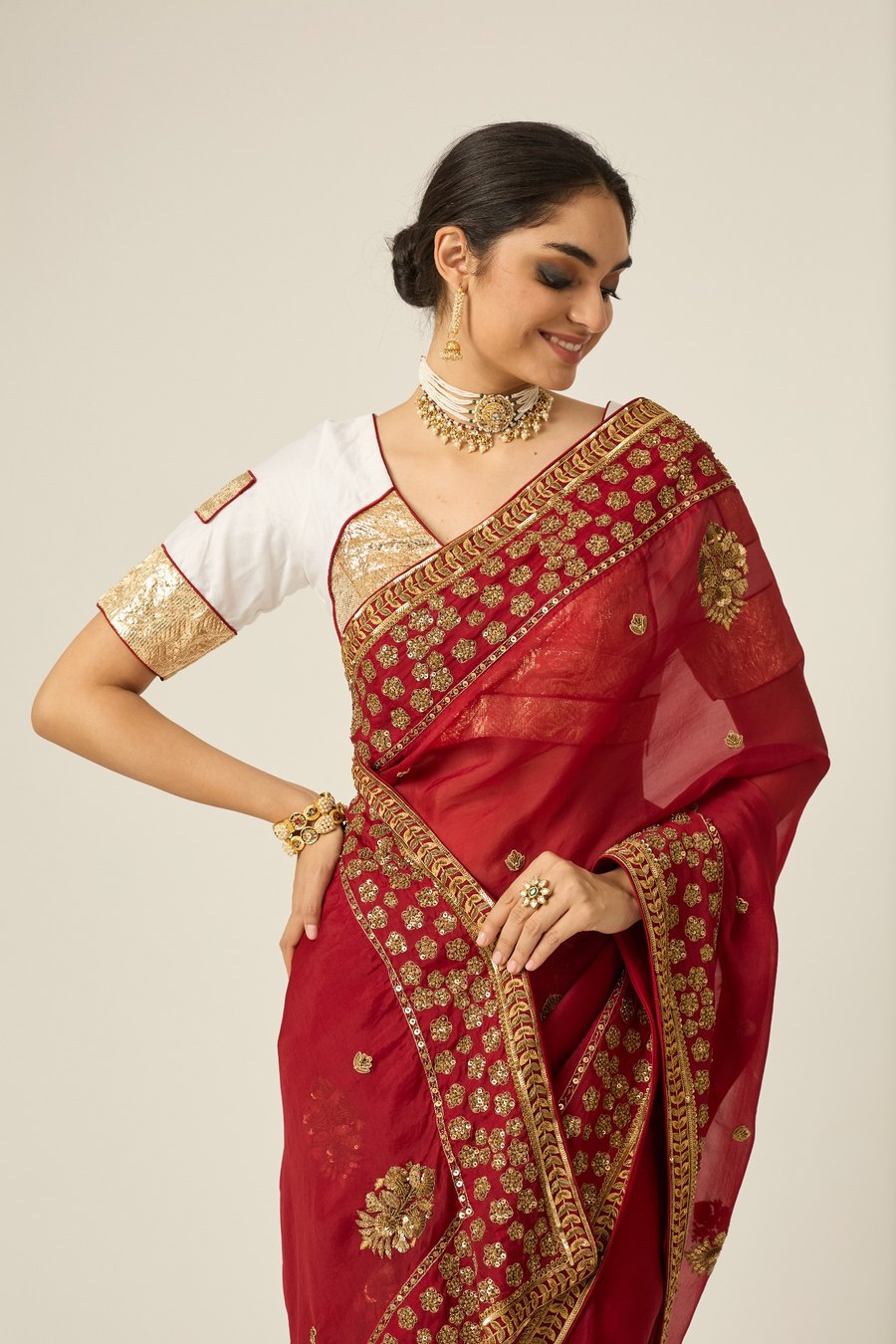
₹59,500
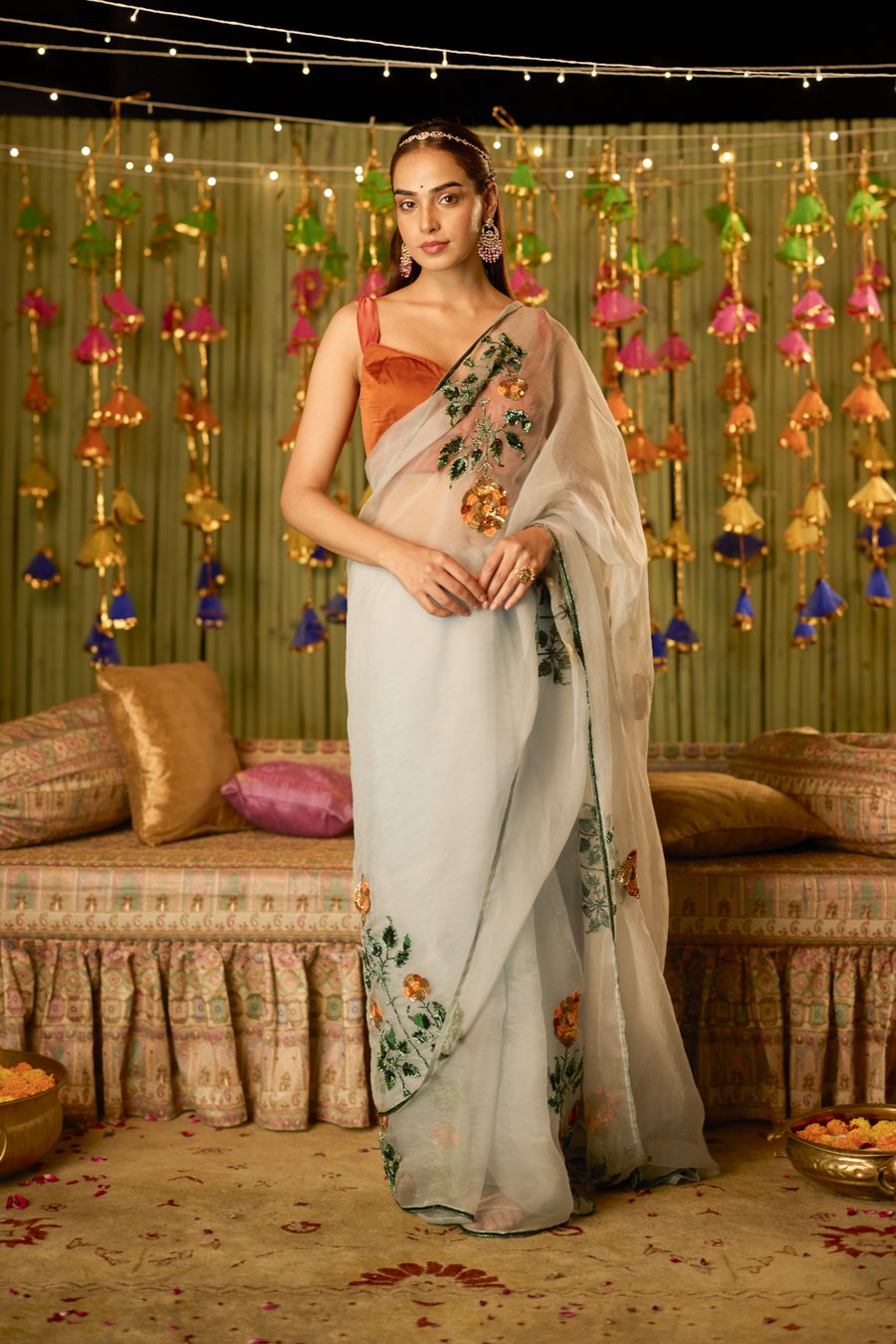
₹48,500
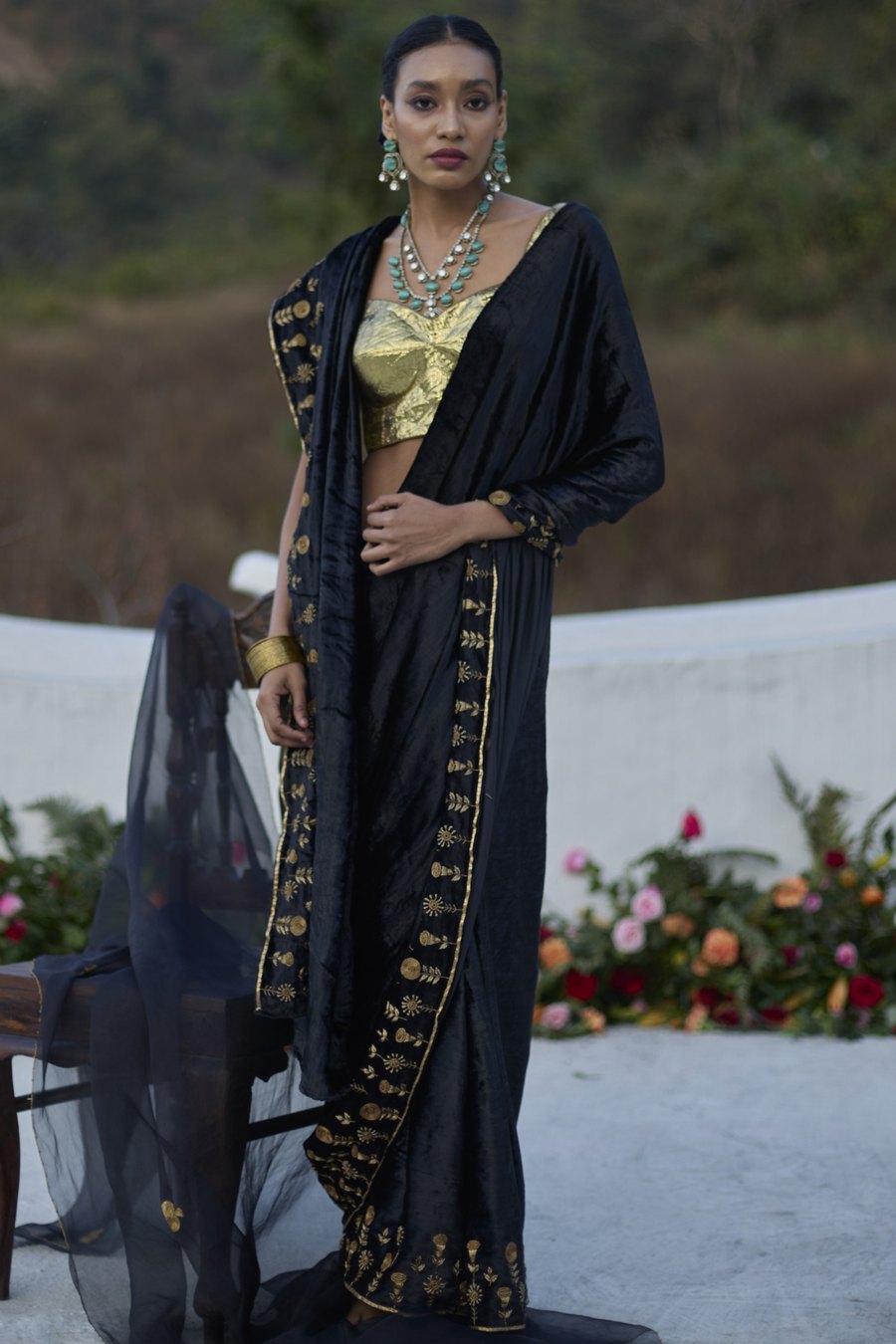
₹48,500
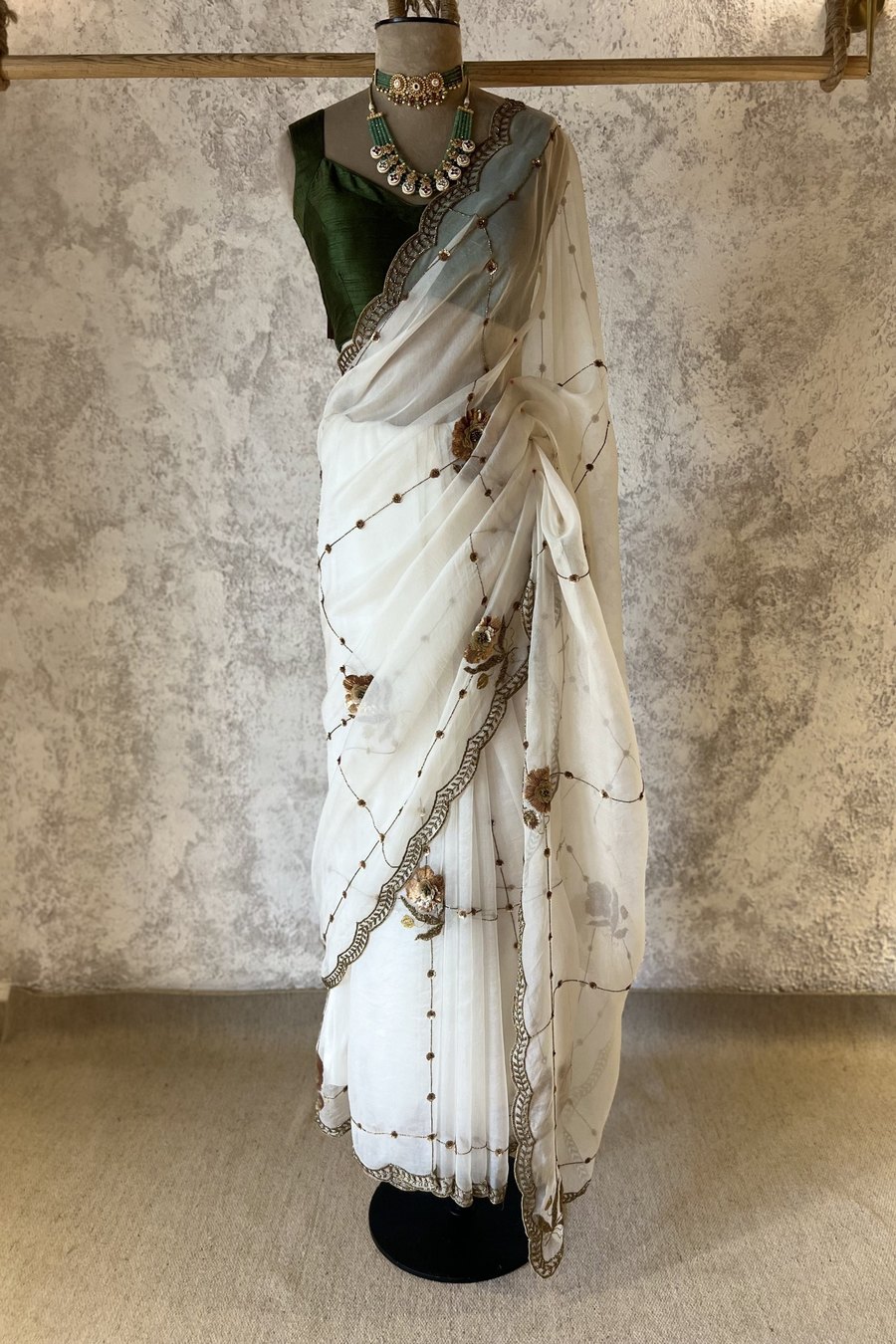
₹46,500
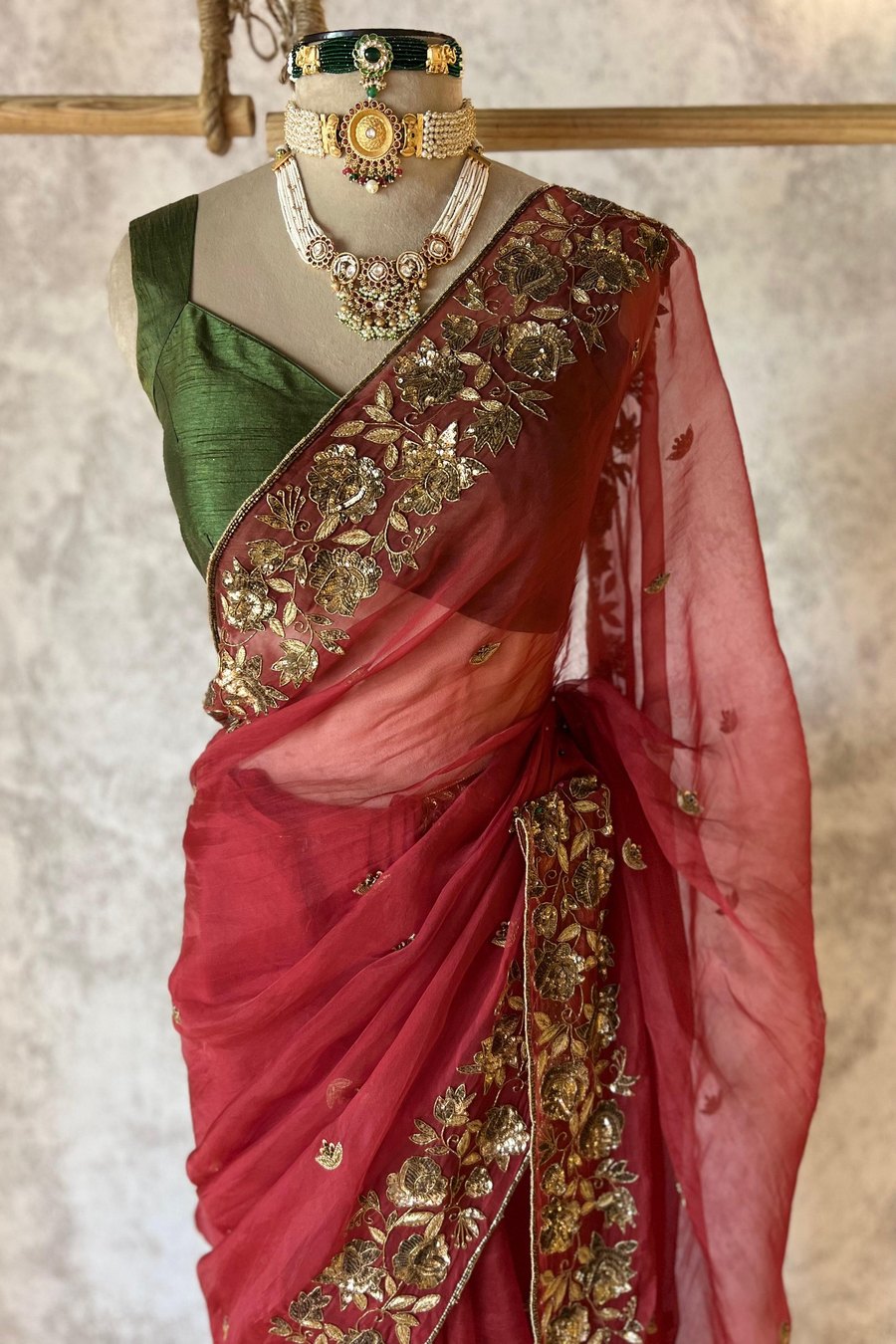
₹46,500
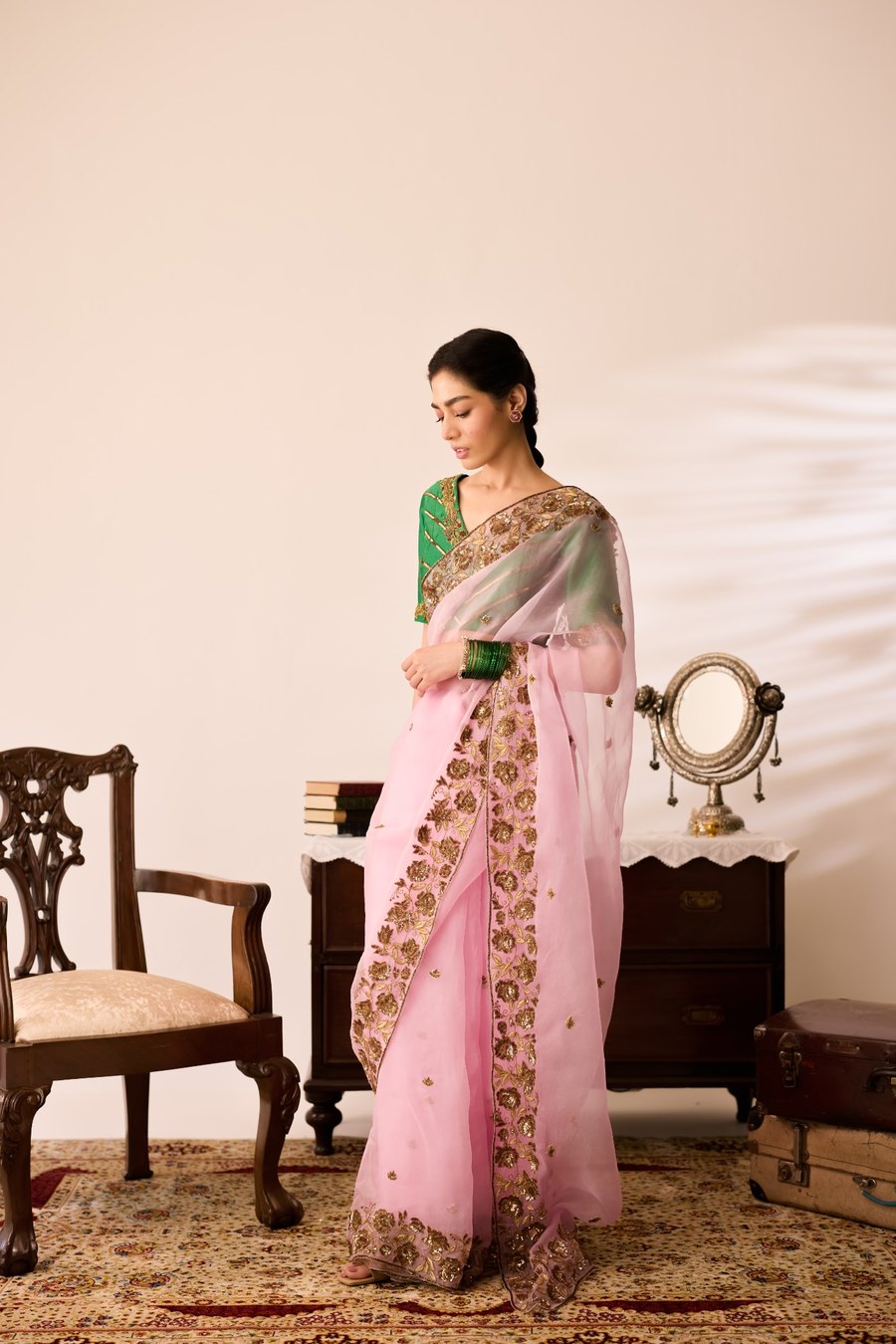
₹46,500
Buying a piece you intend to keep
Because our sarees are made to order with custom sizing, the care story starts before the piece arrives. Tell us the sleeve length, the neckline and the back you want at the ordering stage; it is straightforward to shape a blouse to you then and awkward to change once the piece is finished. Free shipping applies above ₹10,000 across India, and for international orders the site banner carries the code INTSHIP above ₹49,000.
If you would rather see the work in person — and handwork is worth seeing in daylight — we keep both stores open, in Shahpur Jat in New Delhi and in Dehradun. A hand-embroidered saree is a slow purchase. Treated the way this guide describes, it is also the one that outlives the trends, which is the whole point of buying it.

Frequently asked
How often should I dry clean a hand-embroidered saree?
Less often than most people do — once at the end of a season is usually right, not after every function. Repeated cleaning is harder on handwork than wearing the piece a few times. Between events, airing it for a day and refolding it is normally all it needs.
Can I wash a hand-embroidered saree at home?
No, please don't, not even by hand. Water can mark the ground, change the drape, dull metal work and loosen stitching, and a resham colour can run. Blot a spill with a dry cloth, do not rub, and let the piece dry flat in the shade before taking it to a cleaner who works with handwork.
How do I store a hand-embroidered saree so the work doesn't dull?
In cotton or muslin rather than plastic, flat in a stack, somewhere dark and dry, with tissue along the folds and cloth between one embroidered saree and the next. Fold on a different line each time, refold the pieces when the season starts, and never press a naphthalene ball into the cloth.
Can I iron a hand-embroidered saree?
Never directly. Steam it and let it hang, or have it pressed through a cloth at low heat by someone who knows there is handwork underneath. A direct hot iron flattens the zari and dulls metal work, and neither can be undone.
How do I stop the embroidery catching on my blouse or on other sarees?
Keep the blouse separate from the saree on the night you wear it, use as few pins as the drape allows, and separate embroidered pieces with cloth or tissue in storage. Sharp metal and other metal work are what most often catch hand embroidery — far more often than age.
Explore more: saree — or message us on WhatsApp for styling help.

The information below is required for social login
Sign In
Create New Account