

Chidiya is the name of our collection of sarees where the embroidery is scattered across the whole cloth instead of gathered at the border — a bird on one, a zebra on another, a daisy on a third. The things that tie them together are the way the work sits and
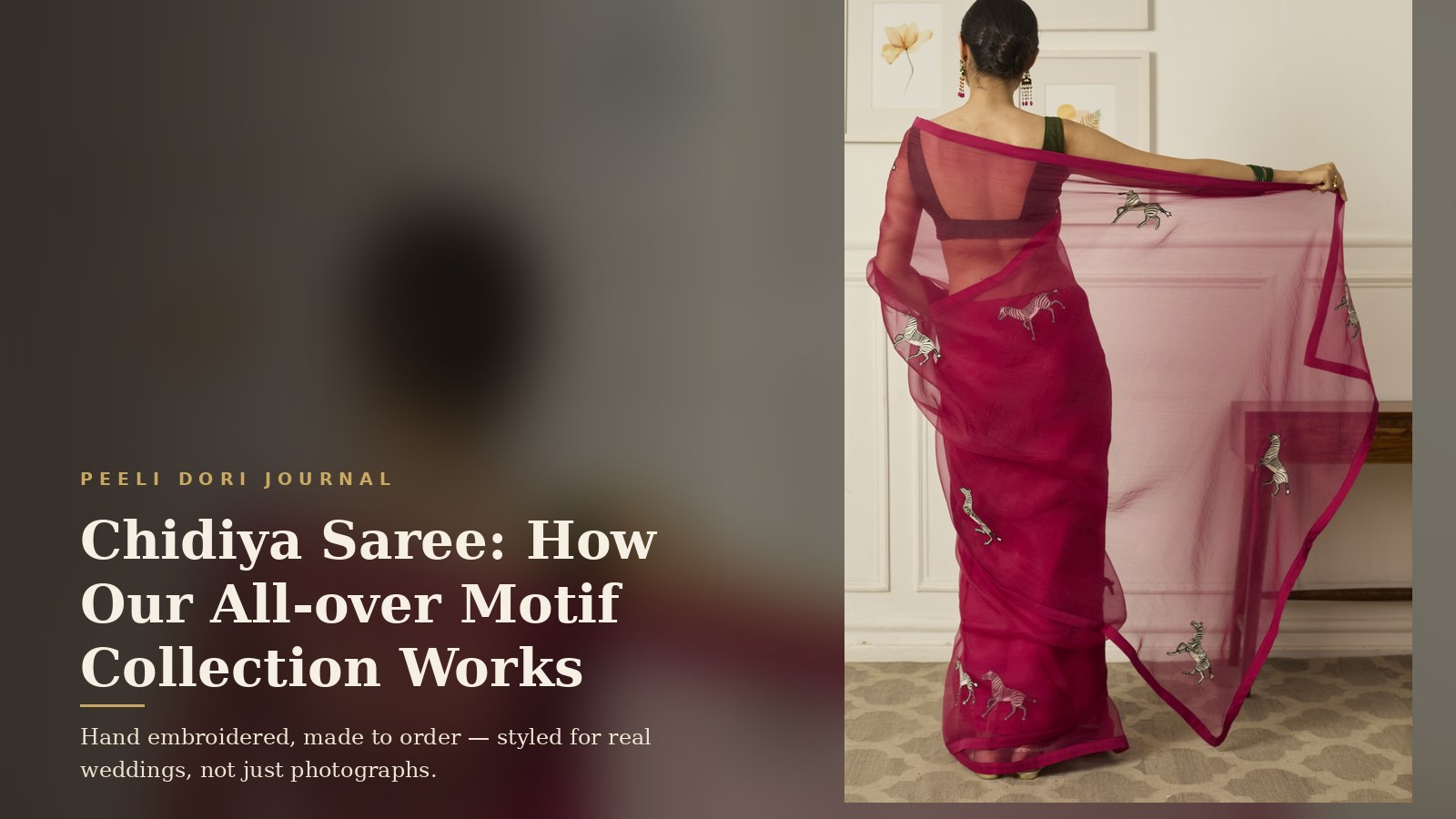
Chidiya is the name of our collection of sarees where the embroidery is scattered across the whole cloth instead of gathered at the border — a bird on one, a zebra on another, a daisy on a third. The things that tie them together are the way the work sits and the way that changes which blouse, which function and which drape actually work. Here is the honest version, including what the name does and does not mean.
First, what the name means — and what it does not
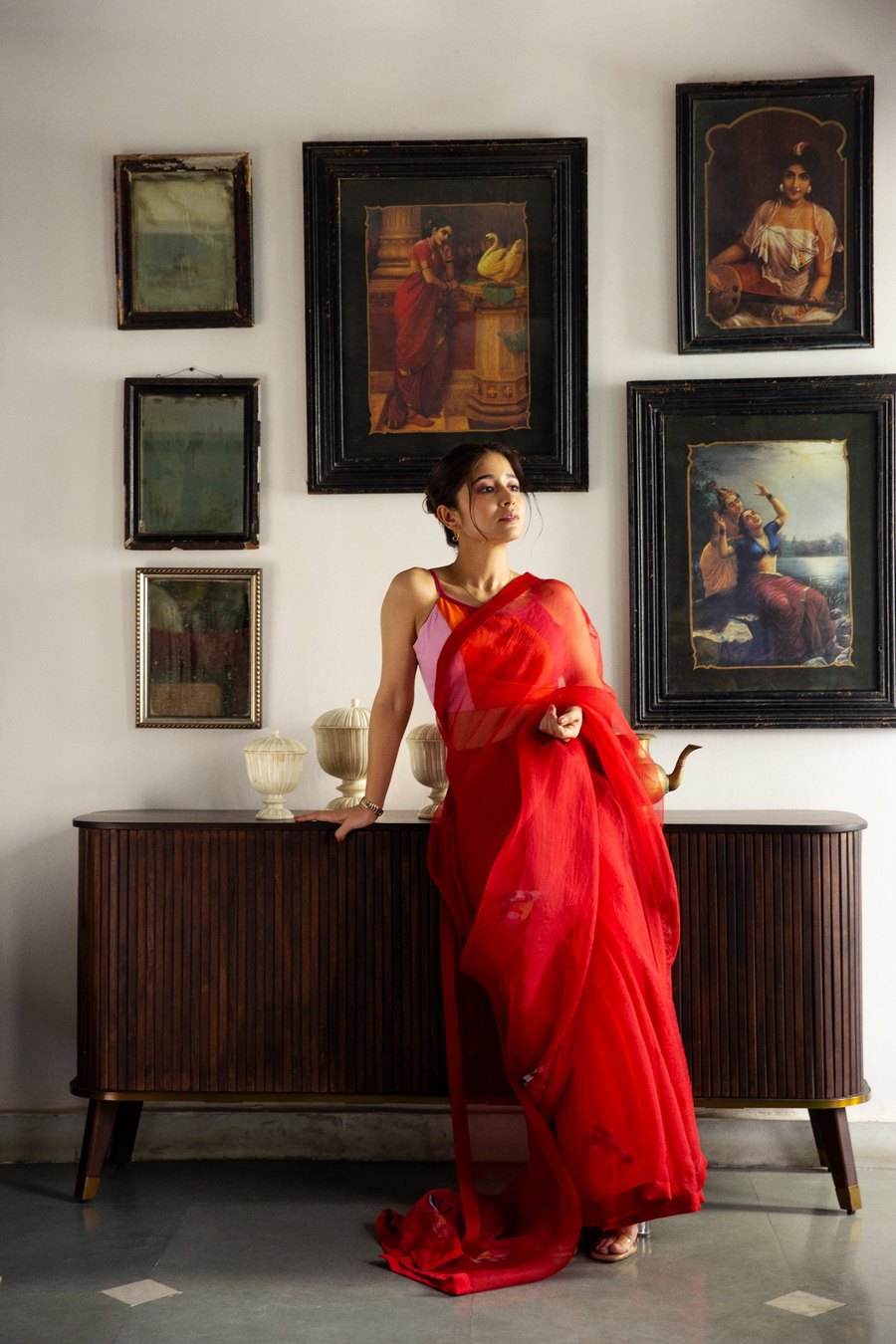
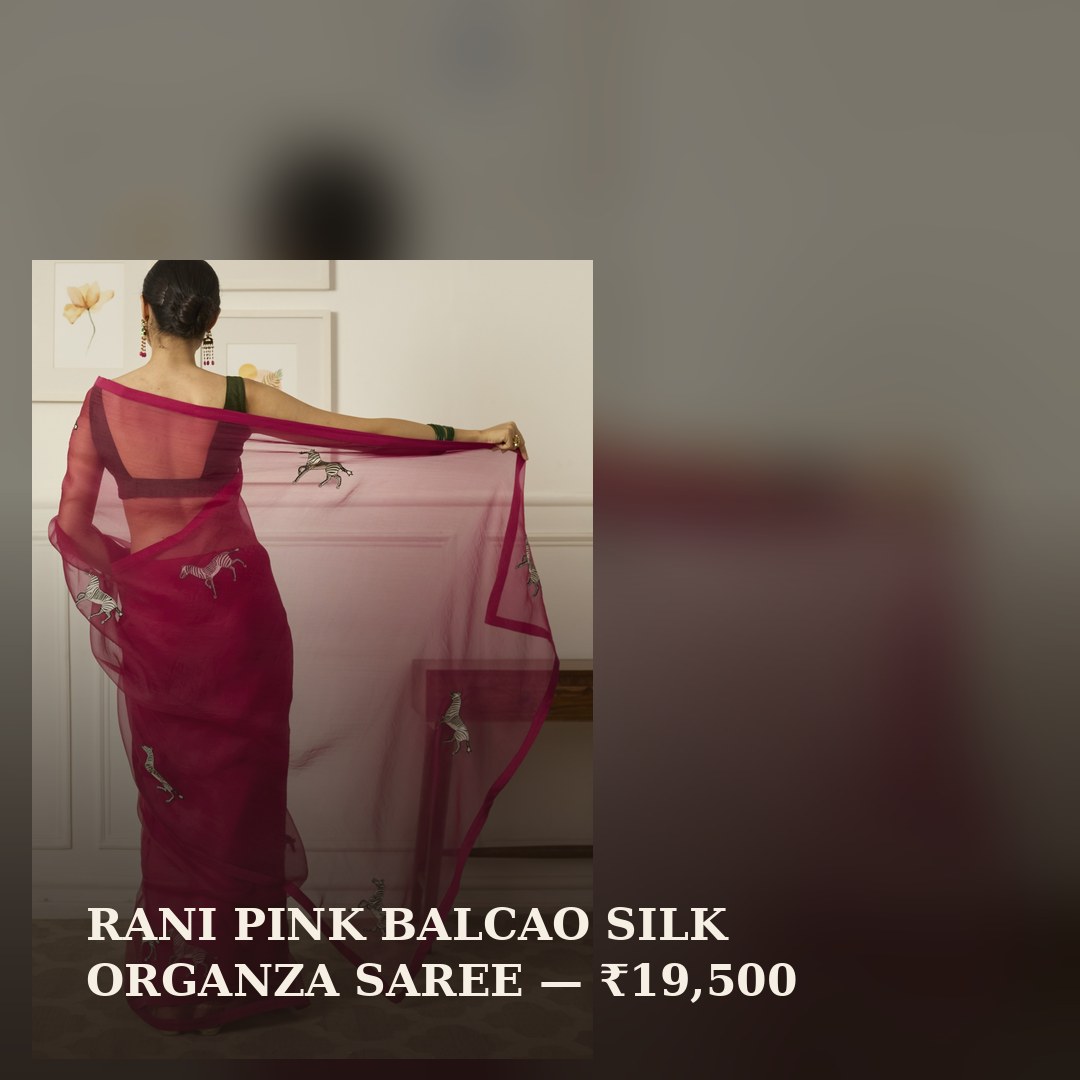
Chidiya means bird. On the saree the collection is named after, the name is literal: resham hand embroidery worked as small bird motifs and scattered over the whole field of a crimson silk organza. The piece is made in the old sense of the word — a border faced in satin, work that runs from the palla to the hem rather than sitting in a band at each end — and the collection took its name from it.
So if you searched for a chidiya saree and you had a different label in mind, one with a similar-sounding name, that is not us, and we would rather say it in the second paragraph than have you find out after a conversation. CHIDIYA is our own collection name. It covers seven hand-embroidered sarees in the shop, each built around a single motif repeated across the cloth, and it is one of the two named collections we keep for this kind of work.
What the seven share is a design decision: all-over embroidery. That decision is the thing worth understanding before you spend money on one, because it changes how the saree behaves on the body and what you can wear it to, and almost nothing written about sarees explains it.
What all-over embroidery does that a border does not
Most hand-embroidered sarees are built around edges. A border at the feet, a worked palla, sometimes a small buti dotted across the body. The eye is led to two bands, and the middle of the saree is left as cloth. An all-over saree reverses that arrangement. The motif repeats in every metre, so there is no quiet field anywhere, and the palla is not visually more important than the knee.
The first consequence is weight. A heavy border weights one end of the saree, which is what makes a palla fall the way it does in photographs. With all-over work the weight is spread evenly, so the drape comes from the pleats at the waist and from the stiffness of the cloth rather than from a heavy end. On silk organza that works in our favour, because organza already stands slightly away from the body and holds a fold instead of collapsing into it.
The second consequence is what the saree reads as from a distance. All-over work at ten feet looks like texture. Up close it becomes individual stitches, and the motif resolves. Which means these sarees photograph well in daylight and in a hall, and they do not compete with a bride's zardozi, because a bride's work is a different kind of attention entirely.
The third consequence is practical. There is no band of embroidery to rub against a chair, a car seat or another person's jewellery, so the wear points are spread out. That is good for the life of the piece and bad for one thing only: the motif at the hem, which is the part that touches the floor.
The cloth and the work
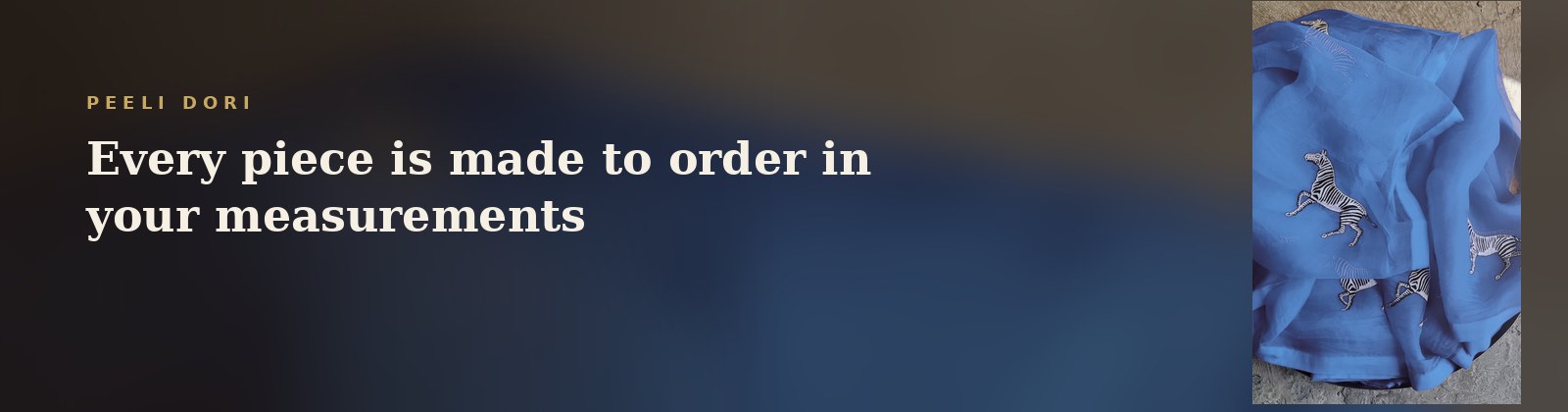
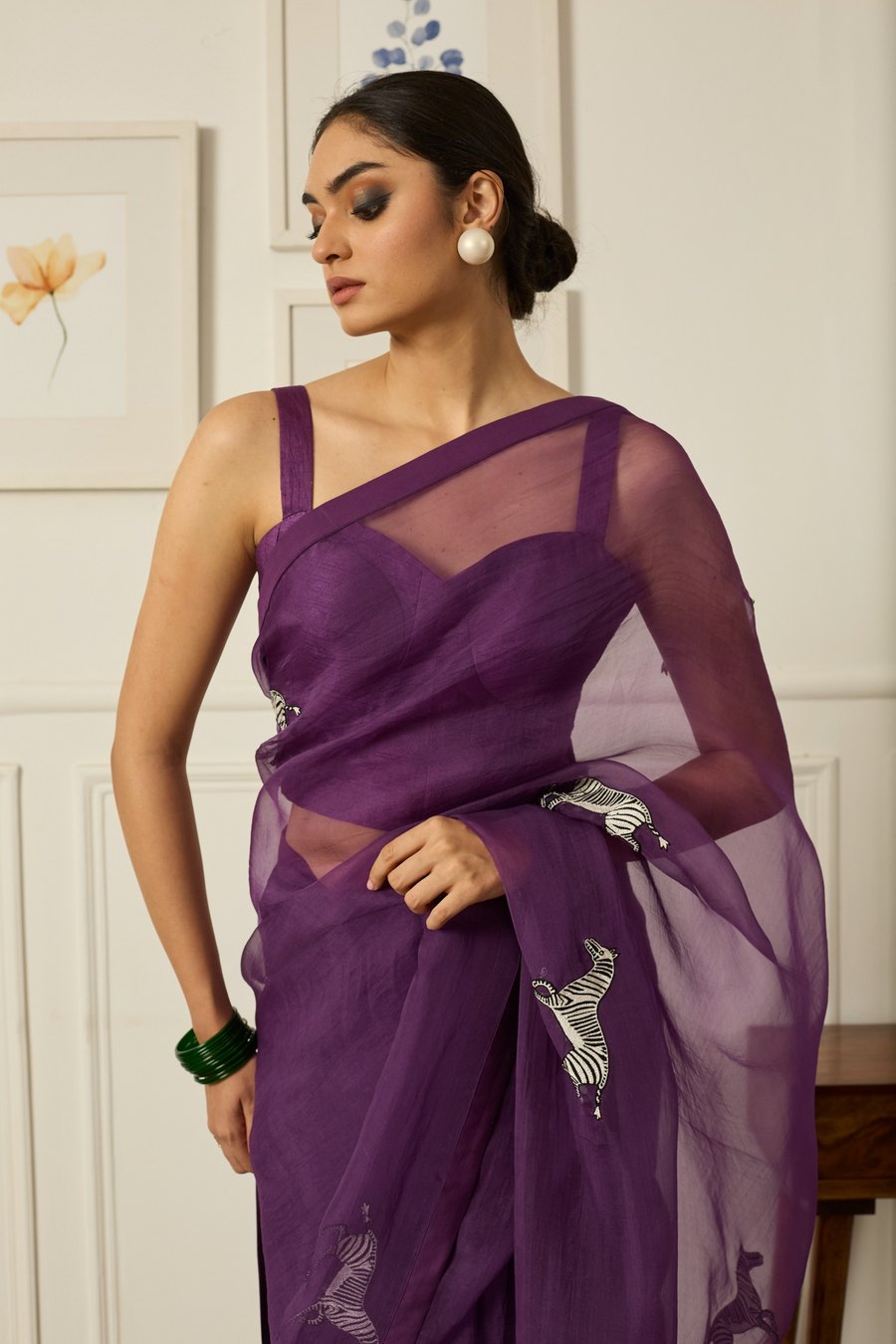
Every saree in the collection is silk organza, dyed with organic dyes and hand embroidered. Organza is a plain weave in fine silk, finished stiff. It takes colour deeply, which is why the crimson, the iris purple and the peacock pink in this collection look saturated rather than washed. It is also semi-sheer, so it needs a lined blouse and a petticoat matched to the saree rather than to the blouse, and colours that you are content to see a hint of in daylight.
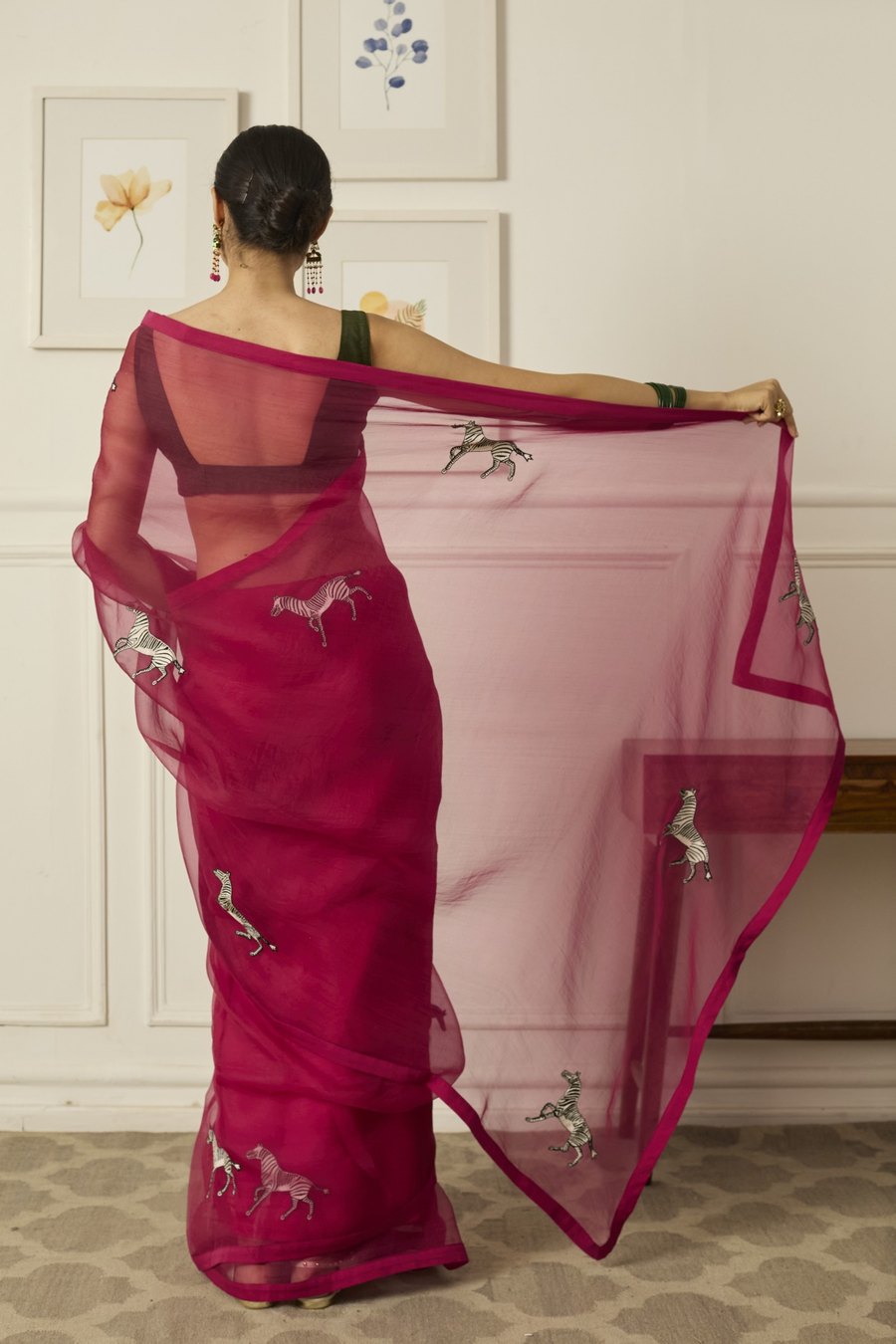
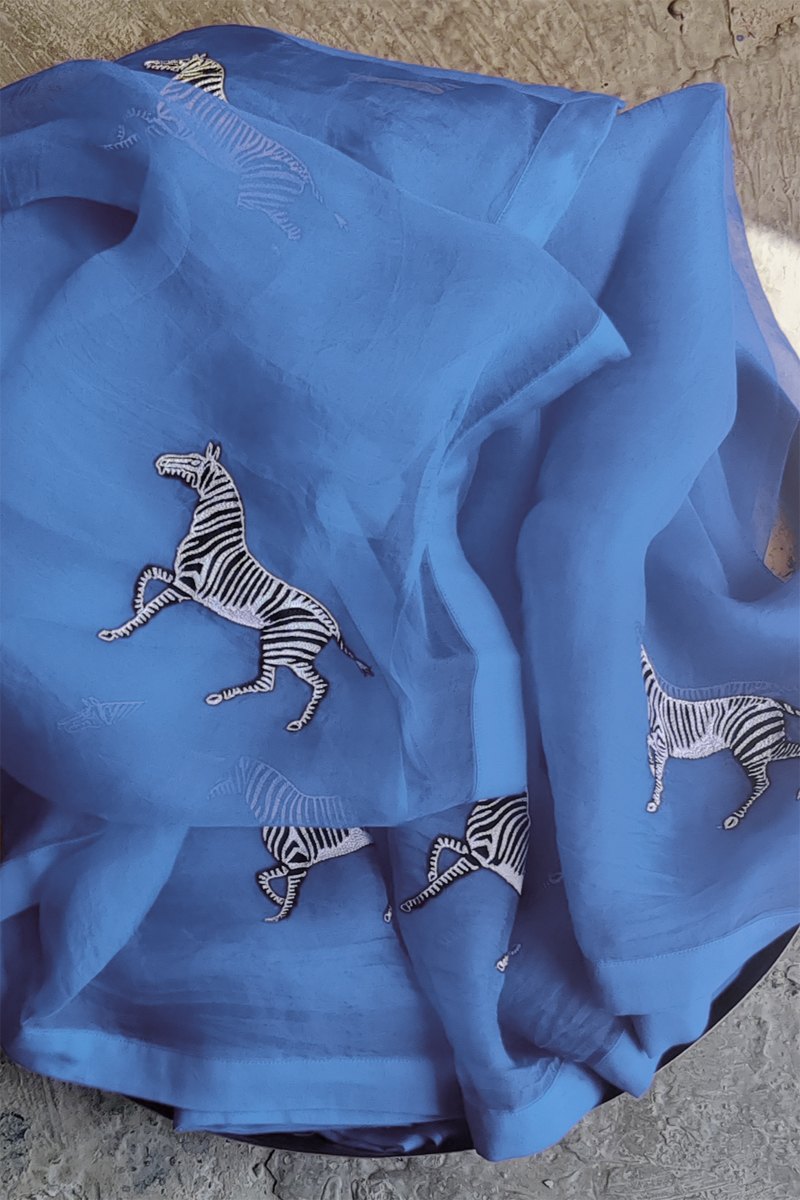
The work differs piece by piece, and the difference is worth reading before you choose. The zebra pieces are stitched in resham double thread, which gives the motif a raised, almost carved edge. The ivory La Rose carries fine thread and beadwork in French florals, so the surface is quieter and catches light in points rather than in lines. The old rose Zeenat uses zari with white pearls scattered through it, which is the most formal of the seven under evening light.
Three checks are worth doing on any all-over saree, ours or anyone's. First, density: the work should be even from palla to hem. If it thins near the bottom, the piece was cut to a budget. Second, the back of the cloth: turn it over, and the reverse should be nearly as tidy as the front. Long loose floats are what catch on a bangle or a ring and pull a motif out of shape. Third, the ground: pinch the saree between finger and thumb. All-over embroidery should not set the cloth into puckers or waves, because a pucker in organza does not press out.
Choosing between the motifs
Start with scale rather than colour, because scale is what decides whether the saree looks like it belongs to you. Small, scattered motifs — the bird, the daisy — read soft, and they are the easiest of the seven to wear in daylight and to wear a second time. A graphic mid-scale motif, which is what the zebra is, reads modern and photographs hardest at night; it flatters a tall frame and a straight drape. Fine florals with beadwork sit between the two and lean formal.
Then the function. For a mehendi or a haldi, where you will be photographed close and sitting on the floor, the Daisy in blush pink or the crimson Chidiya are the two we would put forward, because small motifs survive a crowded frame and the colours sit well against henna and marigold. For a sangeet, where you will be moving, the purple or bluebird Balcao has the boldest read across a room and no border to drag. For an evening reception as a guest, the ivory La Rose with its silver beadwork or the old rose Zeenat with pearls are the two that hold up under artificial light.
Colour should follow your jewellery rather than your mood. Match the saree to the metal you actually wear. An ivory ground with silver work wants white metal; a ground with zari wants gold. Buying the saree first and the jewellery after is how people end up with a wardrobe of pieces that never get worn together.
One thing to avoid: if you will be in the family photographs standing next to the bride, do not choose the same colour family she is wearing, and do not choose a piece with more reflective work than hers. An all-over saree is a lot of surface. It reads as generous in a group photograph and as competing in the wrong one, and the difference is only the seating plan.
Six of the seven pieces, and what each one is for
The collection is small on purpose: seven sarees between ₹17,500 and ₹26,500, all made to order in your measurements. Six are shown here. The seventh is the blush pink Daisy at ₹17,500 — the lightest of the set and the one we would put in front of a mehendi — and it is on the collection page with the rest.
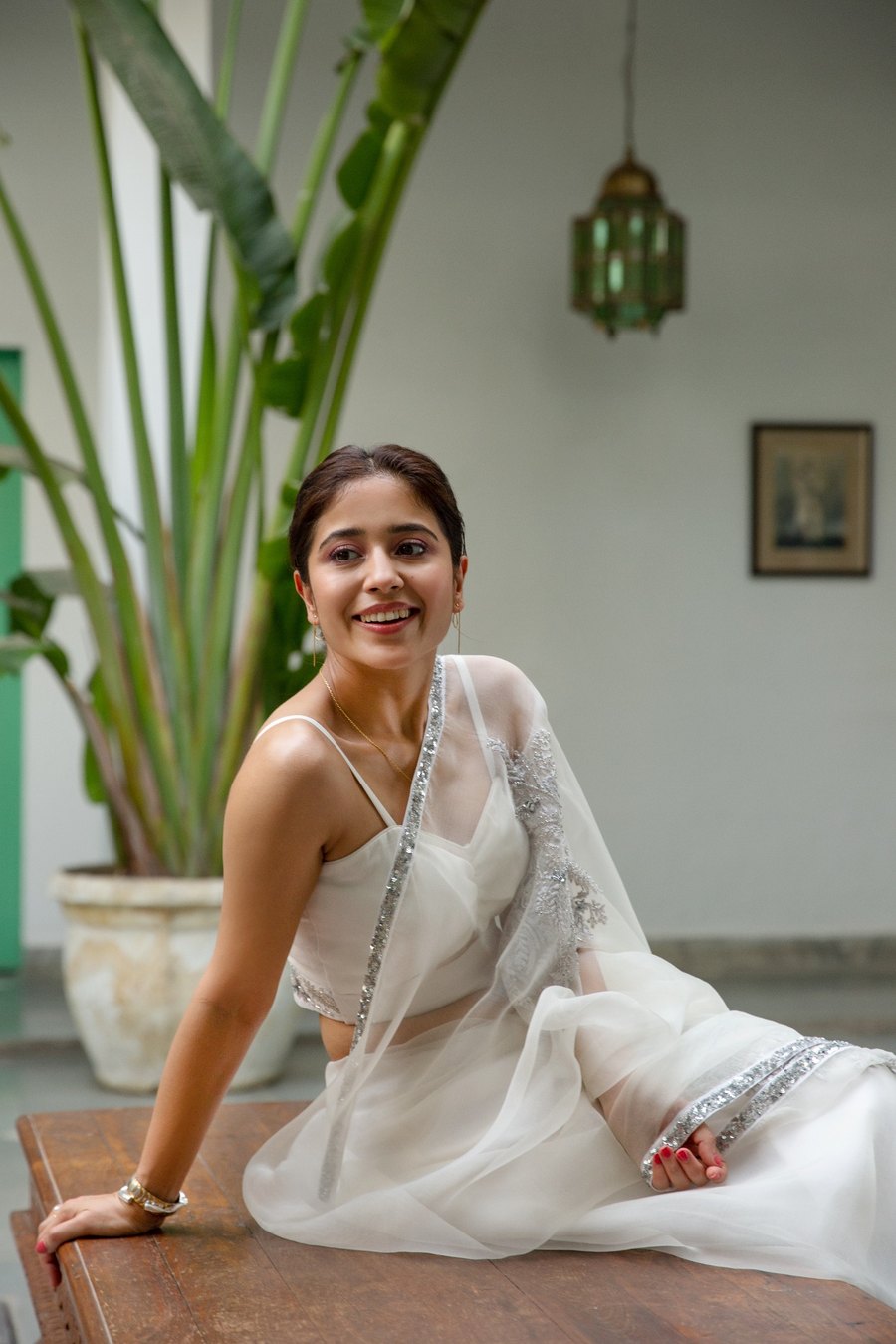
₹26,500
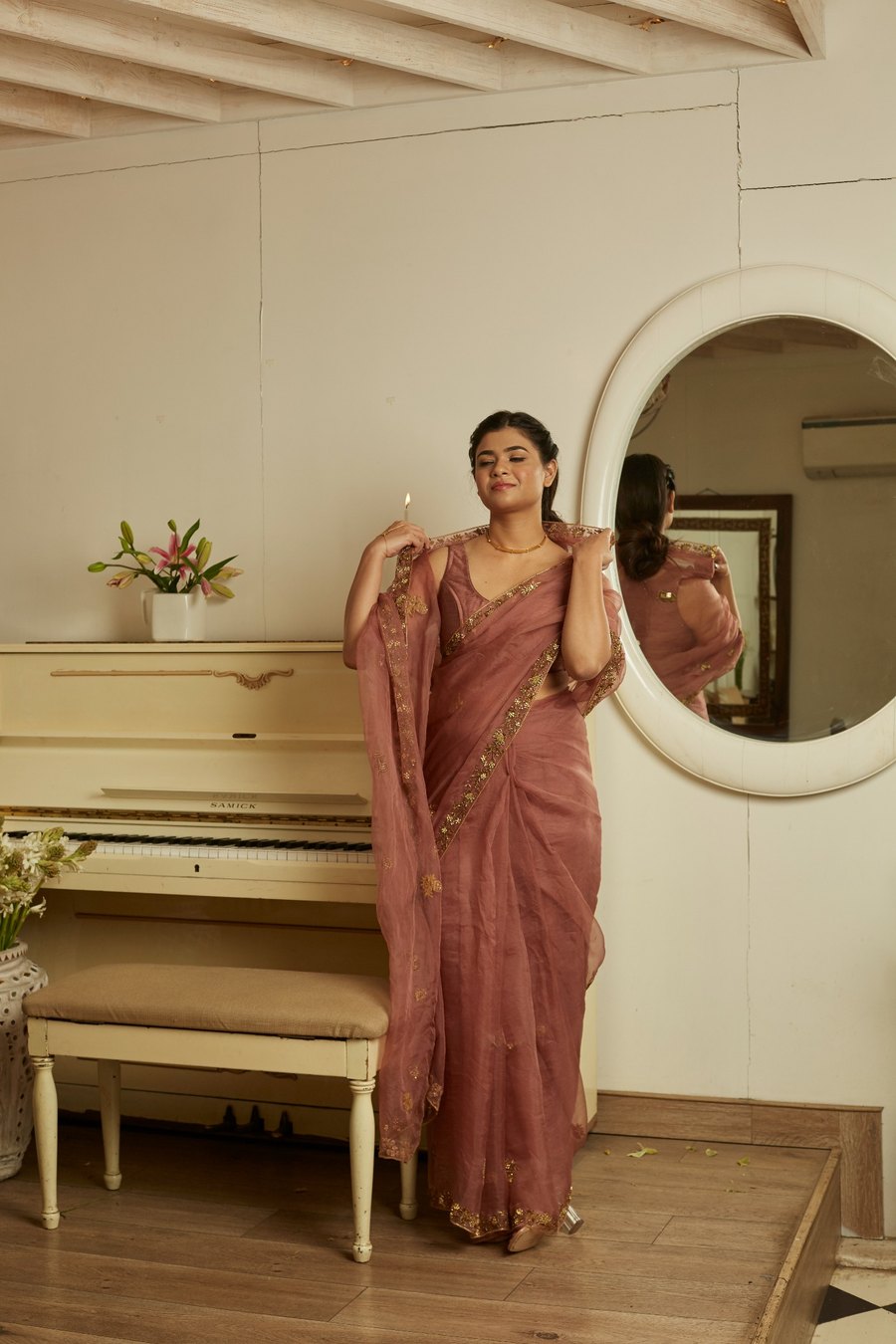
₹24,500
₹19,500
₹19,500
₹19,500
₹19,500
Blouse, drape and jewellery
There is one rule for an all-over saree and it covers most of the decisions: keep the blouse quiet. The saree is already the pattern. A plain silk blouse in cream, ink or gold lets the motif do its work, and a heavily embroidered blouse under an all-over palla gives the eye nowhere to rest and makes the outfit sit badly at the shoulder. Line the blouse always, in a tone close to your skin rather than to the saree, unless you want the contrast deliberately. And keep the blouse lighter in weight than the saree.
The exception is when the neckline is the point. The crimson Chidiya is described on its product page as an ensemble with a halter-neck blouse in a block print, and that pairing works precisely because the print is small and geometric against a field of birds — it does not repeat the motif, it answers it. If you want that effect with another piece, a halter or a high-neck sleeveless cut in a solid colour does the same job.
Pleats want restraint. Five to seven folds, pinned flat, is enough on organza. Over-pleating an all-over saree stacks the motif on itself at the waist, which is the one place on the body where the work will crease and stay creased. Pin the shoulder into the blouse seam allowance and not into the embroidery, and use a fine pin; organza remembers a hole longer than a soft silk does.
For jewellery, earrings before necklace. The motif already sits at the collarbone and across the chest, and a necklace laid over it tends to look like a second pattern arguing with the first. If you want a necklace, choose something plain and thin and let the earrings carry the weight. Skip anything shaped like the motif — a bird pendant over a field of birds is the one mistake this collection invites.
Care, and how to store work that covers the whole cloth
All-over embroidery has a storage problem that a bordered saree does not: the work touches itself. Folded on a shelf, motif presses against motif for months, and the threads abrade each other slowly. If you have the shelf space, roll the saree around a fabric-covered tube instead of folding it, and the whole problem disappears. If you do not, fold it along a different line each time and put a layer of acid-free tissue between the folds.
Air the saree overnight after wearing, before it goes near a cupboard, and keep it in a cotton or muslin bag rather than plastic. Dry clean only when the embroidery has actually dulled rather than after every wearing; hand work does not need frequent cleaning, it needs to not be crushed. Do not iron the embroidered field. If the saree needs pressing, press the plain back through a cloth on low heat, and keep the iron off the metal or pearl work entirely.
If a thread lifts, do not pull it, and do not cut it. Send us a photograph on WhatsApp first and we will tell you whether it can wait until the season ends or wants to come back to us. Most lifted threads on resham work are a two-minute repair if the loop is still intact, and a much longer one if it has been pulled through.
Frequently asked
Is CHIDIYA a brand or a collection?
CHIDIYA is the name of our own collection of hand-embroidered sarees — seven pieces, silk organza, all-over motifs. It is not a separate label and we are not affiliated with any other brand of a similar-sounding name. If you were looking for a different shop, this is not it, and we would rather tell you that plainly.
What does chidiya mean on these sarees?
Chidiya means bird. The crimson saree the collection is named after carries resham hand embroidery worked as small bird motifs scattered across the whole field of the cloth, with a satin-faced border. The other pieces in the collection follow the same idea with a different motif each: a zebra, a daisy, French florals.
Can I wear an all-over embroidered saree to a wedding?
Yes, as a guest, a sister or a friend of the family. The even weight and the absence of a heavy border make it easier to sit, stand and dance in than a bordered saree, and the all-over work photographs as texture rather than competing with the bride's zardozi. Avoid matching the bride's colour family if you will be in close family photographs.
What blouse works with an all-over embroidered saree?
A quiet one. Plain silk in cream, ink or gold, lined, and lighter in weight than the saree. The saree is already the pattern, so an embroidered blouse on top of it usually looks like two pieces arguing. The exception is a small geometric print or a statement neckline such as a halter, which answers the motif instead of repeating it.
How much are the CHIDIYA sarees, and can they be made in my size?
The seven pieces run from ₹17,500 to ₹26,500. Every one is made to order, so the blouse is measured rather than picked off a size chart — send us your measurements or come to Shahpur Jat in New Delhi or our Dehradun store, and we will confirm the numbers on WhatsApp before anything is cut. Shipping is free across India above ₹10,000; for international orders the code INTSHIP applies above ₹89,000.
Explore more: silk organza saree · saree — or message us on WhatsApp for styling help.

The information below is required for social login
Sign In
Create New Account