

A wedding season is not one evening. It is a run of four or five, spread over three months, in different cities, in different lights, with your face in every second photograph. The anarkali is the shape that carries you through the middle of that run - the meh
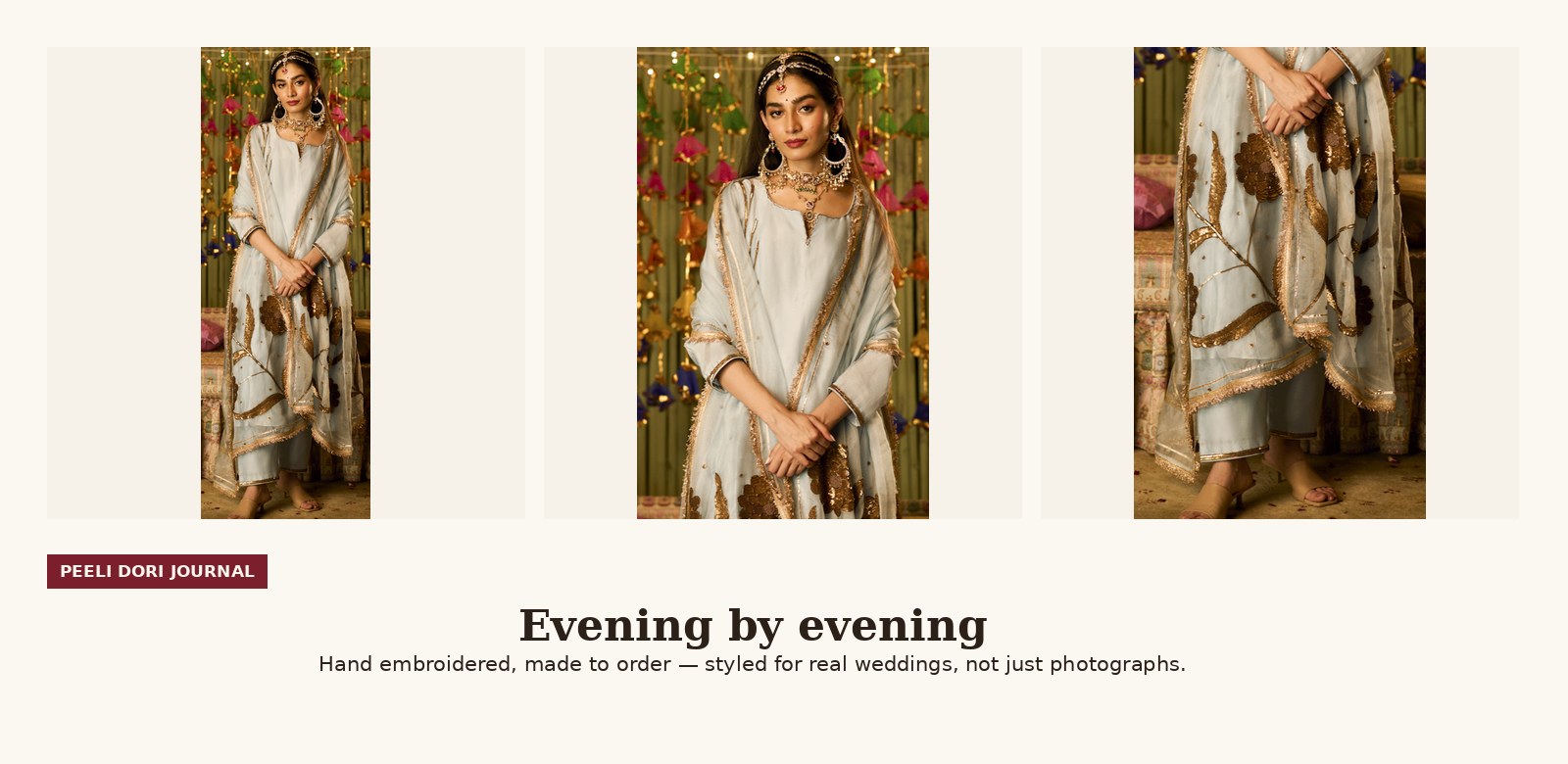
A wedding season is not one evening. It is a run of four or five, spread over three months, in different cities, in different lights, with your face in every second photograph. The anarkali is the shape that carries you through the middle of that run - the mehendi, the sangeet, the reception where you are not the bride and are still on your feet from six in the evening. This is how we would choose one for the season, evening by evening.
A season is a calendar, not a day
The first thing we ask a customer buying for a wedding is not what she likes. It is how many evenings she is dressing for, whose weddings they are, and which of those evenings she is family and which she is a guest. Those three answers decide almost everything else, because the season asks different things of you on different nights. A mehendi at noon in a garden and a reception at nine in a banquet hall are not the same garment problem, and buying one outfit to solve both is how people end up with something that is slightly wrong at each.
The anarkali earns its place in this calendar because it sits between the two things people normally reach for. A saree is beautiful and needs a blouse that fits and someone patient to drape it - fine at home, difficult in a hotel room in another city. A lehenga is a decision you make once, usually for the biggest night, and then it lives in a cupboard. A stitched anarkali is one piece you put on by yourself. It holds its shape while you sit on the floor with henna on your palms and it still has movement when the sangeet starts, which is a narrower set of demands than it sounds.
What it does not do is forgive fit. Because it is stitched, it has to be cut to you. More on that below, because it is the part people leave too late.
Which anarkali for which evening
We would plan the season backwards from the photographs. Not because photographs are the point, but because the camera tells you what each evening will actually ask of the outfit.
For a mehendi you are sitting on the floor for two hours with your hands held out in front of you, and the camera comes close, at hand height, in daylight. What matters is a hem you can gather without it sitting in the dust, work that survives being folded under you, and a dupatta that pins back so it is not in the artist's way. Lighter cloth helps, and so does a colour that holds up in flat afternoon light rather than one that needs a spotlight.
For a sangeet, the opposite problems. You will be standing, walking, possibly dancing, and the evening runs long. The skirt has to swing rather than drag. The dupatta has to be secured properly - two pins and, if the piece allows it, a belt - because the quickest way to ruin a sangeet outfit is to spend the evening holding it up with one elbow. Keep the shoulder light, too: heavy work piled at the sleeve is lovely in the photograph taken at the start of the night and tiring by the fourth song.
For the wedding itself, if you are a guest rather than family, we would go quieter than instinct suggests. You will be in group photographs at close range, standing beside people in their own best, and a piece with work spread evenly across the whole skirt photographs as one bright mass. Work concentrated in a border and a bodice reads properly at that distance - and it lets you wear the same outfit to a second function with a different dupatta, which nobody notices.
For a reception the heavier piece finally earns its keep. Dim rooms and hard flash are unkind to fine thread and generous to metal. If you are buying one anarkali for a whole season and a reception is on the list, buy for that evening and let the lighter functions be handled by something plainer.
How the work behaves in the season's light
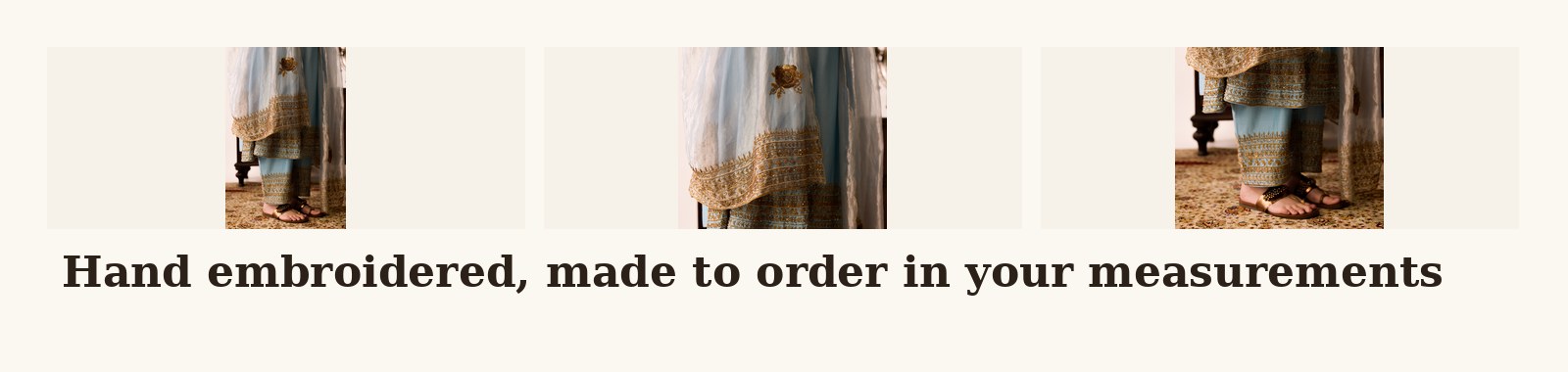
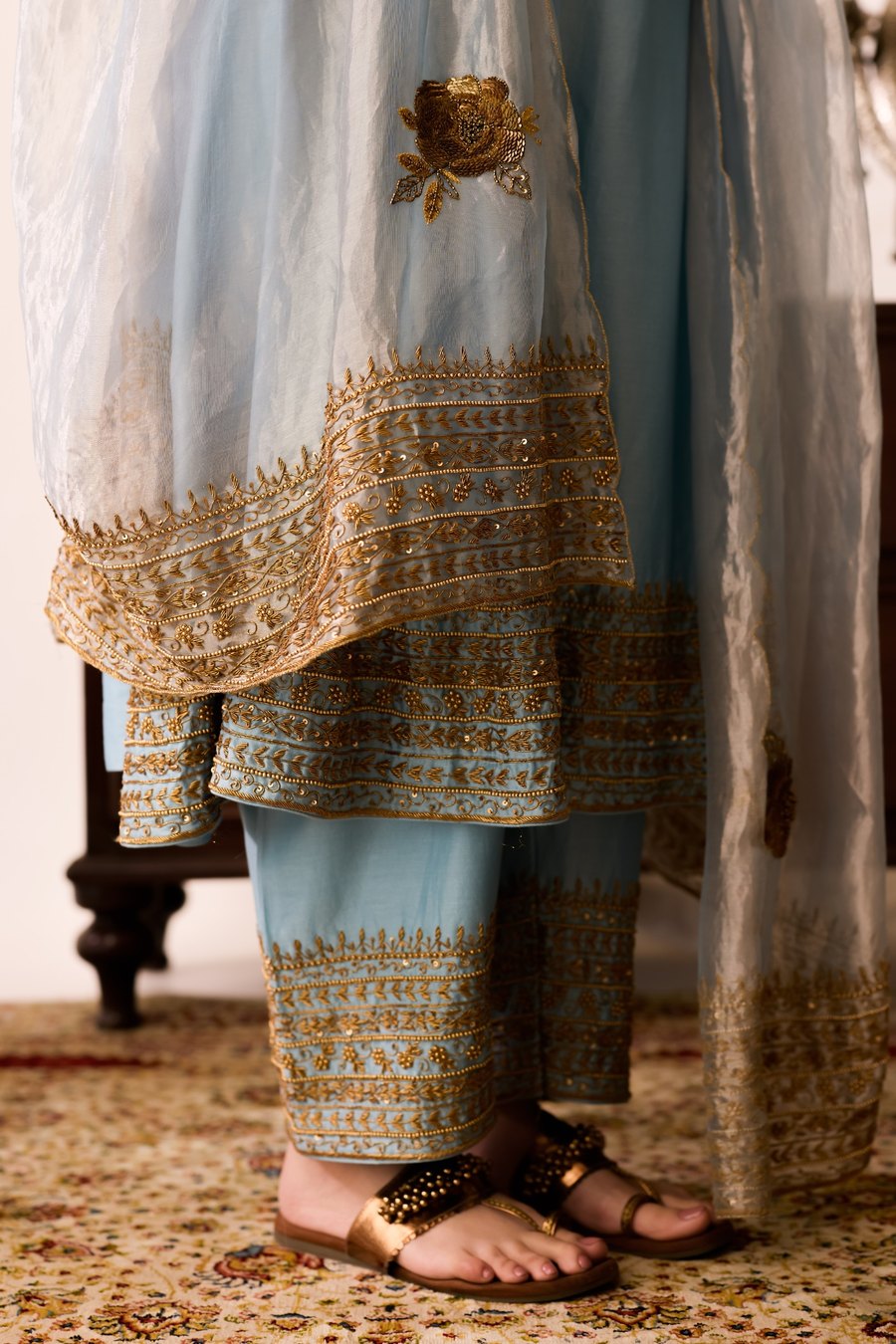
Most of what goes wrong with a wedding outfit goes wrong in the photograph rather than in the mirror, and the cause is almost always the light. A north Indian season runs through short, flat December afternoons and long evenings lit by halogen, phone flash and whatever the videographer is carrying. Work that is dense and even across the skirt becomes a single bright shape at ten paces; work with edges, gaps and a border keeps its pattern. That is not a rule about which embroidery is better. It is a rule about distance.
So the inspection worth doing is a cheap one. Take the piece to a doorway, hold it at the height it will sit on you, and look at it from four or five steps back. Then light it with a phone torch at close range and look again. The two views tell you different things: the first is what the wedding photographs will see, the second is what your neighbour at dinner will.
Then turn it inside out. On a hand-worked piece you will see the thread carried between motifs and slightly uneven tension, because a person did it. Machine work is uniform to the millimetre and flat where it should catch. Nobody at the wedding will see the inside; you are looking at it because it is the fastest way to know what you are paying for. Ask what the cloth is and how many panels the skirt has, too - an anarkali eats fabric in a way a kurta never will, and the flare has to come from somewhere.
We work with organic dyes, which matters more in this season than people expect. The deep colours that hold under Indian light and still look like themselves a year later are usually the ones that were dyed properly to begin with.
If you are buying two, buy them as a pair
The mistake we see most is two outfits that do the same job. Two heavy, dark, all-over pieces for two nights that were never going to be the same anyway. If the season has more than one evening in it, we would rather you bought a pair that covers the calendar: one that works in daylight and closer to the floor, one that works in a dark room and on your feet.
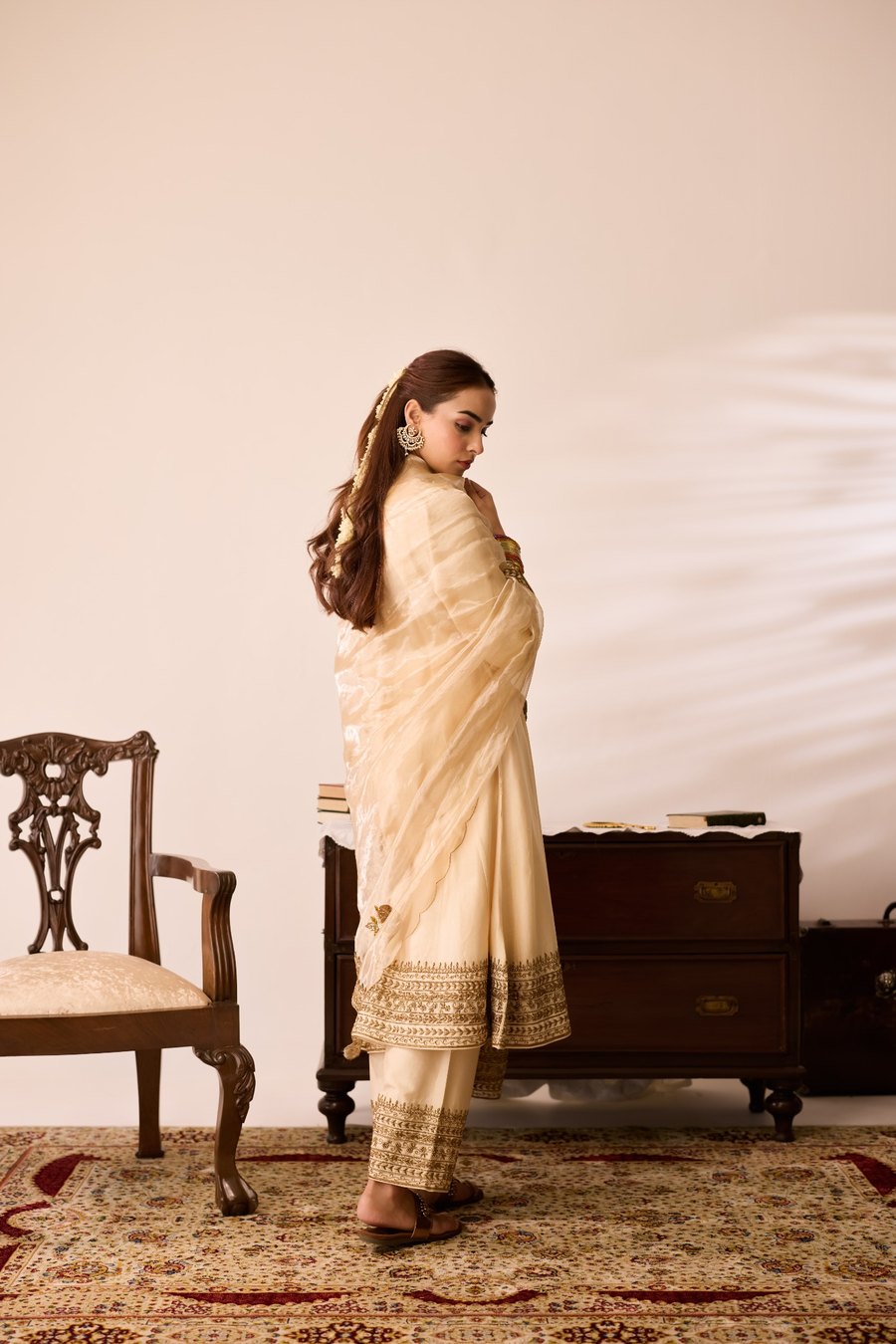
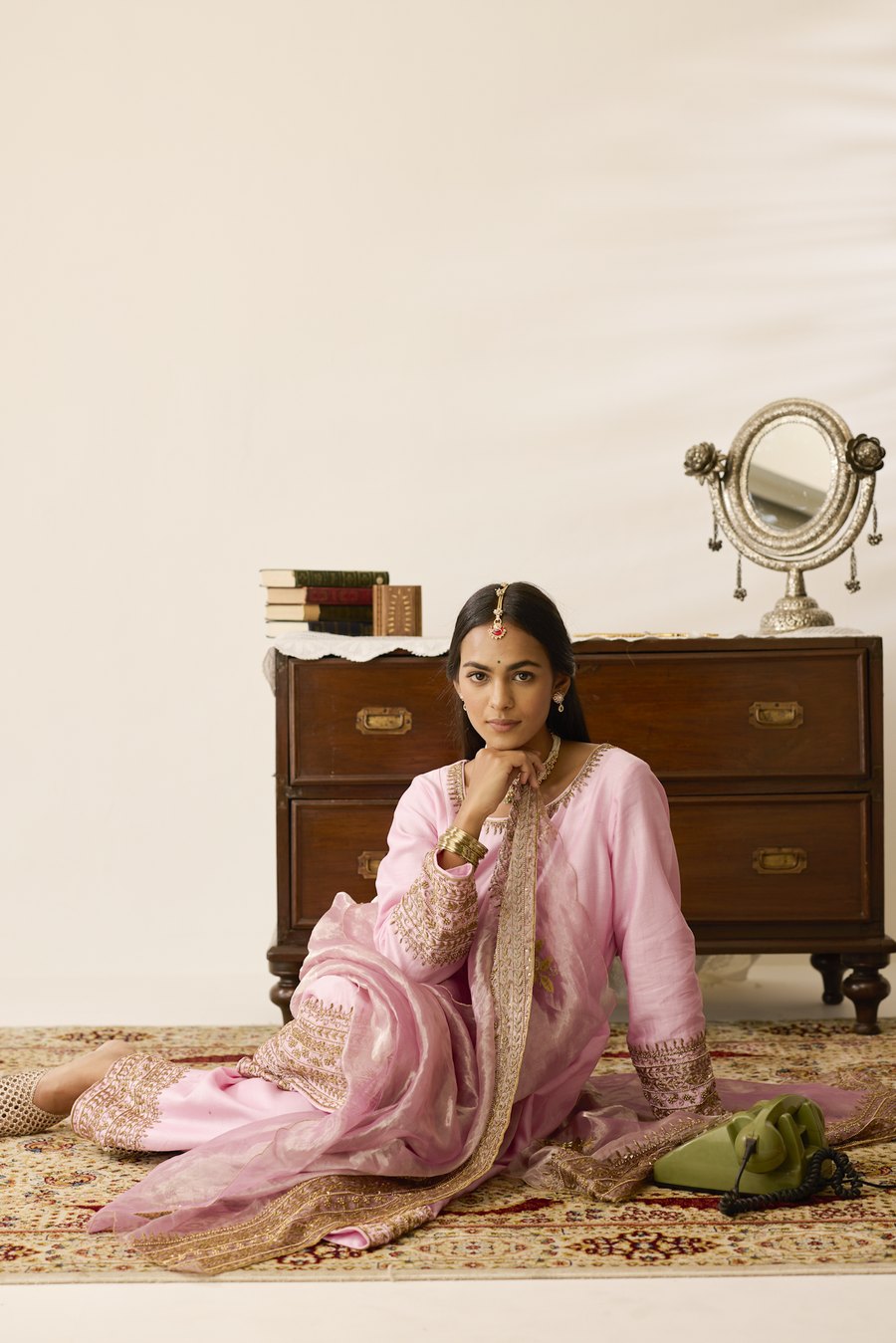
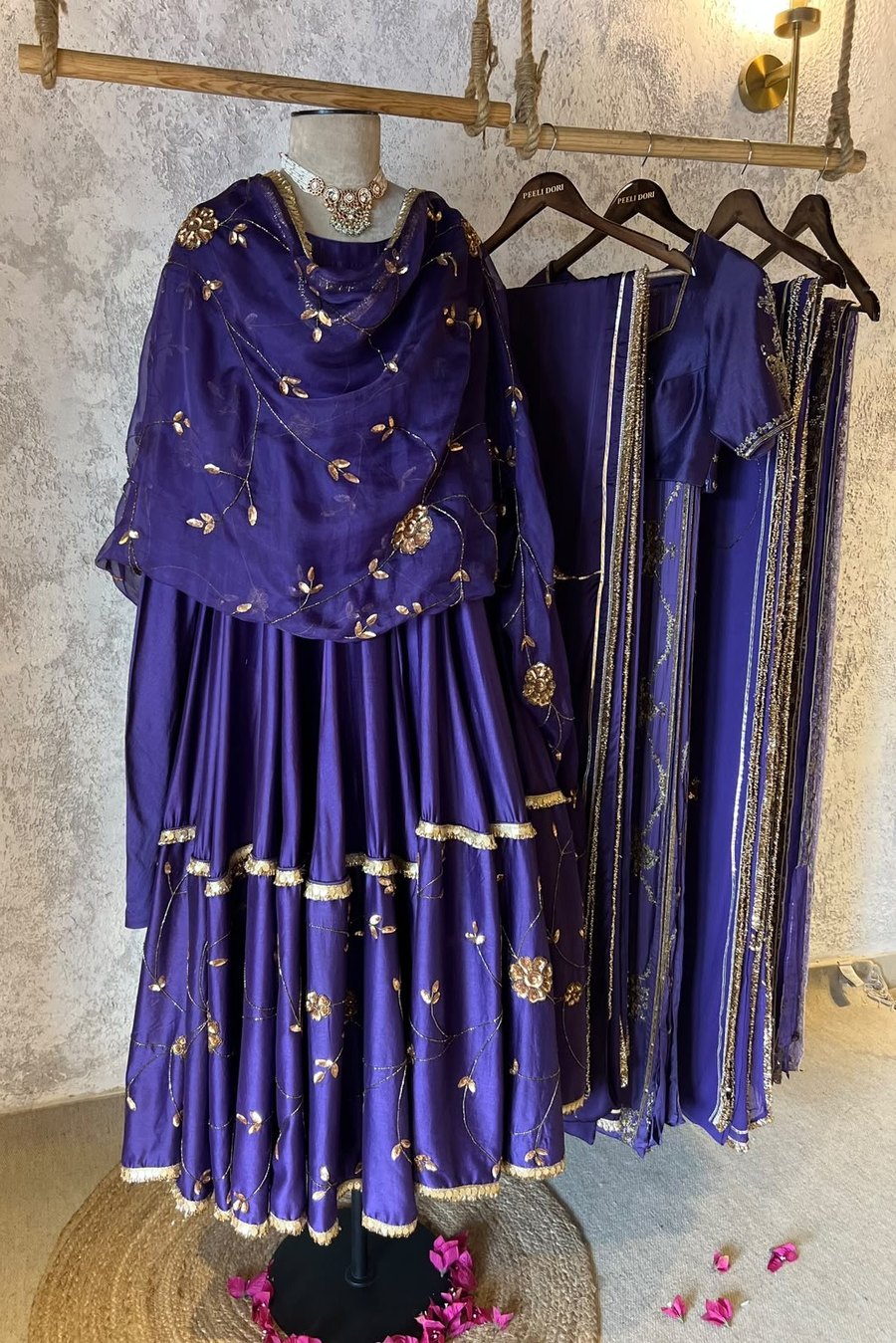
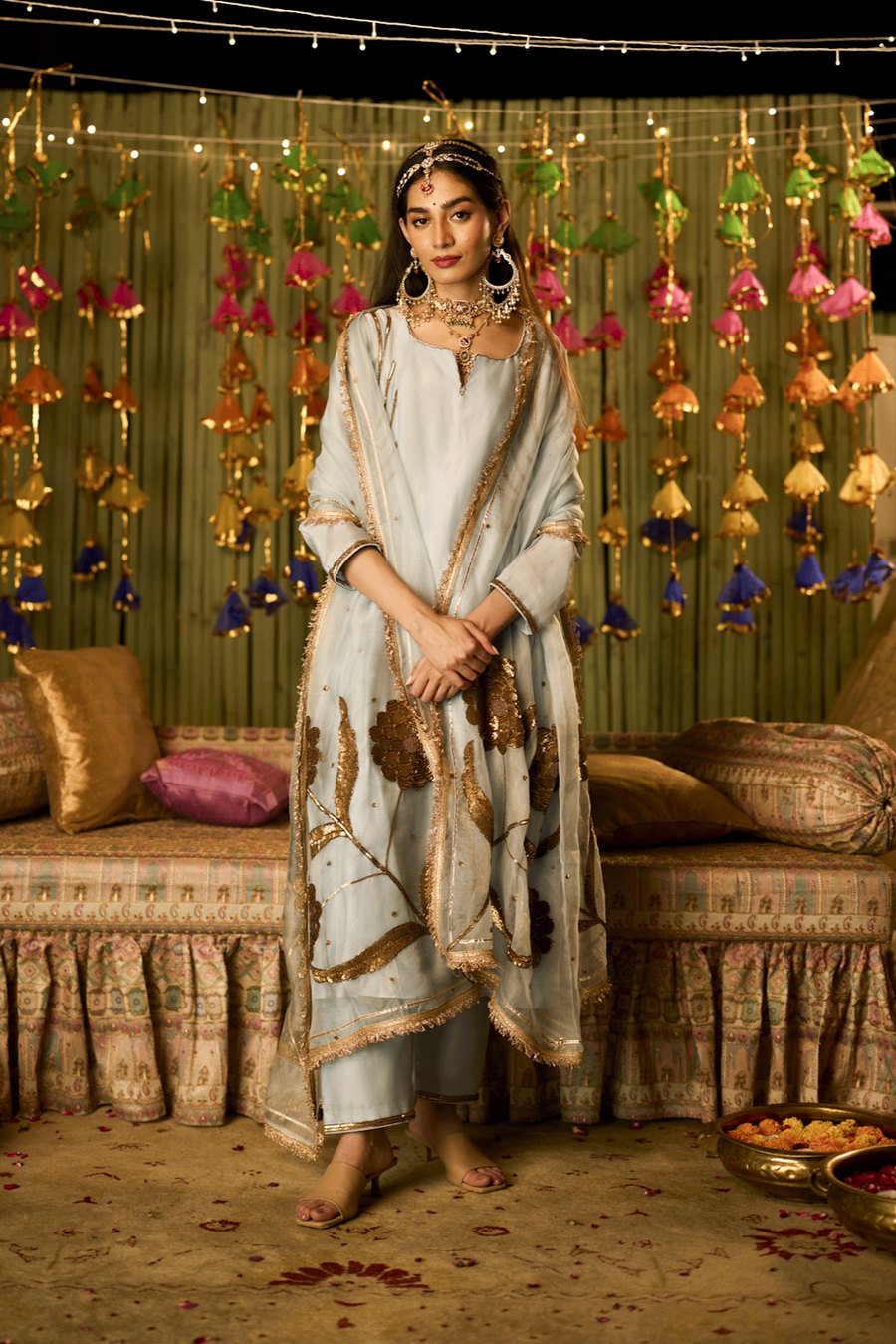
In our own catalogue we would split it like this. The Gulmohar sets at ₹44,500 are the evening half - coconut and powder blue for functions where the camera is close and the room is bright, the gulabi for a reception where the work has to do the talking in low light. Each comes as a set, shown with its dupatta in the photographs, and the set is what ships.
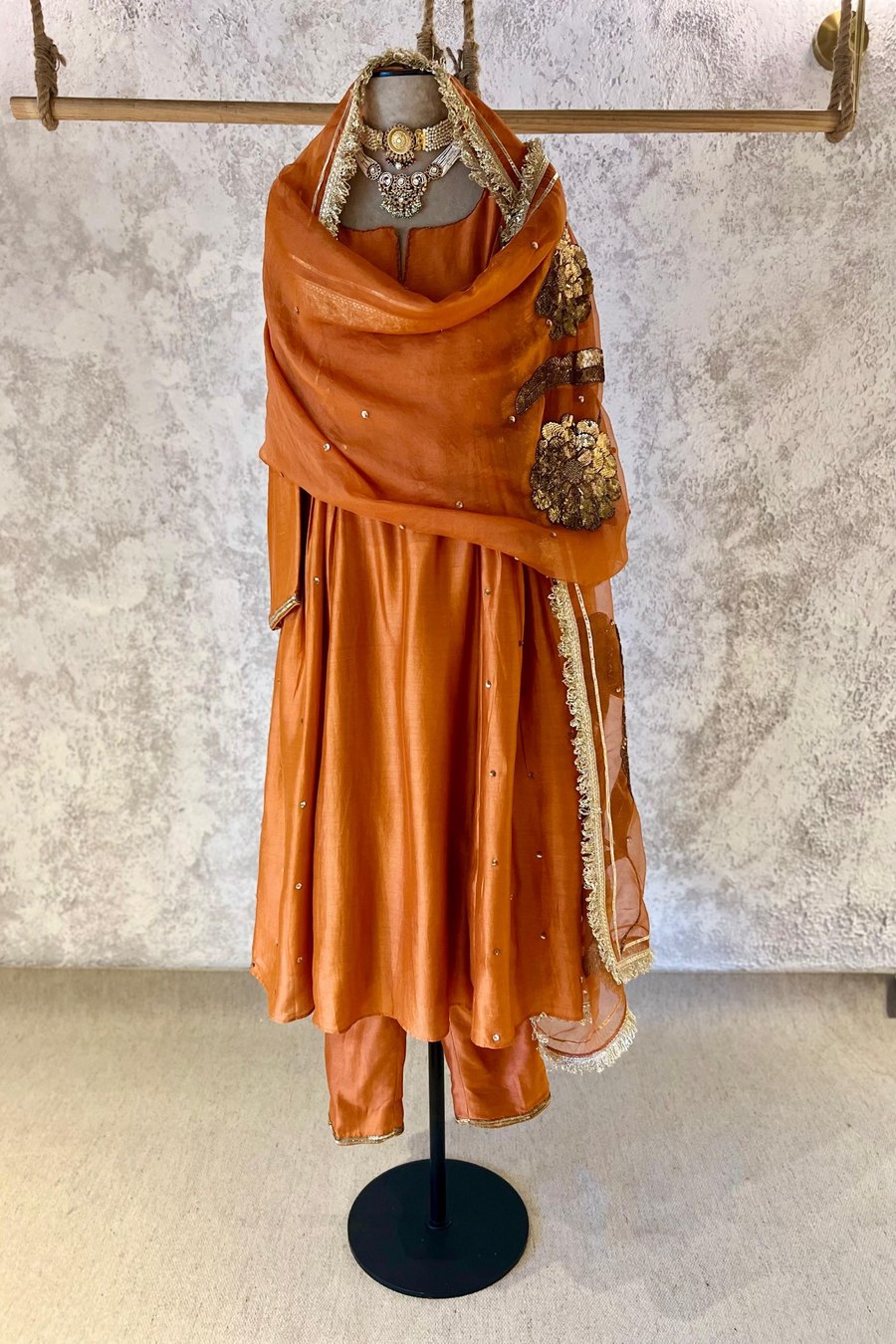
The daylight half is where the price comes down without the piece getting thinner. The Nayanthara anarkali at ₹36,500 is the quiet choice for a wedding you are attending rather than hosting. The two Madu sets at ₹36,500, powder blue and rust orange, are cut in chanderi silk - a dry, papery cloth that takes a crease and travels without drama, which is what you want if the season involves a flight and a hotel room. Madhurima at ₹34,500 is the one we suggest to the family member who would rather not be the subject of the evening, and it is where a hand-embroidered anarkali starts with us.
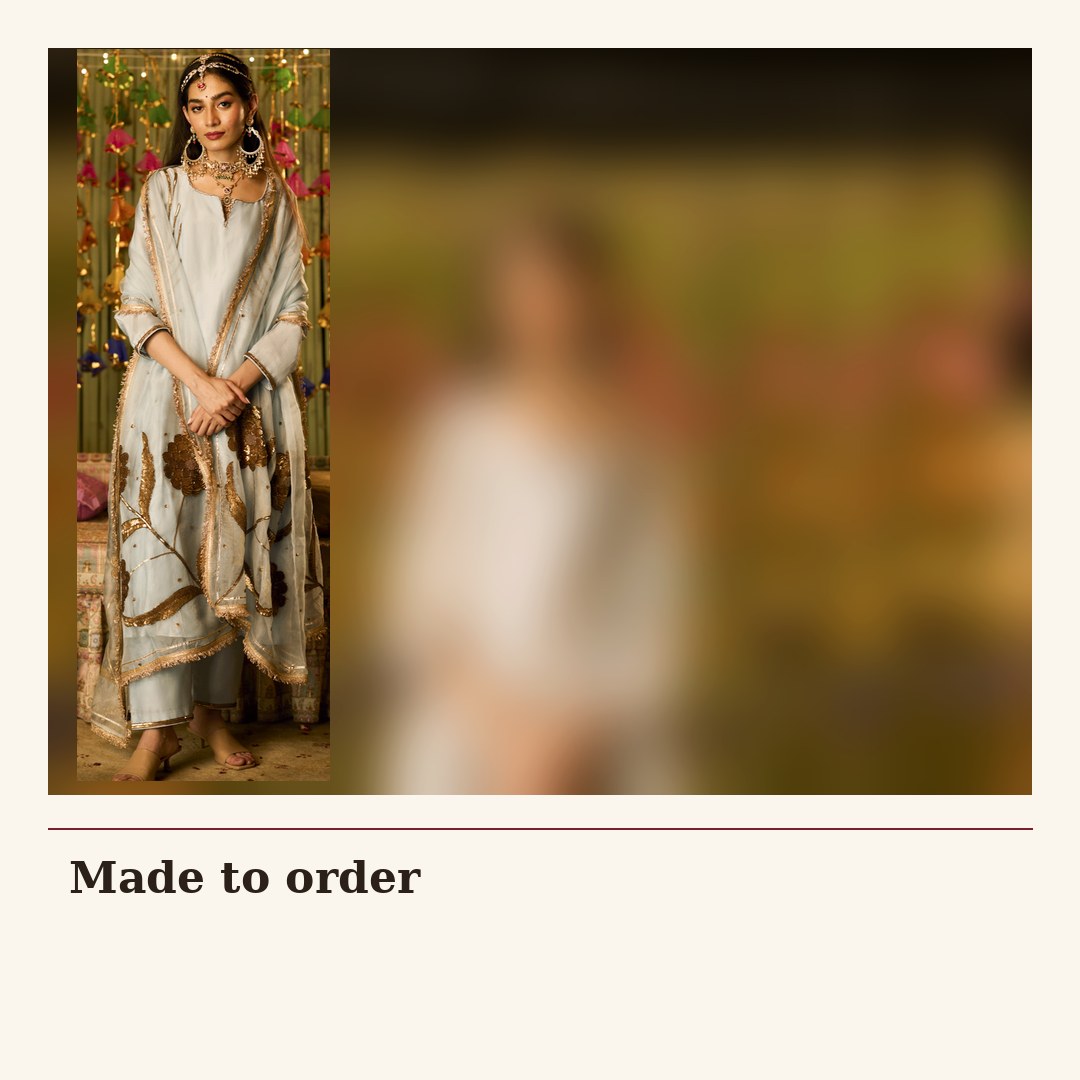
Everything here is hand embroidered and made to order, so the piece you receive is cut for your measurements rather than altered towards them. Within India, shipping is free above ₹10,000, which covers all of these. For a wedding abroad we ship internationally, and the code INTSHIP applies above ₹89,000 - worth knowing if you are buying an anarkali alongside a saree for the same week.
₹44,500
₹44,500
₹44,500
₹36,500
₹36,500
₹36,500
The fitting question, and why it cannot wait
Because an anarkali is stitched, it cannot be fixed on the day the way a saree can be draped differently. Two things decide whether it works: your height in the shoes you will actually wear, and how much room the skirt gives you when you sit down. We have seen more good outfits ruined by two centimetres of hem than by anything else, and it is almost always because the fitting happened barefoot in the afternoon for an evening that will be spent in heels on a carpet.
This is where made to order is an advantage rather than a delay. The piece is cut to your measurements from the start, so a correction lives in the pattern and not in a tailor's hands two weeks before the wedding. Send your measurements on WhatsApp and we will check them against the style before anything is cut. If you are in Delhi or Dehradun, come to Shahpur Jat or the Dehradun store and we will take them ourselves - it takes less time than guessing, and it is the only part of this that cannot be rushed at the end.
The week itself: repetition, and packing
Most people in a wedding season dress for more evenings than they buy outfits for, and the anarkali repeats better than anything else in a wardrobe. Change the dupatta and the register changes: a light one with a thin border for the mehendi, the matching one for the sangeet, a heavier one borrowed from another set for the reception. A sleeve change, where the piece allows it, does more than jewellery does. What gives a repeat away is never the skirt - it is the photograph with the same dupatta, the same earrings and the same hair in two different cities.
For travel, fold along the panels rather than across the embroidery, and carry the dupatta separately so its border is not crushed under the skirt. Coming from Delhi to a hill wedding, give the piece a day out of the bag before the function: chanderi and silk both drop their creases faster hanging than being pressed in a hurry.
Care between the functions
Between two functions a week apart, the sensible thing is to do as little as possible. Hang the skirt from the waistband so the weight of the hem pulls the creases out and the embroidery is not carrying the load. Keep the dupatta flat rather than hung, because a border hanging by its own weight will stretch. No perfume on the work itself, and no hot iron pressed directly onto metal thread.
For anything beyond that, ask us about the specific piece. Different work on different cloth wants different handling, and a general rule is how outfits get damaged. We would rather tell you what we recommend for the one you bought than have you guess.
Frequently asked
Is an anarkali appropriate to wear to a wedding if I am a guest?
Yes, and often it is the more comfortable choice - you can put it on without help and sit down in it. The thing to watch is volume. Heavy work across the whole skirt competes with the bride in group photographs; work in a border and a bodice, a deeper colour and a simpler dupatta reads as dressed for the occasion without asking for the room.
Can one anarkali cover more than one function in the season?
Usually two, sometimes three, if you plan the change rather than repeat the whole look. Keep the skirt and change what sits around it: a lighter dupatta for the mehendi, the matching one for the sangeet, a heavier one for the reception. Sleeves and jewellery change the register more than most people expect, and it is the identical dupatta and earrings in the second photograph that give a repeat away.
Is chanderi silk too plain for a wedding evening?
It is quieter, not plainer - the work does the talking rather than the cloth. Chanderi has a dry fall and takes a crease beautifully, which makes it very good for daylight functions and for anything that involves a flight. For a dark reception where you want the piece to hold its own in photographs, a heavier silk with denser metal work is the better answer.
How far in advance should I order for wedding season?
Earlier than feels necessary. We do not keep a rack of anarkalis in sizes, so every piece is cut, embroidered and stitched for the person who ordered it, and the season is exactly when everyone orders at once. Tell us the date of your first function and we will tell you honestly what is possible. That conversation is easier in October than in the last week of November.
What do I need to measure if I am ordering from another city?
Height in the heels you will wear, bust, waist, shoulder, armhole and the length from shoulder to the hem you want. Send them on WhatsApp and we will do a fit check against the style before it is cut. If you would rather not measure yourself, the Shahpur Jat and Dehradun stores will do it - and if you are near either city in the season, it is worth the detour.
Explore more: wedding 2026 · designer hand embroidered blouse — or message us on WhatsApp for styling help.

The information below is required for social login
Sign In
Create New Account