

Almost nobody asks us to choose between an organza saree and a lehenga because they like both equally. They ask because an organza saree is the lightest way to get the movement and the shine of a lehenga, and because a lehenga is the one thing a saree can neve
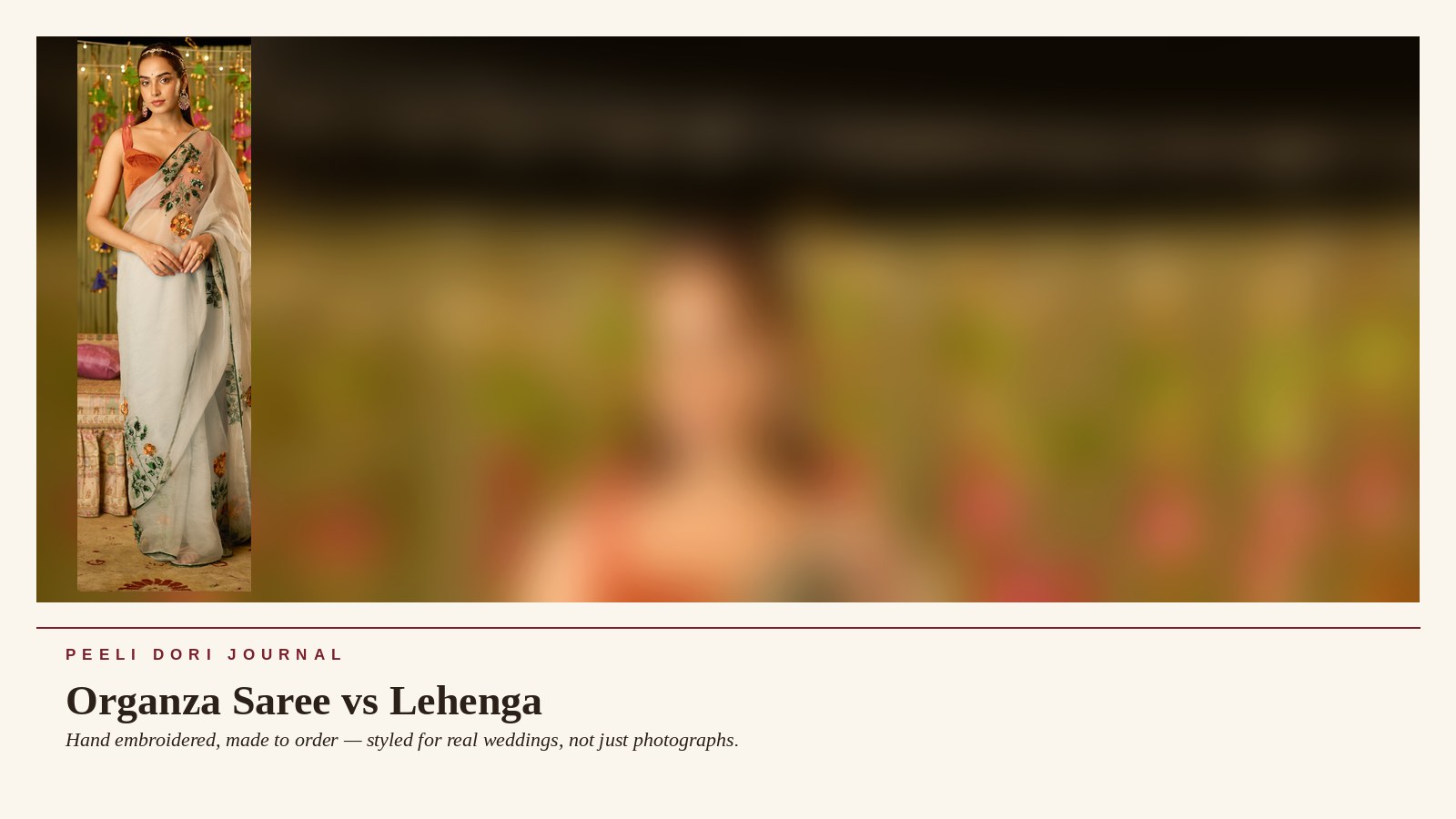
Almost nobody asks us to choose between an organza saree and a lehenga because they like both equally. They ask because an organza saree is the lightest way to get the movement and the shine of a lehenga, and because a lehenga is the one thing a saree can never be — stitched, structured, and heavy enough to stand on its own. The two are not rivals. They solve different problems on the same wedding calendar, and once you know which problem is yours, the choice makes itself.
Start with the day, not the fabric
The question usually arrives with a photograph. A friend’s sangeet, a bride in a full saree/silk-organza-saree.html" style="color:#8a6a3a;text-decoration:underline;">organza saree with a bold blouse and a belt, and by the end of the week there are three lehengas saved on the phone as well. That is the honest starting point, because the look is not what separates them. Weight, structure, and how many metres of fabric you are prepared to carry through a long day are what separate them.
Organza is a sheer, crisp, springy silk. It holds a pleat the way good paper holds a fold, it sits slightly away from the body instead of clinging, and it catches light from across a room. A lehenga is the opposite kind of garment: several metres of fabric and a lined skirt with a fitted bodice. One moves with you and can be pinned on the day. The other is built to a set of numbers weeks in advance and holds its own volume without any help.
So the useful question is not which is prettier. It is which function you are dressing for. Daytime mehendi, a sangeet you will actually dance at, a long reception you will work the room through — these are organza days. A main wedding ceremony where you sit on the floor for the pheras, where the light is low and the photographs come from the side, is a day a structured piece earns its keep.
In the store we end up suggesting a mix more often than either alone: an organza saree for the lighter functions, a lehenga for the main ceremony, or organza right through if you would rather buy pieces you can wear again. That last point matters more than people expect. A saree can be re-draped for another function with another blouse. A lehenga is a skirt and a top that belong to one day.
Fabric and craft: what to look at up close
Ask what the organza is made of. Pure silk organza has a crispness that comes back when you handle it — you can hear it — and it carries hand embroidery without sagging. The lighter synthetic organza on the market is cheaper and shinier, and it will not hold gota patti or zardozi the same way. On a sheer ground the work is visible from both sides, so good embroidery is finished on the reverse as carefully as on the front. Turn the piece over before you decide.
Ask about the embroidery itself. Gota patti reads as flat, metallic ribbon work. Zardozi is denser and heavier. Dabka is finer still. On organza the flatter, lighter work tends to sit best, because the fabric is springy and the embroidery has to move with it rather than drag it down. We hand-embroider everything on this rail, and the work is what you are paying for, not the metreage.
A lehenga is the reverse conversation. Ask how many layers the skirt carries, whether the waistband is stiffened, and how much adjustment is built in. The volume lives in the construction, so the construction is what you are buying. Do not judge one lying flat on a table. Judge it standing up.
Colour behaves differently on the two as well. Sheer silk takes dye deeply, so maroon, red, and emerald read rich and keep their depth under a lens. In a heavier, layered piece the same colour reads flatter, because less light passes through it. If the photograph matters to you more than anything else, sheer has the advantage.
How to choose for your body and your function
Organza generally flatters when you want a clean line. It does not add bulk at the hip, it shows the shoulder and the waist, and it makes height look deliberate. The trade-off is that there is nowhere to hide. A sheer saree needs a properly fitted blouse and a petticoat in the right colour, and both are visible decisions rather than hidden ones.
A lehenga flatters when you want volume and coverage: a fuller skirt over the hip, a bodice that stays exactly where it is put, and a floor-length weight that photographs as grandeur. If you want to sit cross-legged on a stage without thinking about your drape for two hours, this is the piece that lets you.
There is a middle path worth knowing about. An organza saree draped in a lehenga style, with fuller pleats, a belt at the waist, and the pallu pinned across, gives you the volume and the drama without committing to a stitched skirt — and the same saree goes back to being a saree on Monday. We drape this in the store for anyone who is torn, and it settles the question about half the time.
Whatever you lean towards, settle the fit early. Everything we sell is made to order and cut to your measurements, so the blouse needs your numbers and the drape needs your height in the heel you will actually wear. If you are buying from another city, send the measurements on WhatsApp and ask for a fit check before the final stitching. That is far easier than fixing a shoulder two weeks before a wedding.
The organza pieces we would put in front of you
If the saree wins for your calendar, these are the six we would show first. Hand-embroidered organza and silk satin between ₹44,500 and ₹59,500, every one made to order, every one cut to your measurements, every one light enough to fold into the corner of a suitcase. All six are from our organza rail. Prices are as listed, and the blouse and petticoat are worth a conversation on WhatsApp before you commit to anything.
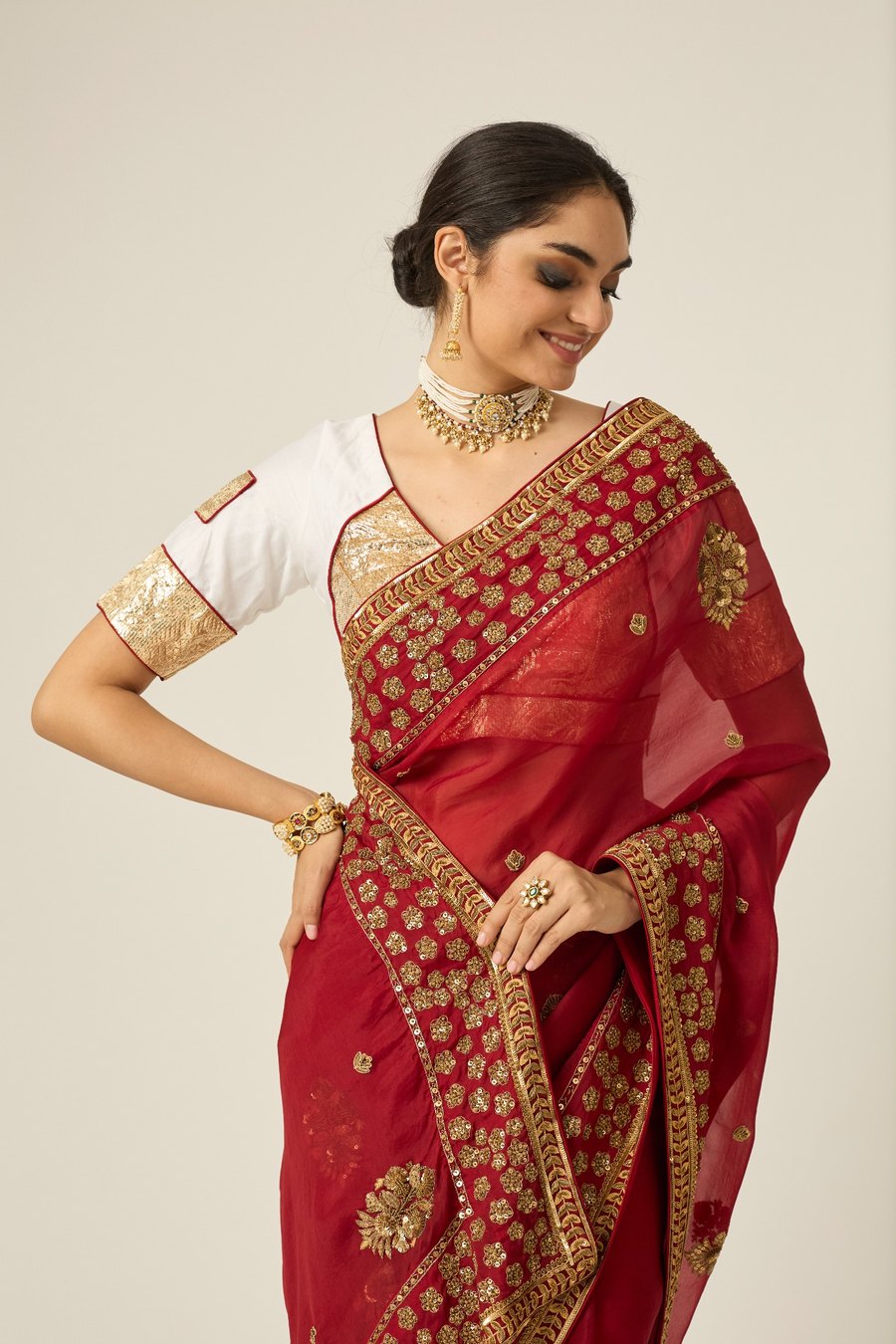
₹59,500
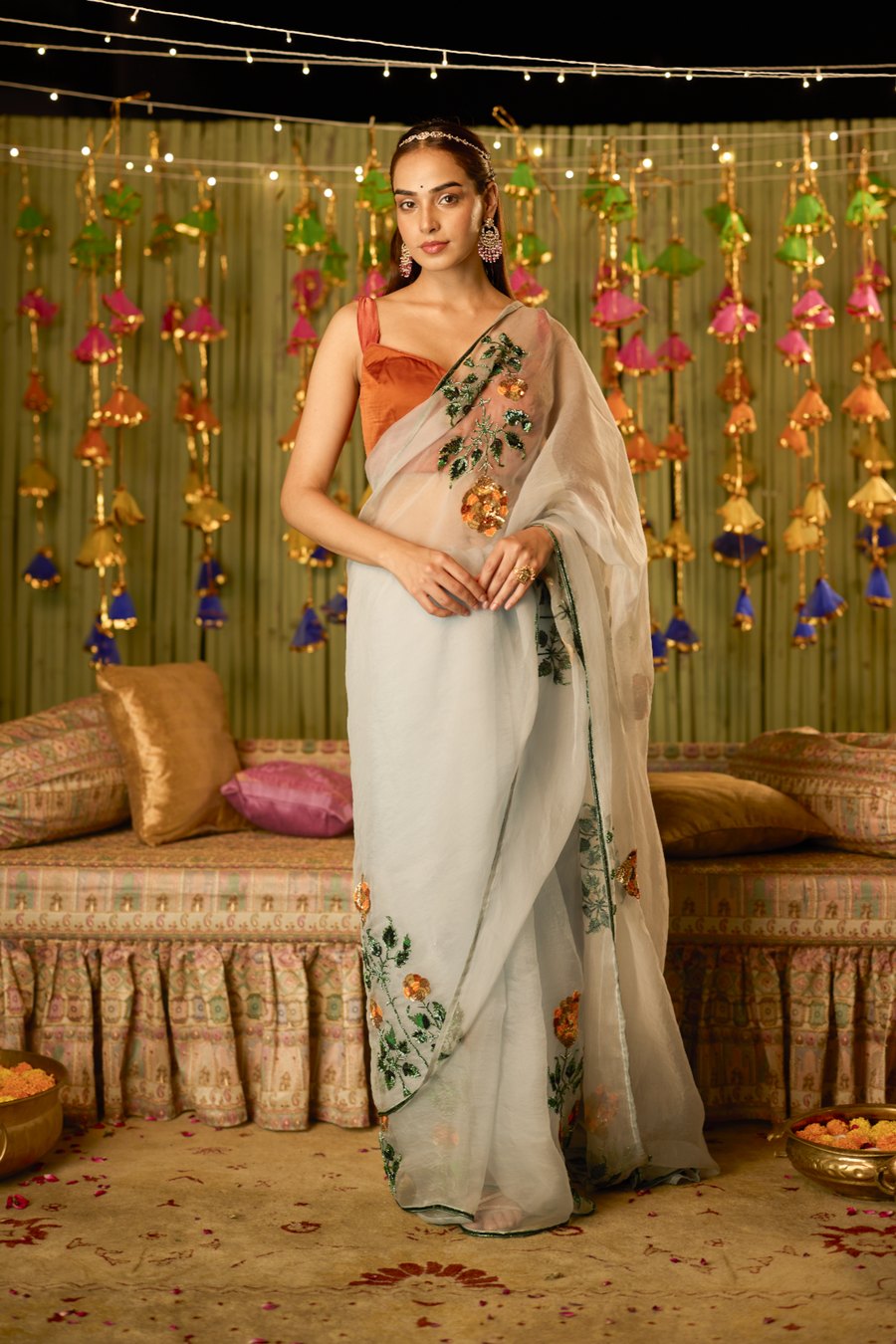
₹48,500
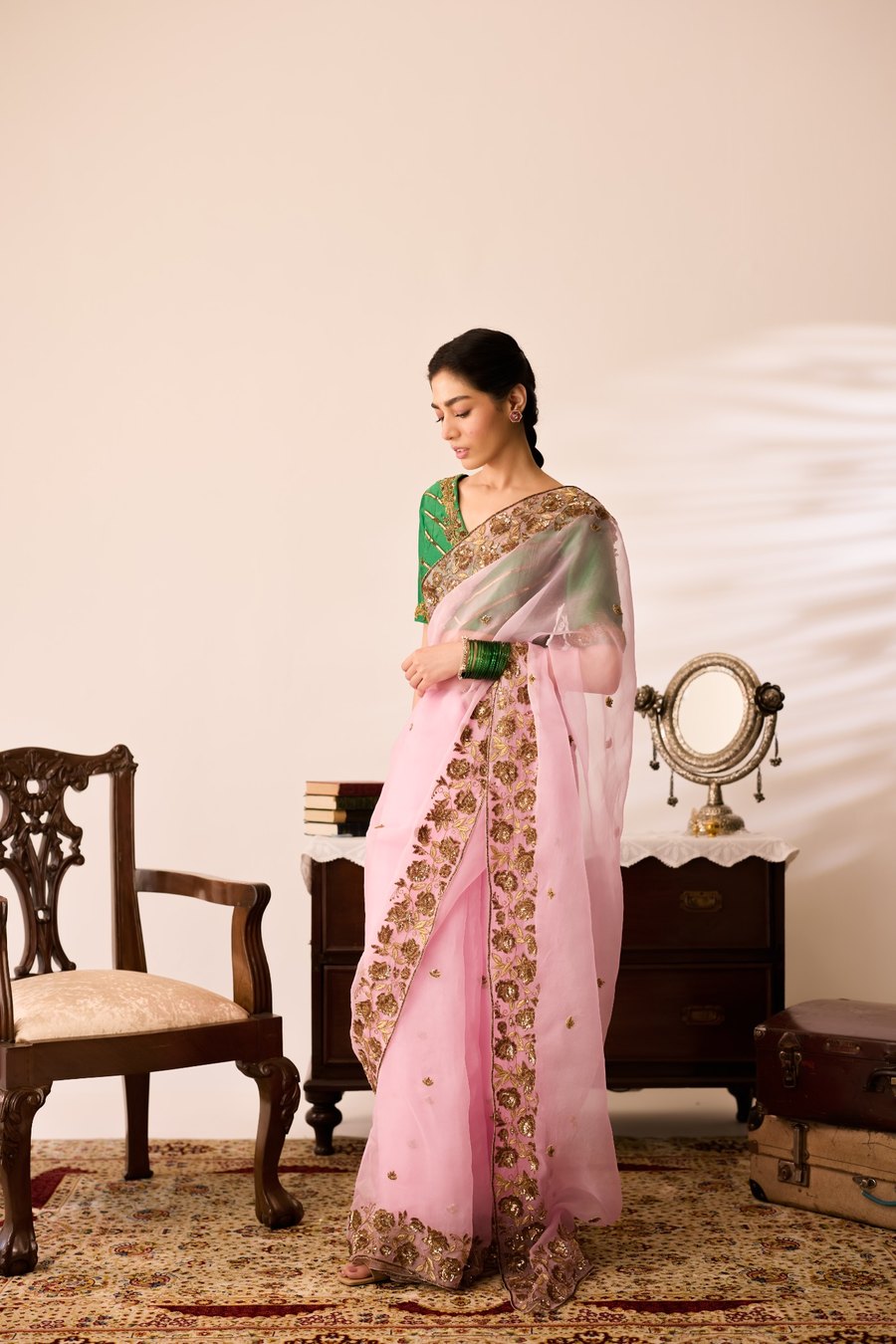
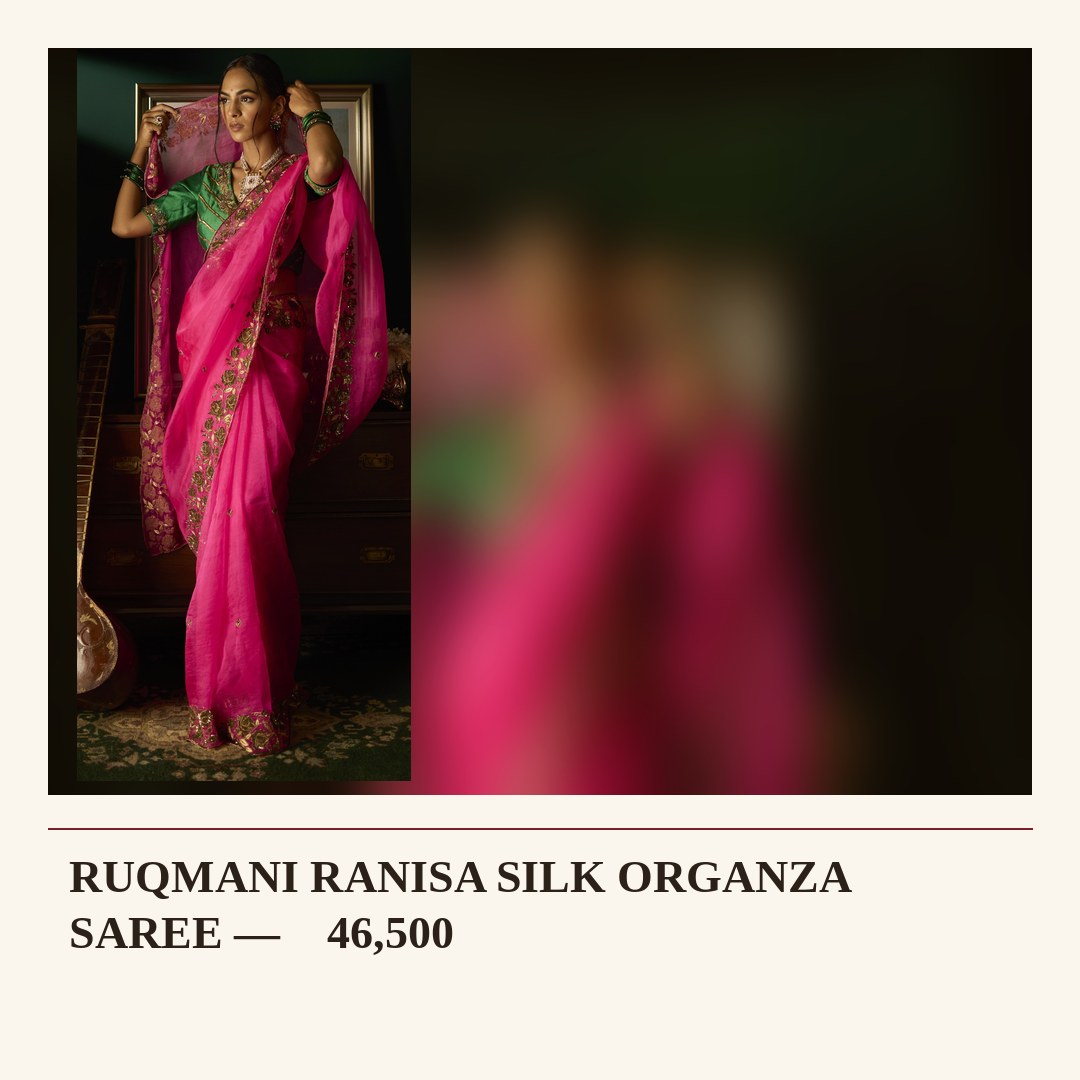
₹46,500
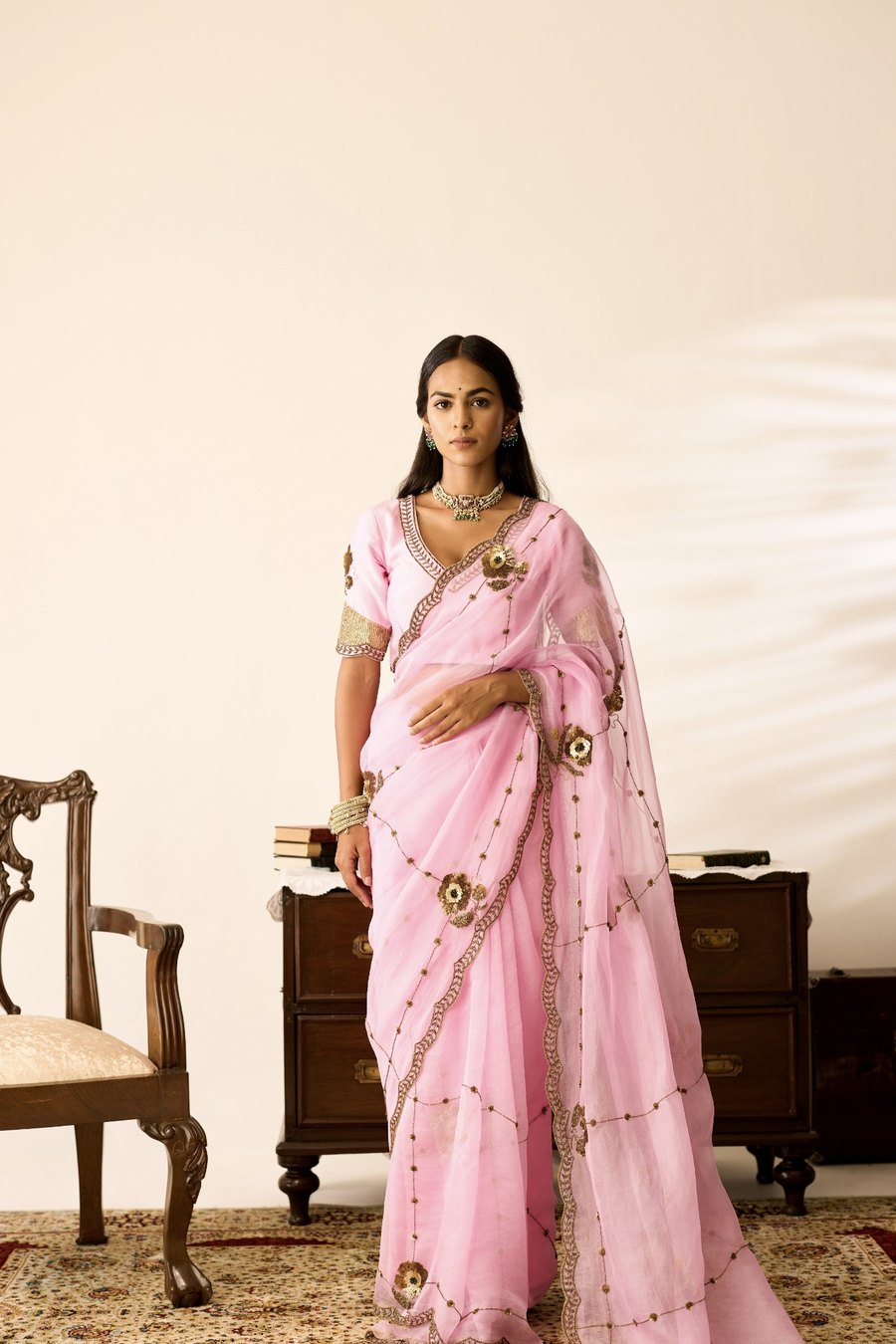
₹46,500
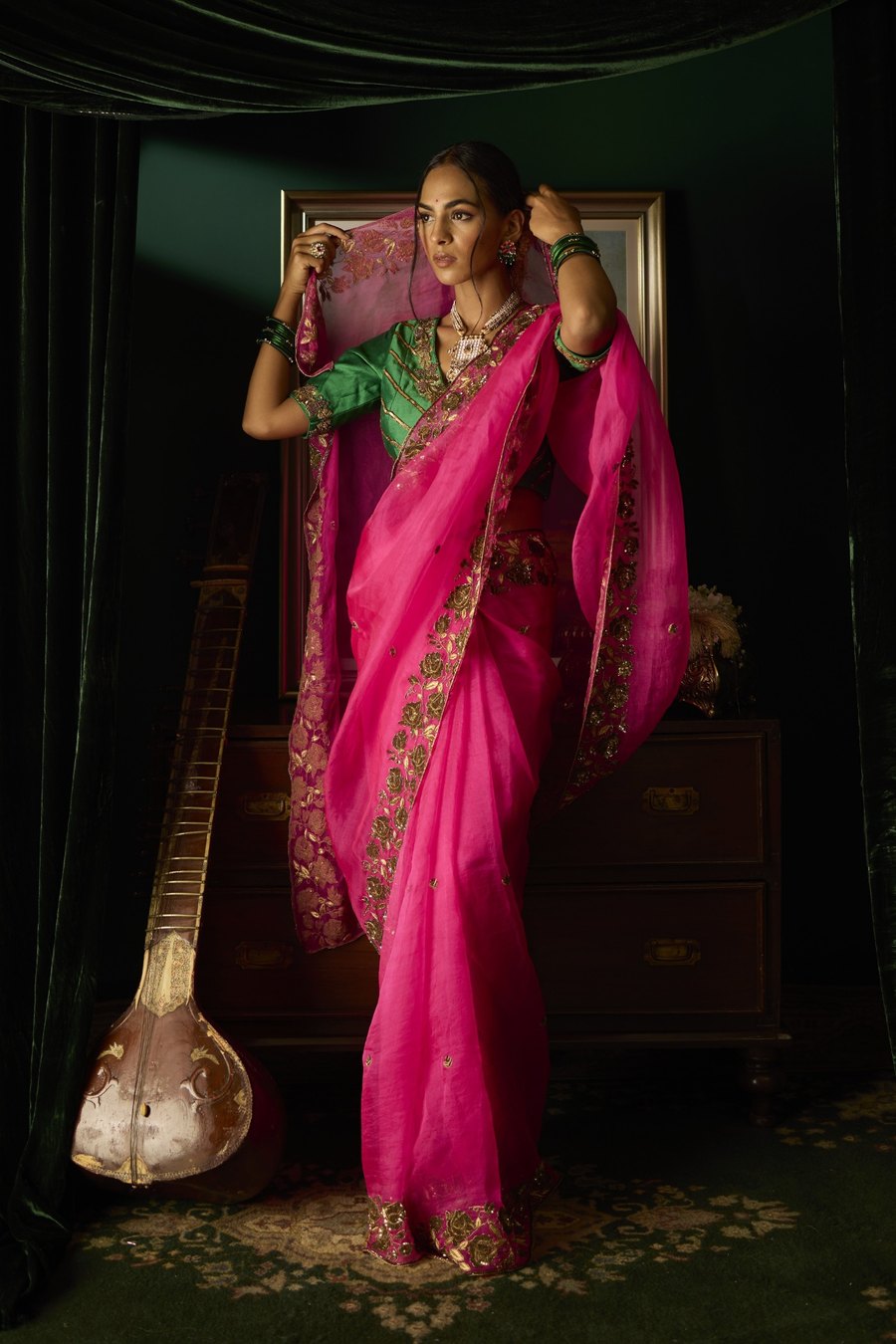
₹46,500
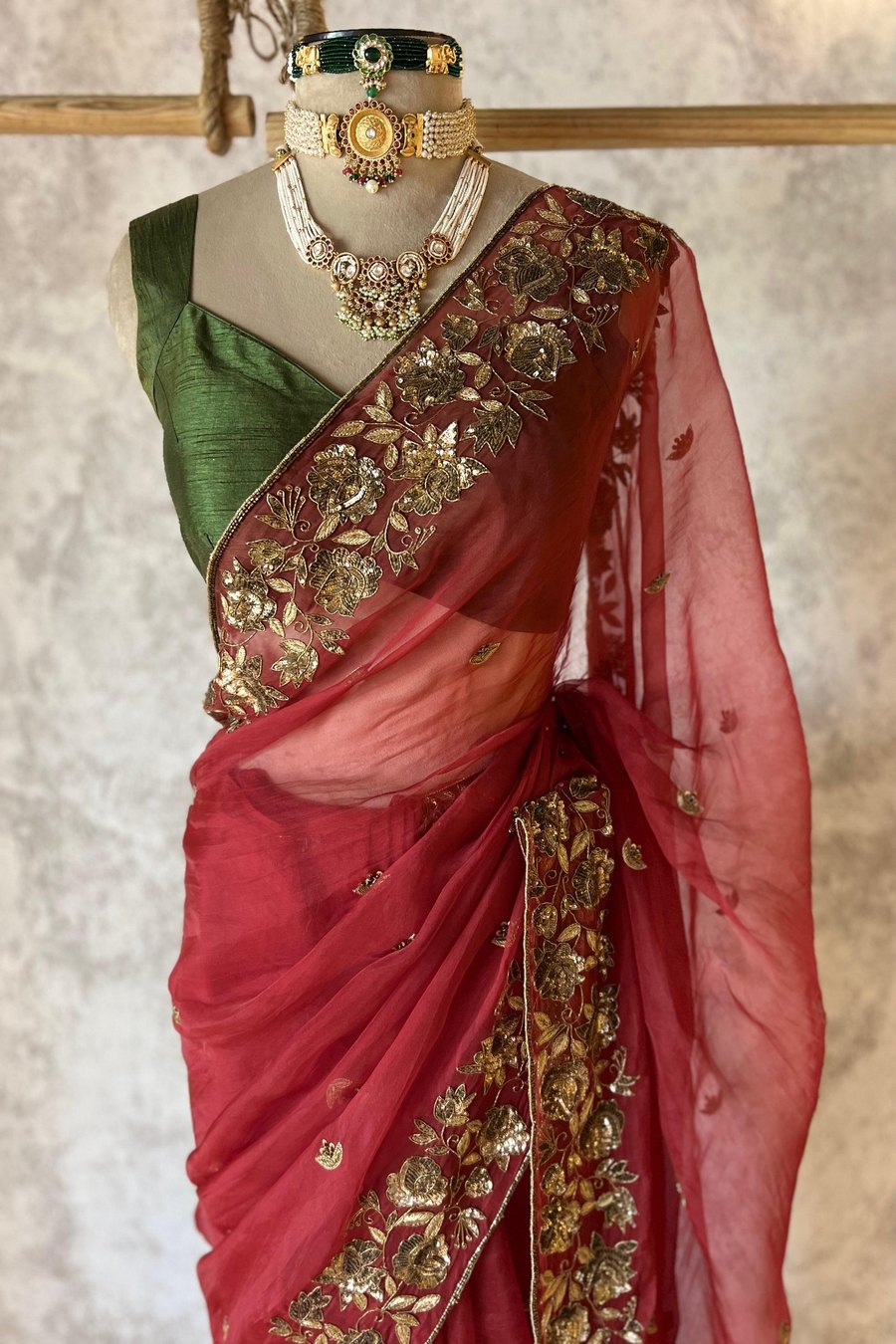
₹46,500
Blouse, drape, and the details that decide the photograph
With a sheer saree the blouse is doing most of the work. It is the only fitted piece in the outfit, and under an organza ground it shows through the pleats, so it reads as part of the design rather than something hidden underneath. A structured blouse — a corset line, a waistcoat element, a stronger sleeve — gives a sheer saree the architecture it does not have on its own.
Match the petticoat to you, not to the fabric. Under a sheer ground, a white petticoat beneath a deep piece reads grey in daylight, and a dark one can dull the colour of the saree itself. Bring the saree and the blouse to the fitting and let us look at all three together under the lights rather than in a photograph on a phone.
A crisp organza holds a pleat well, which is the quiet advantage. The drape you set at nine in the morning tends to still be roughly where you left it at six. Pin the pleats, keep an extra inch of length for photographs, and decide early whether the pallu will sit on the shoulder or come across the arm, because it changes which part of the embroidery the camera sees.
With a lehenga the equivalent decisions are the dupatta and the bodice: how the dupatta falls, and how much of the skirt’s work it is allowed to do. If you are standing beside the bride, keep your volume quieter than hers and let the embroidery carry you instead.
Care, travel, and the week after
Silk organza creases at the fold, so for travel it is better rolled around a soft core than folded flat in a suitcase. Deep dyes hold better out of direct sunlight, so keep stored pieces away from a bright window. Do not wash an embroidered organza at home — a watermark left by the embroidery is much harder to fix than a trip to the cleaner. If a pleat has been sitting in a wardrobe for months, a light press through a cloth brings the crispness back quickly.
A lehenga needs the opposite care. Store the skirt flat or hang it from a wide, padded support rather than a thin hanger by the straps, so the waistband keeps its shape, and keep the bodice filled out so the neckline does not flatten. Both should go to a cleaner who knows hand embroidery, and you should tell them what the work is before you hand it over.
The week after is where the two part ways for good. The lehenga goes back to the wardrobe with one function behind it. The organza saree goes back to the same wardrobe and comes out again for a friend’s reception, a Diwali dinner, a family photograph, with a different blouse and no one any the wiser.
Frequently asked
Is an organza saree lighter than a lehenga?
Considerably, and that is the reason most people choose it. An organza saree can carry hand embroidery across the whole body and still fold into a small box. A layered, stitched lehenga cannot. If you are travelling to the wedding, or standing through a long function, that difference shows up by the second hour.
Can you get a lehenga look with an organza saree?
Yes, and we do it often. A saree draped with fuller pleats, a belt at the waist, and the pallu pinned across gives you the volume and the presence of a lehenga without the stitched skirt. You keep the drape and lose the commitment.
Is organza only for daytime functions?
No, it depends on the piece and the light. Sheer silk takes dye richly, so a deep maroon or emerald organza holds its own at an evening reception. What it will not do is give you the heavy, grand volume of a bridal lehenga — so if that is the brief, keep organza for the other functions.
Is a sheer organza saree difficult to wear?
It asks for more than a heavy saree, not less. The blouse has to be fitted, the petticoat has to be the right colour, and the pleats want pinning. Get those three right and it is the easiest drape you will own.
How does the price compare between an organza saree and a lehenga?
On our rail the bridal lehengas sit above the saree band. The six organza sarees above run from ₹44,500 to ₹59,500. Everything is made to order, so tell us your dates and your budget and we will be straight with you about what is possible.
Explore more: saree · tissue silk sarees — or message us on WhatsApp for styling help.

The information below is required for social login
Sign In
Create New Account