

A saree is draped; the blouse is the only part of the outfit that is actually cut to you. Which means the neckline, the sleeve and the back are not decoration added at the end — they are the three decisions that make the rest of the drape sit properly. Get the
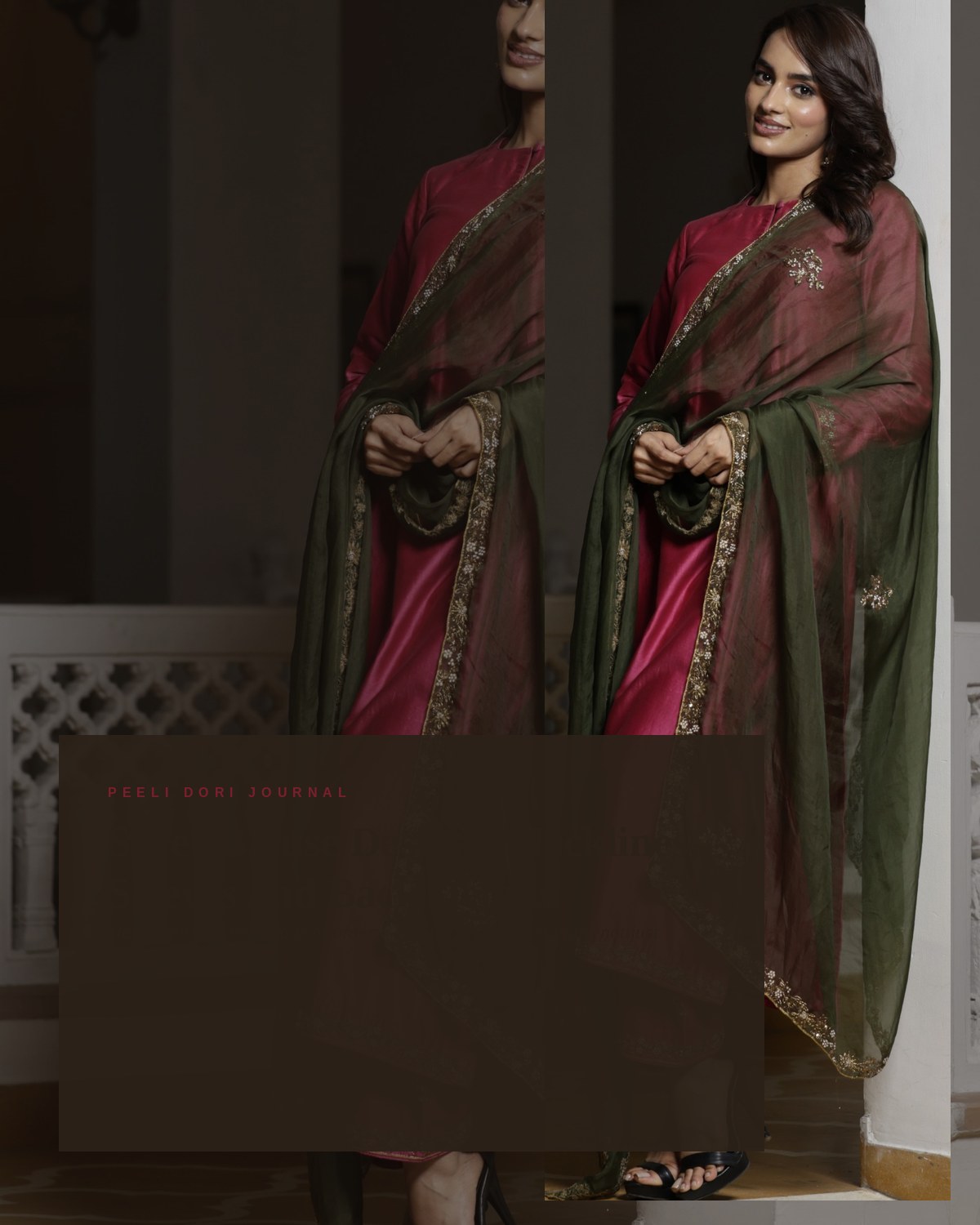
A saree is draped; the blouse is the only part of the outfit that is actually cut to you. Which means the neckline, the sleeve and the back are not decoration added at the end — they are the three decisions that make the rest of the drape sit properly. Get them right and the saree needs one pin. Get them wrong and you will spend the evening pulling at the pallu.
Why the neckline is decided first
Most people choose the saree, then look for a blouse to match it. It works better the other way for one reason: the blouse is the only tailored piece in the whole outfit. The saree has some give in it. The blouse does not. Its neckline sits a fixed distance below your collarbone, its armhole is cut for one arm, and its back closes at one point. Everything else — where the pallu falls, which earrings you can wear, whether the necklace sits on cloth or on skin — follows from those three measurements.
There is a practical test we use in the store. Pin the saree on the shoulder and look at the frame the neckline makes around the face. A deep neckline opens that frame and pulls attention upward, which is flattering in photographs and unforgiving of a badly fitted shoulder. A high neckline closes the frame and makes the jewellery the focal point instead. Neither is better. They simply do different jobs, and the job should match the function you are dressing for.
The second thing the neckline decides is the dupatta. If the pallu is going to be pinned across the chest — which it usually is at a wedding, because you need both hands — a very deep neckline will disappear under it. In that case the detail you paid for is on the back, not the front, and the front should stay simple.
The necklines, and what each one actually does
A round or scoop neck is the safest shape and the easiest to live in. It suits almost every face and every age, it holds a heavy necklace well, and it does not gape when you bend. Its weakness is that it can look plain on a heavily worked saree, so the interest has to come from the embroidery on the blouse itself rather than from the cut.
A sweetheart neck follows the line of a good necklace almost exactly, which is why it photographs well in bridal portraits. It flatters a longer neck and a defined collarbone. On a broader shoulder it can make the chest look narrow, and it needs a well-cut princess seam or it will not sit flat at the centre dip.
A square neck is the most architectural of the everyday shapes. It gives a clean horizontal line at the collarbone, which balances a fuller bust and suits a saree with a strong border. It is also the least forgiving of a shoulder seam that sits even a centimetre too wide, because the eye reads that straight line immediately.
A V neck, shallow or deep, lengthens the neck and narrows the shoulder. It is the shape to choose if you want the blouse to disappear under a chunky choker, because the jewellery does the framing. Deep V plus a heavy necklace rarely works — the two compete for the same space.
A high or boat neck is what we suggest for a daytime function, a temple visit or anyone who does not want to think about a necklace at all. It closes the frame and puts the attention on the earrings and the saree's border. In summer it can feel warm, so the fabric matters more here than in any other shape.
A halter is the one shape that changes the line of the whole outfit. It leaves the shoulder bare and holds at the back of the neck, so the saree's own shoulder pleats have to be pinned differently. It is beautiful on a narrow shoulder and difficult on a heavy bust. If you are considering one, try it with the saree on, not with jeans — the drape is what decides it.
Sleeves: less about fashion, more about the day
Sleeve length in a saree blouse is a comfort decision that people treat as a style decision. Sleeveless is cool and easy and photographs cleanly, but it means the armhole has to be cut very accurately, because there is no sleeve to hide a gap. Cap sleeves are the least useful of the options in practice: they cover the part of the arm you were not worried about and add a horizontal line where the arm is widest.
Short sleeves to mid-upper-arm are the most forgiving shape we cut. They balance a heavy saree, they suit almost every function, and they do not interfere with bangles. Elbow length suits a formal evening and reads older in a good way; it is also the length that works best with a very deep back, because the back becomes the only bare plane and the whole outfit looks deliberate.
Three-quarter and full sleeves are for the women who have decided they want their arms covered, and there is no reason to talk them out of it. What matters is the armhole and the elbow ease: a full sleeve cut tight at the elbow will pull the shoulder seam out of place every time you raise your hand, and you will raise your hand constantly at a wedding.
One detail worth knowing: a sleeve that ends where the saree's pleats begin will fight the pleats. If the pallu is going to sit on the upper arm, keep the sleeve above it or well below it, so the fabric has somewhere to go.
The back is where a blouse is really designed
In the front, a blouse is a neckline and two darts. In the back it is engineering. The dori — the cord that ties at the back — is the most common closure on hand-embroidered blouses and the one we recommend most often, because it lets the blouse be tied to the body you are that week rather than the body you were measured as. It also gives the back a designed element without a single extra hook.
Corset lacing does the same job with more control and more drama. It holds the waist firmly, which is useful under a heavy saree, and it lets the blouse be let out or pulled in by a couple of inches without a tailor. The cost is time: lacing takes a second pair of hands and about five minutes, and it has to be re-done after every wash.
Hooks are the quiet option, and the right one if you dress alone. The failure to watch for is gaping: hooks set too far apart will open when you sit, and a gaping back is the single most common reason a blouse goes back to the tailor. A well-made blouse uses a hook-and-eye at close intervals plus a small modesty panel behind the opening.
Deep backs look best when the saree does the covering — the pallu falls over one shoulder and the other side stays open. If you want a deep back and a fully covered front, that is a perfectly sensible combination and it is the one we cut most often for evening functions, because it keeps the drama where the photographs are taken from behind: at the mandap, walking up to the stage, standing with the family.
Matching the blouse to the saree, not to the trend
The rule that holds up across almost every outfit we have made: the blouse and the saree should not both be busy. If the saree carries dense handwork across the body, the blouse wants a quieter surface and a stronger cut. If the saree is plain — an organza, a light tissue, a chanderi — the blouse can carry the embroidery, because it is the only place the work will be seen.
For a daytime mehendi or haldi, keep the blouse light. Chanderi, cotton silk and light raw silk all breathe, and a high or square neck with short sleeves will survive a hot afternoon better than anything strapless. For an evening reception, silk and silk satin hold their shape under artificial light and take a deeper neckline without looking like they are trying too hard.
For the wedding itself, the decision is usually about weight rather than shape. A heavily worked blouse with a heavy saree is a lot of garment for a long day. Most brides and most mothers we dress end up with the work concentrated in one place — the blouse — and a saree that is rich in the border and calm through the body. It is easier to carry, easier to sit in, and it reads better in photographs because there is somewhere for the eye to rest.
Six blouses from the store, and where each one belongs
These are the shapes we currently have in the studio, all hand embroidered and all made to order in your measurements. Prices are what they are today; the point of the list is the range, not a ranking.
Start with the ROSY BLOUSE at ₹27,600 if you are dressing for the wedding itself and want the blouse to be the embroidered piece. The ASHANI BLOUSE at ₹26,500 is the red silk option, which is the easiest colour to pair with a gold or ivory saree and the hardest to get wrong in a family photograph. The BLACK ROSY BLOUSE at ₹25,600 is the evening choice — black reads as a deliberate decision rather than a safe one when the work is good.
The LANA PEARL BLOUSE at ₹18,500 sits in the middle of the range and is the one we suggest when the saree already has a lot going on: pearl work is quiet from a distance and detailed up close. The MAJORDA BLOUSE at ₹16,500 and the GULNAZAAR BLOUSE at ₹15,500 are the two we would put on a first-time customer, because both work with a plain organza or a light tissue saree without needing a second opinion. The MIRAYA MIRROR BLOUSE at ₹15,500 is for a sangeet — mirror work catches movement and party light in a way that flat embroidery does not.
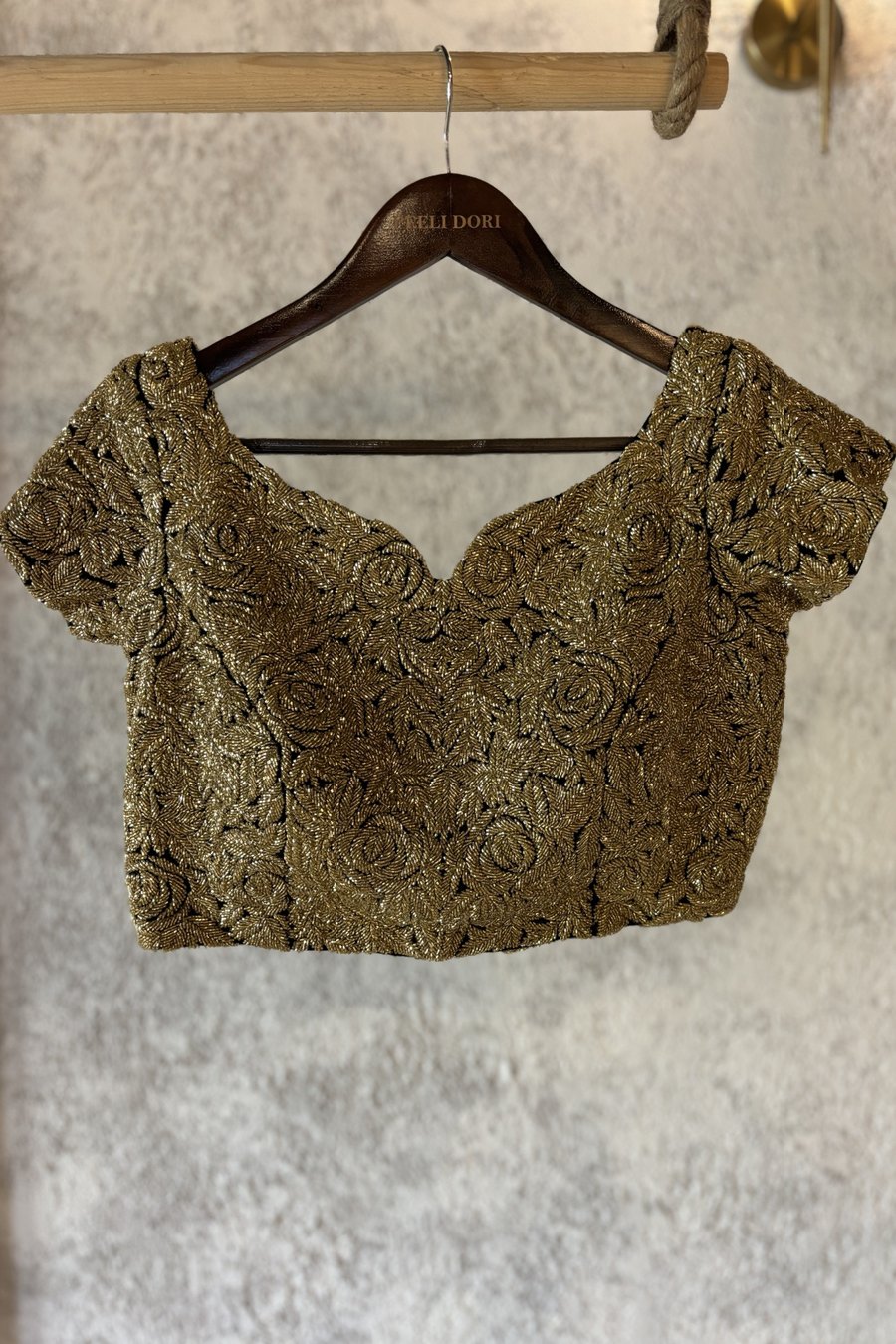
₹27,600
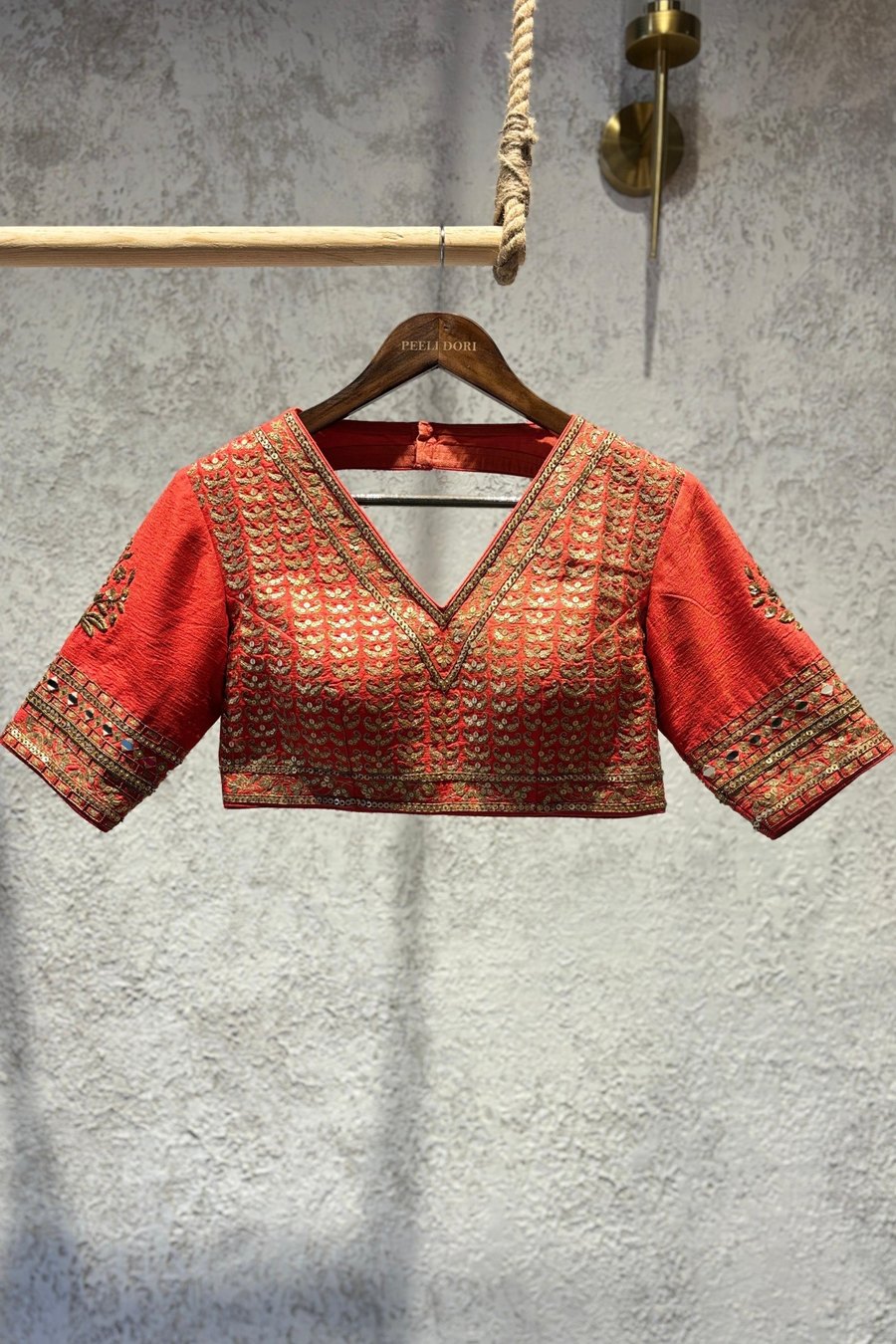
₹26,500
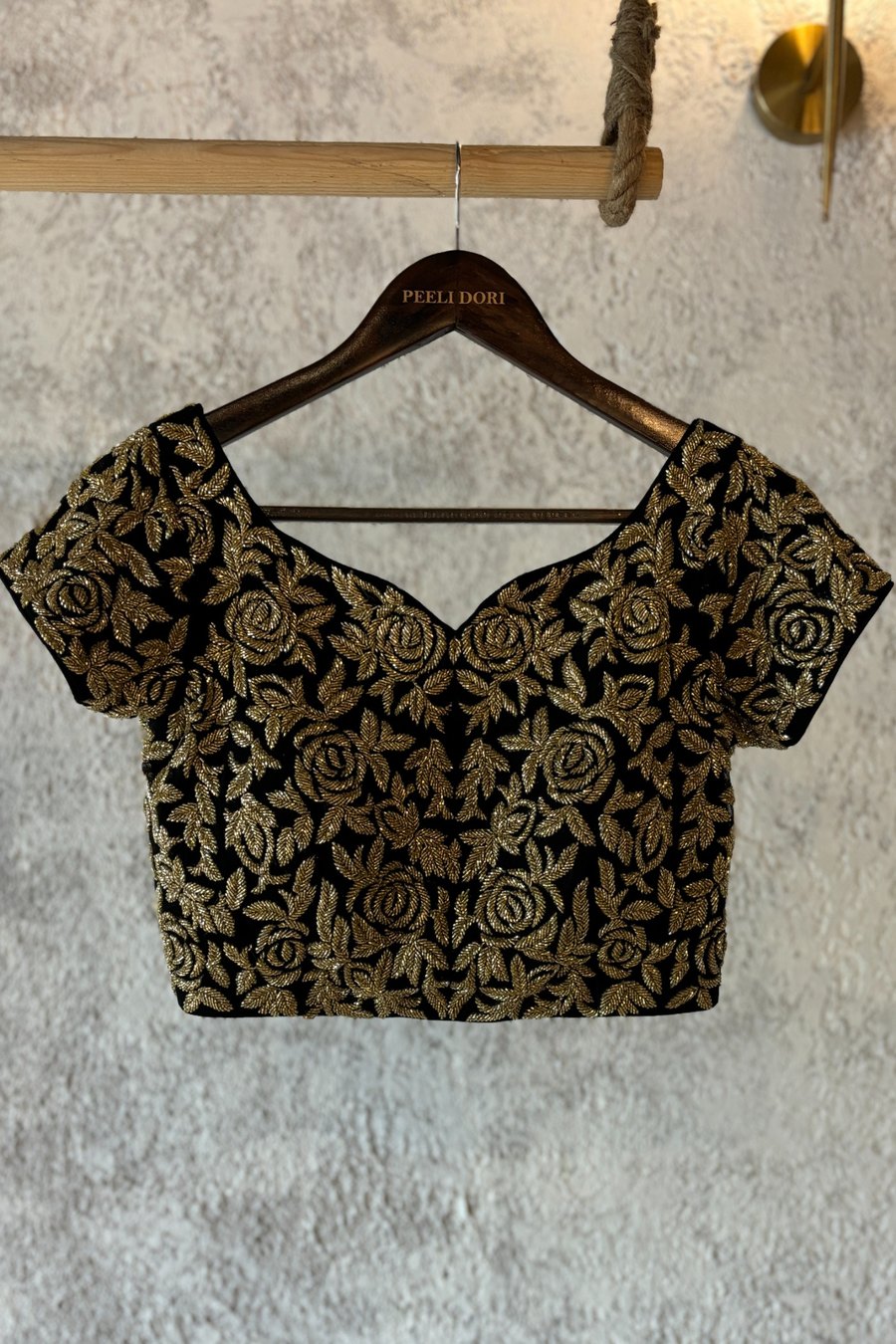
₹25,600
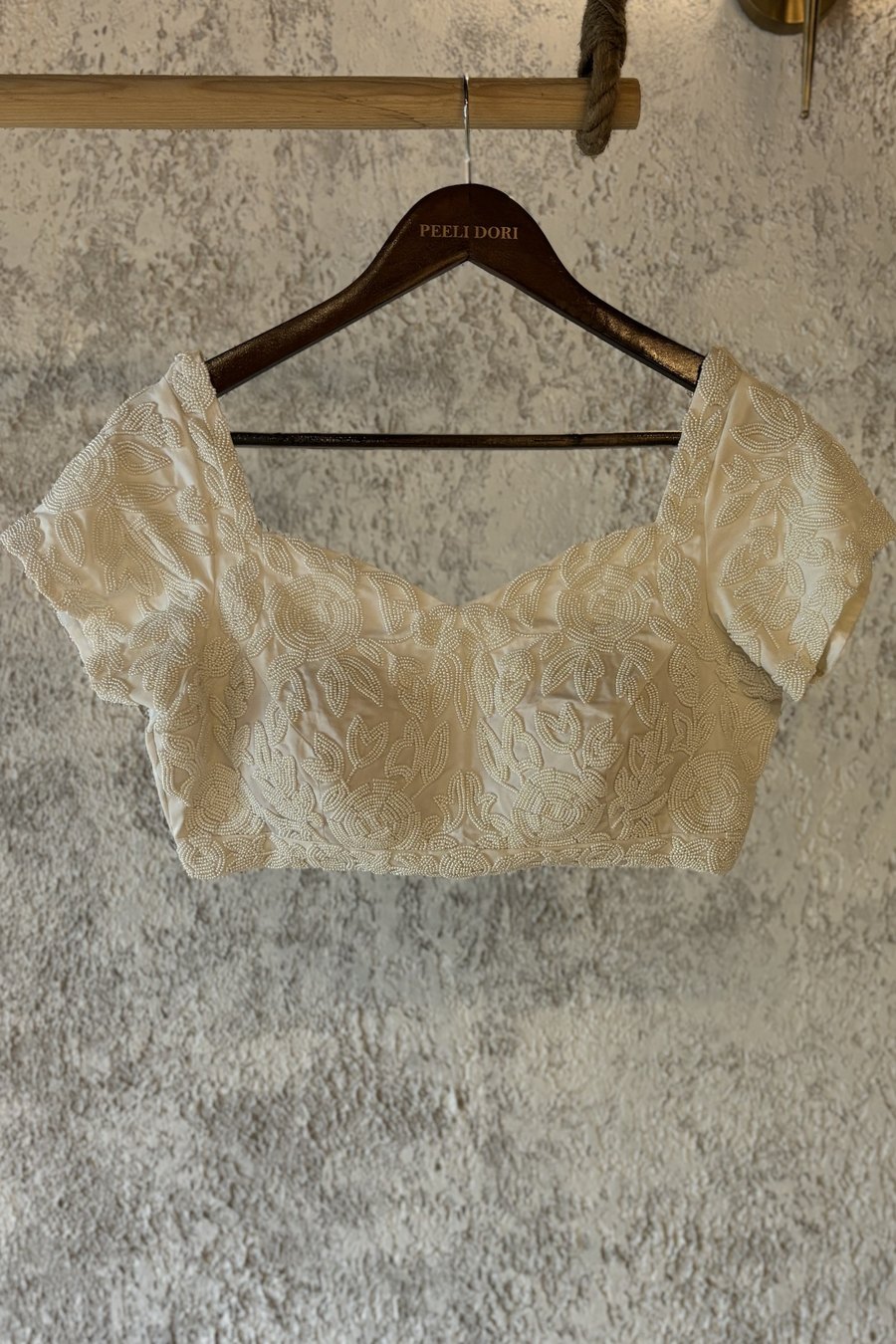
₹18,500
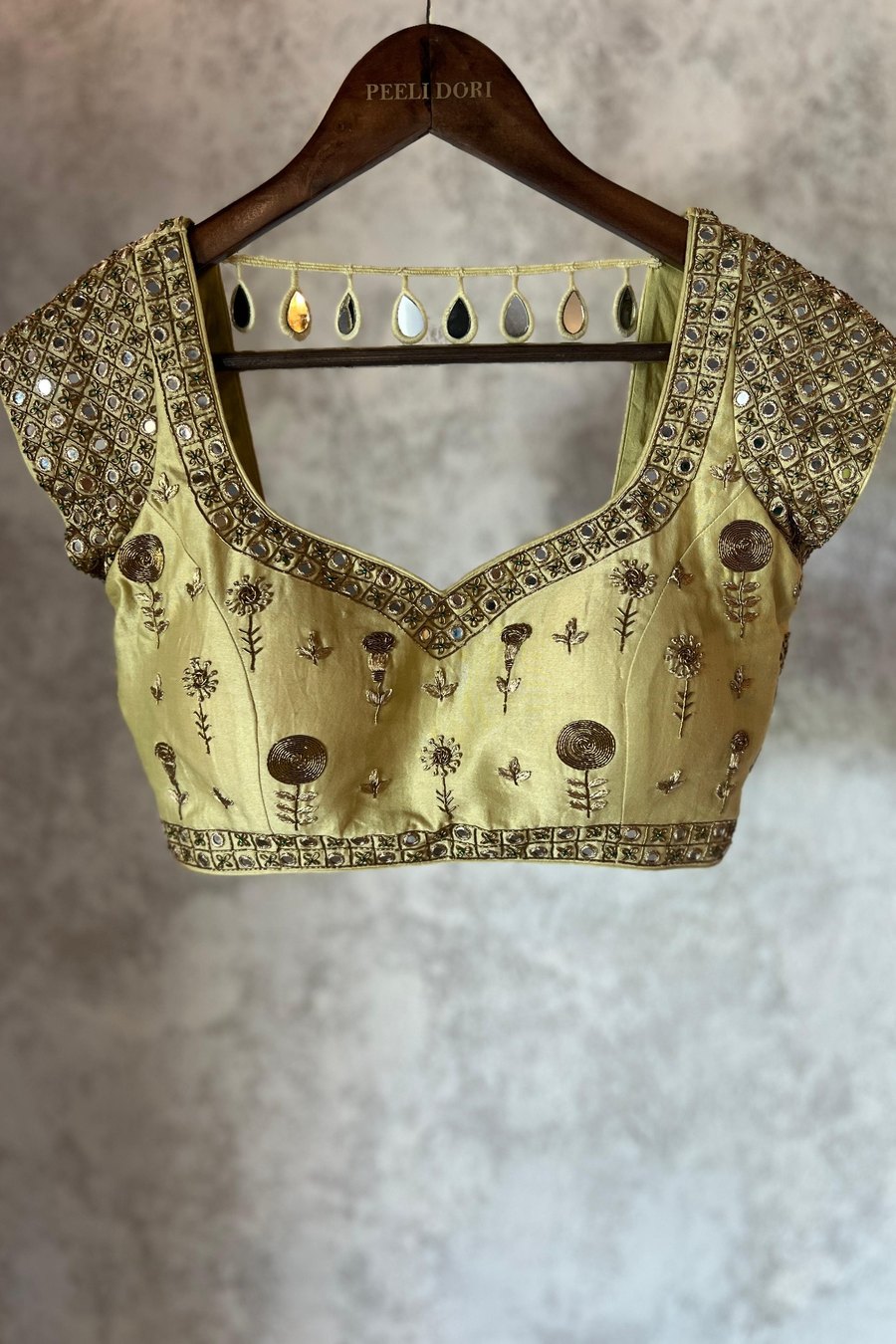
₹16,500
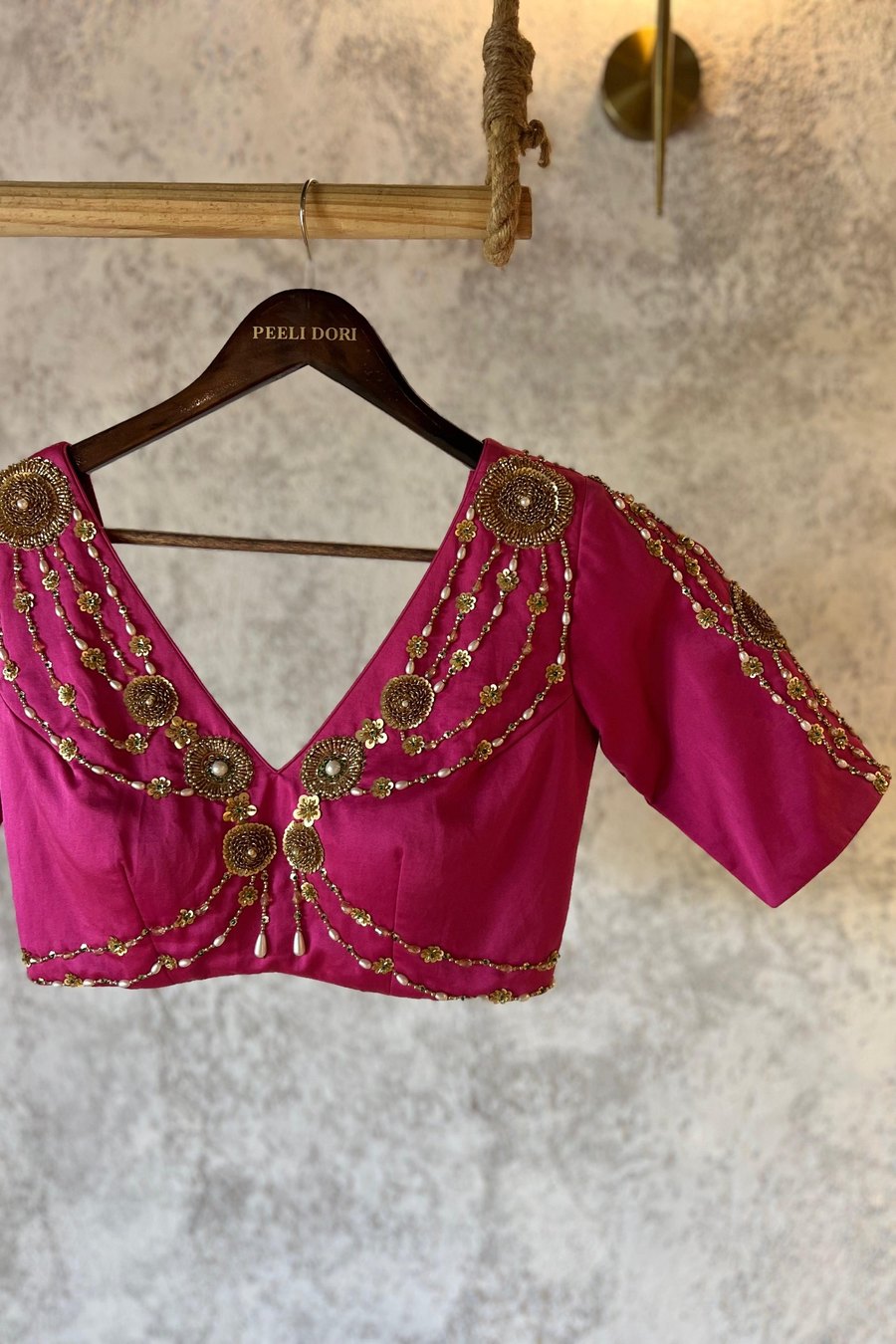
₹15,500
Fit, measurements and what a tailor can still change
Four measurements decide a blouse: bust, underbust, shoulder and armhole. Add the front neck depth and the back neck depth if you want the shape to be exactly as you pictured it, and the sleeve length and bicep if the sleeve is not sleeveless. Everything else is a consequence.
Because every piece here is made to order with custom sizing, these are taken before the cloth is cut rather than adjusted afterwards. That matters more with embroidery than with plain fabric: the work is placed on the panel while it is flat, so taking in a side seam after the fact can pull the motif off-centre. If you are between sizes, we would rather cut to the larger measurement and take it in at the sides than cut tight and hope.
What can still be changed after stitching: side seams by an inch or so each way, the armhole slightly, the sleeve length, and the position of the hooks. What cannot be changed without unpicking the embroidery: the neckline depth, the shoulder width, and the placement of a back motif. That is the reason to spend ten minutes on a fit check before the order goes to the karigars — message us on WhatsApp with your measurements, or come to Shahpur Jat in Delhi or the Dehradun store and try the shapes on with a saree.
Looking after a worked blouse
A hand-embroidered blouse is the part of the outfit that takes the most wear — it is against the skin, under the pallu, and it is what you lean back on in a chair. Three habits make it last. First, air it for a few hours after wearing, inside out, before it goes anywhere near a wardrobe. Second, dry clean only, and only when it actually needs it; the chemicals are harder on zari and mirror work than a little dust is.
Third, store it folded rather than hung. A blouse on a hanger carries its own weight from the shoulder seams, and a heavily worked piece will slowly stretch out of shape. Fold it inside out, keep the hooks closed so they do not catch the embroidery, and put it in a cotton or muslin bag rather than a plastic cover — plastic traps moisture, which is the real enemy in a Delhi summer and in a Dehradun monsoon alike.
Between functions, steam the blouse rather than ironing it. A hot iron pressed directly on gota or mirror work will flatten the raised surface, and that texture is the whole reason you chose the piece. If you must press it, do it inside out through a cotton cloth, on the lowest setting that will do the job.
Frequently asked
Which blouse neckline suits a heavy necklace?
A high or boat neck, or a shallow round neck, gives a heavy necklace room to sit on cloth rather than on skin. A deep V or a deep sweetheart competes with a choker for the same space. If the necklace is the piece you want people to notice, keep the neckline high and simple and let the jewellery do the work.
Should the blouse be stitched before or after the saree is chosen?
Choose them together, but decide the blouse's neckline and sleeve first. The blouse is the only tailored piece, so it sets the frame for the face and decides where the pallu can be pinned. A saree can be draped around a blouse; a blouse cannot be re-cut around a saree.
What is a dori blouse?
A dori blouse closes at the back with a cord that ties, rather than hooks or a zip. It is the most adjustable closure we make, because it can be tied to fit you on the day, and it adds a designed element to the back. It needs a second pair of hands to tie, which is the trade-off.
Can you make a blouse in my measurements?
Yes. Every blouse here is hand embroidered and made to order, with custom sizing, so the bust, underbust, shoulder, armhole and neck depths are cut to you before the embroidery is placed. Send your measurements on WhatsApp or visit Shahpur Jat in Delhi or our Dehradun store for a fit check. Shipping is free above ₹10,000 across India, and we ship internationally with code INTSHIP on orders above ₹89,000.
How long does a hand-embroidered blouse last?
With dry cleaning only when needed, folded storage in a muslin bag and steam instead of a hot iron, a well-made blouse will outlast the saree it was bought for. The parts that wear first are the armhole seam and the closure, both of which a tailor can rebuild without touching the embroidery.
Explore more: saree · dupatta — or message us on WhatsApp for styling help.

The information below is required for social login
Sign In
Create New Account